
This feature is part of a six-month series from Magic Canoe’s Contributing Writers. Four writers were selected to each cover Salmon, New Economies, Environment, or Indigenous Leadership. This is the first story for the New Economies Desk. Major support for the Contributing Writers Series is made possible by a gift from Priscilla Bernard Wieden, in loving memory of Dan Wieden.
In the late 1960s, James Greeley Sr. earned his keep logging old-growth trees in Southeast Alaska. As he aged, the man needed another way to generate income. After a stint as a laborer and tunnel inspector in Seattle, Greeley Sr. turned to oyster farming in waters off Prince of Wales Island, a misty, fog-shrouded island in Alaska’s southern panhandle.
Now retired, Greeley Sr.’s son, Jimmy, and his partner, Katie Bode, carry on the tradition as owners of Tommaso Shellfish, a two-person operation that leases four acres of Sea Otter Sound. The couple stages out of Naukati, a former logging camp with a population of between sixty and 140 people, depending on the season.
Like other Alaska oyster farmers, the Tommaso Shellfish owners grow Pacific oysters. The chewy bivalve is second only to eastern oysters as the nation’s most popular variety. Greeley Jr. and Bode credit Alaska’s cold, clean water and the surrounding coastal temperate rainforest for producing a premium product with a unique taste—buttery with hints of salt water, seaweed, and mineral.
“We’ve built this business in the middle of nowhere and grow some of the best oysters in the world,” Greeley said.
Surrounded by Alaska’s dense 17 million-acre Tongass National Forest, roughly the size of West Virginia, Naukati once served as a center of logging activity on Prince of Wales, the country’s fourth largest island. Like other small towns on this rain-drenched island—a place cloaked in ancient spruce, hemlock, and cedar trees—Naukati’s former life centered around floating docks filled with bunkhouses, cookhouses, mess halls, camp stores, and schools for the children of logging families.
From the mid-1950s until the 1990s, clear-cut logging was king in Southeast Alaska, a regional economy underpinned by 50-year timber contracts signed by the U.S. Forest Service. Alaska Native corporations, established by Congress in a 1971 land claims settlement, also conducted industrial-scale clear-cutting.
The floating logging camps, along with the tree cutters themselves, are mostly gone now. The timber industry is a shadow of its former self, diminished by changing economics and politics, and the rise of the modern environmental movement.
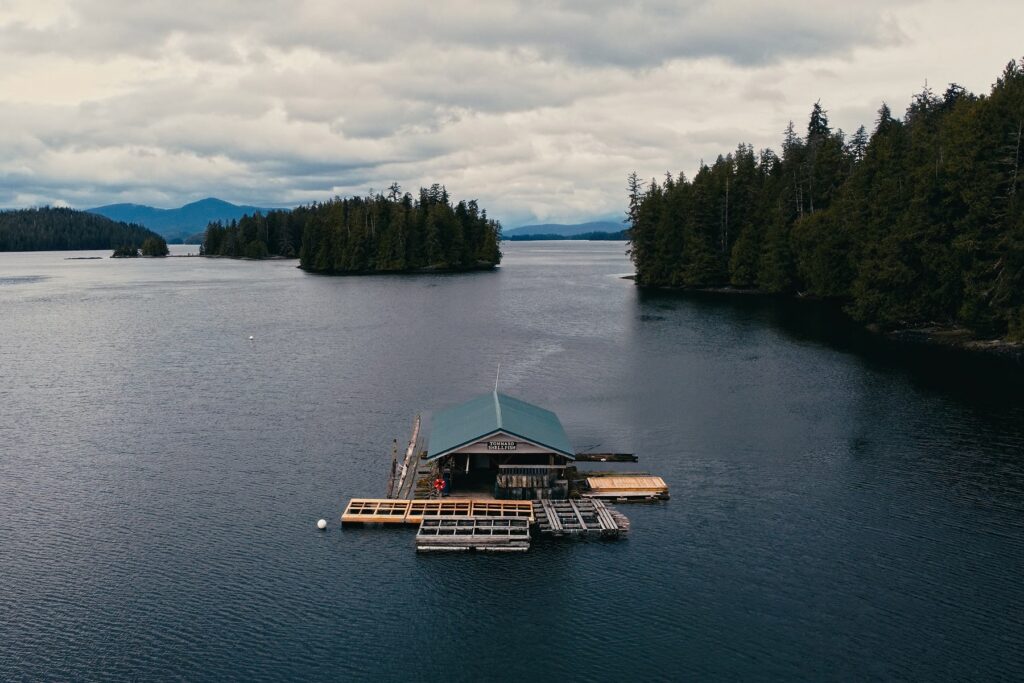
After the region’s two large pulp mills closed in the 1990s, Naukati, like many of Southeast Alaska’s towns, was forced to chart a new course.
Many residents moved to the lower 48. Some who stayed, like Greeley Sr., traded chainsaws for commercial fishing, captaining a charter boat, running lodges, or growing shellfish. Some are now also dabbling in harvesting kelp, a brown seaweed traditionally used for food, and more recently, as an ice cream thickener, supplements for livestock and pets, cosmetics, and crop “biostimulants”—mixtures of materials used to promote the growth of crop plants.
In Alaska, “mariculture”—the cultivation of marine plants and shellfish—centers around oysters and kelp, not the more controversial aquaculture practice of finfish farming, which is outlawed in Alaska.
Shucking Together
Mariculture is on the rise in Alaska. The number of applications for starting mariculture operations in the state has grown from about six per year, between 2014 and 2018, to 14 applications annually between 2019 and 2023, according to the National Oceanic and Atmospheric Administration. As of the fall of 2025, Alaska had 76 aquatic farm leases covering more than 1,600 acres. More than 40 others are proposed or pending, according to research commissioned by the Alaska Mariculture Cluster.
Naukati’s transition from logging camp to mariculture mecca reflects a larger story of Southeast Alaska’s shifting economy. Along with Tommaso Shellfish, four other commercial oyster farms operate out of Naukati, Naukati Bay, and nearby Sea Otter Sound. The farmers share information and resources through a collective they started in 2009 called the Alaska Oyster Cooperative, and they’re in the midst of taking that to the next level. A feasibility study was recently completed for a cooperatively owned, shore-based mariculture facility that would include cold-storage shipping containers, machinery for assembling boxes, an ice maker and freezer, a forklift, and other equipment.
By sharing such a facility that would eliminate some of the business tasks they would otherwise contend with individually, oyster growers would be able to concentrate on improving their yields. The long-term goal is also to have a retail business where oysters can be sold on-site—perhaps even an oyster bar.
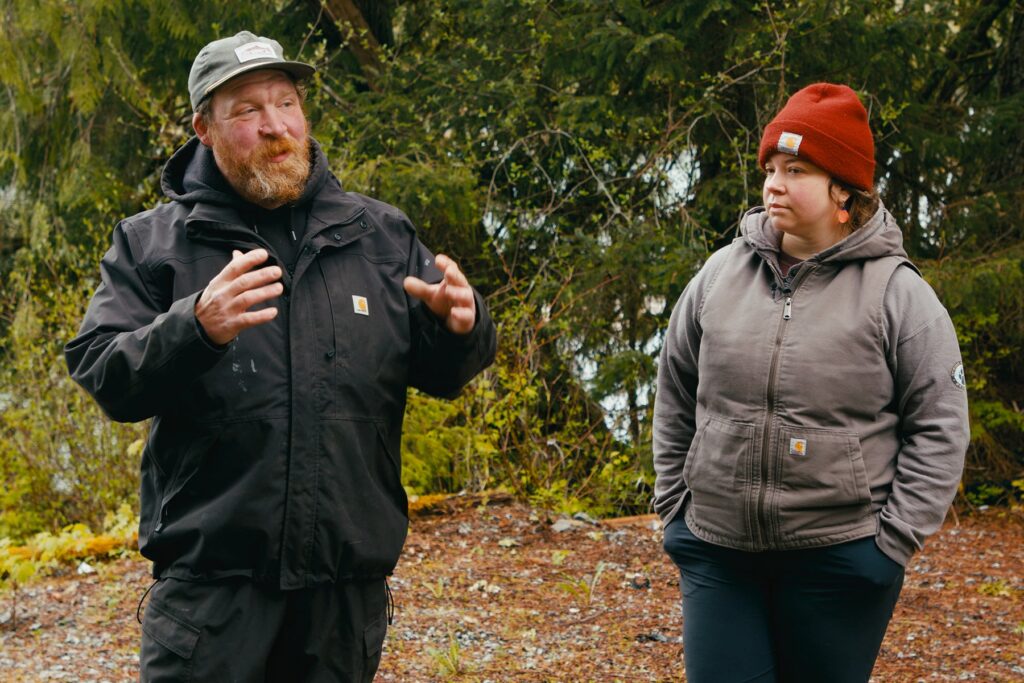
The cooperative model is appealing to the five oyster businesses in Naukati. They see it as a way to reduce costs and share risks in a remote spot where developing infrastructure individually can be cost-prohibitive.
“We’ll be sharing a lot of the burdens,” Greeley Jr. said.
The plant is expected to open later this year. For Bode, that can’t happen soon enough.
“The hardest part about farming isn’t growing the oysters, [or] the husbandry that goes along with it,” said Bode. “It’s the infrastructure and getting this product off the island and figuring out shipping from a remote place.”
Because of Naukati’s location on the coast of the Alexander Archipelago, oyster growers deal with constant transportation challenges. They rely on floatplanes, ferries, a limited road system, and Alaska Air Cargo in Ketchikan, a nearby hub city on Revillagigedo Island, to get their oysters to market. Customers are spread across Southeast Alaska and Anchorage.
Other growers, including some in Ketchikan and in Southcentral Alaska, ship to markets in the lower 48. They use distributors, sell directly to restaurants and seafood markets, do direct-to-consumer sales, or take a combination approach. According to the Alaska Department of Natural Resources, an estimated 1.7 million oysters were harvested statewide in 2025, up from 1.2 million in 2024.
The Alaska mariculture industry has received generous support from the federal government and the Alaska State Legislature. In 2022, state lawmakers approved $7 million in funding for research and workforce development. The U.S. Economic Development Administration awarded a $49 million grant from the COVID-era American Rescue Plan Act of 2021 to catalyze a $100 million mariculture industry in Alaska. The idea was to diversify and strengthen coastal economies and complement seasonal businesses like tourism or fishing.
The money, which runs through the end of 2026, is earmarked for projects that stimulate private investment, jobs, training, and market development. The funding is also intended to incentivize equipment purchases, while boosting research and development, and technology deployment.
Eric Wyatt, a Navy veteran and cofounder of Blue Starr Oyster Co. in Naukati, commercially fished for years before selling his boat and going all in on mariculture. “There are limited opportunities for employment around here,” Wyatt said. “I was attracted to oysters.”
Wyatt is using some of the government grant funding as well as his own money to grow his production. “We’re expanding the farm pretty massively,” Wyatt said.
He expects to soon triple the volume of oysters he sells. Wyatt has two employees and an apprentice to help him out and plans to expand his workforce down the road. Although raising oysters in Southeast Alaska’s notoriously cold and harsh environment isn’t easy work, he sees it as an investment in the economic health of the state. It’s also a way to boost food security in a state where most food is imported despite its abundant fish and wildlife.
“It’s a source of pride that we can bring an actual meaningful, sustainable economy here. This is my retirement.”
Eric Wyatt
“It’s a source of pride that we can bring an actual meaningful, sustainable economy here,” he said. The 62-year-old also expects to continue oyster farming well into the future. “This is my retirement.”
Wyatt is thankful for the advent of mariculture. Before mariculture came along, residents had two options for work on Prince of Wales: logging or tourism. Neither was for him.
Former logger and commercial fisherman Michael Kampnich, who lives in Craig, Alaska, the island’s largest town located an hour’s drive from Naukati, sees a promising future for mariculture on Prince of Wales.
“It’s filling a niche,” Kampnich said. “I think it’ll be successful.”
In his view, unlike logging, fishing, mining, or oil drilling—Alaska’s traditional revenue sources—mariculture is not an extractive industry and has low impact on the environment. But raising oysters or growing kelp in Alaska, with its big seas and punishing storms, is only for the hardy, several growers pointed out.
Other barriers to a thriving mariculture economy are regulatory hoops. Getting through the permitting and compliance paperwork can be a heavy lift.
Wyatt, a pragmatist, doesn’t see that as a barrier. “I think the hurdles in Alaska [compared to the lower 48] are much less. If you can’t navigate them, you’re going to have trouble running your own business,” he said.
Raising Kelp
While oyster farming is on the rise in Alaska, seaweed harvesting is also taking off, ever since the first commercial harvest took place in Kodiak in 2017.
According to the Alaska Department of Natural Resources, growers harvested 344,000 pounds of kelp in 2025 from twelve aquatic farms, up from about 100,000 pounds in 2018.
Wild kelp is also harvested in Alaska for personal use or small-scale commercial food production, including for items like salsas, pickles, and seasonings. But commercial farming of kelp vastly exceeds wild kelp harvesting in terms of the number of pounds removed from the ocean, according to the Alaska Department of Fish and Game.

Based on seed outplanting and growth in the biostimulant market, kelp farmers are expected to harvest a record crop of 872,000 pounds this year, according to Anchorage-based McKinley Research Group. Among hundreds of varieties, the primary species of seaweed commercially harvested in Alaska are sugar, bull, and ribbon kelp.
While Asia produces most of what goes into the global multibillion-dollar seaweed industry, Alaska has some advantages that could position it for future growth. The state has cold, nutrient-rich waters and 33,000 miles of coastline, with abundant places to farm. In fact, Alaska already has a huge fishing industry, with a skilled maritime workforce and some of the largest kelp beds in the world.
But Alaska seaweed harvesters face challenges, too. These include a shortage of processing infrastructure, few people already skilled in seaweed farming, vast distances from markets, uncertain availability of buyers, and high production costs compared to prices.
“Access to consistent markets is a huge issue,” said Melissa Good, a mariculture specialist with Alaska Sea Grant, speaking at a public lecture in April 2026 at the University of Alaska Fairbanks (UAF).
Despite those challenges, researchers who study the emergent industry see lots of potential for growth, and some of that will come from Alaska’s tribal citizens who have been fishing and harvesting seaweed for millennia.
“Harvesting seaweed for our people has always been a family thing,” said Mangyepsa Gyipaayg, or Kandi McGilton, a Ts’msyen artist from Metlakatla. “Everyone puts up seaweed a little differently. In my family, we’ll harvest the seaweed, bring it home, lay it out on a sheet in the sun, and dry it. Then we’ll bake it in the oven.”
Black seaweed, similar to nori that is used in sushi, is the preferred species for eating in Southeast Alaska. People often mix it in with fish and rice. “It’s a staple in every home because we’re a fishing community,” said Gyipaayg. “It’s just a no-brainer to go out and get it every year.”
Besides the cultural and nutritional significance of seaweed, Alaska tribes are increasingly entering kelp farming for economic opportunities. Metlakatla-based Native Sea Trust Inc. has applied to the Alaska Department of Natural Resources for nine leases, each one 30 acres in size, to grow kelp in waters off Metlakatla on Annette Island, Alaska’s only Indian reservation.
Native Conservancy, an Indigenous-led organization based in Cordova, Southcentral Alaska, is developing several kelp programs, too, including community nurseries to grow kelp seeds. The idea is to empower iiyaaG, or Eyak, communities to produce their own kelp seed and build local mariculture expertise. They also aim to grow Indigenous leadership in Alaska’s seaweed economy by training tribal youth in ocean farming, employing them and producing enough seed to support hundreds of acres of ocean farming.
Mariculture as a Climate Win
Cascadia Seaweed Co. opened a new seaweed-processing facility in Port Edward, British Columbia, in May, to turn kelp into biostimulants. With its close proximity to Alaska, the new operation should help Alaska seaweed growers looking into this new market. With the facility now open, Alaska kelp growers in Kodiak and Cordova are already shipping their product to the facility, said Dan Lesh, deputy director of Southeast Conference, a business development nonprofit that is assisting the mariculture industry and is distributing the federal funds to support its growth.
The University of Alaska Fairbanks is also assisting kelp farmers by studying seaweed as a feed supply for livestock. Raising reindeer meat production is increasing in Alaska, but farmers currently have to import feeds like soybean meal, alfalfa, or grass hay.
“Producers are spending a ton of money to get these feeds here. So we’re really in kind of a bottleneck,” said Jim Vinyard, livestock nutritionist at the university’s Agricultural and Forestry Experiment Station in Palmer. “Finding something local could really help.” He said kelp could play a big role in feeding cattle and other livestock, because kelp is not only a good source of carbohydrates, protein, and minerals, but it also plays a role in curbing greenhouse gases released by cows and other livestock.
“Seaweed has the ability to mitigate methane emissions just by being a hydrogen sink.”
Jim Vinyard
“Seaweed has the ability to mitigate methane emissions just by being a hydrogen sink,” said Vinyard.
Livestock supply chains are some the biggest sources of methane on the planet. A single cow produces about 200 pounds of methane annually, and livestock, mostly cattle, produce about a quarter of all methane emissions in the United States, said researchers at Colorado State University. Curbing that by feeding cattle seaweed could be a way to help mitigate accelerating climate change.
This summer, the University of Alaska Fairbanks is conducting kelp feeding trials on 15 cows. Scientists will be studying how the animals fare, comparing outcomes of those fed kelp versus a conventional diet of pellets purchased from a feedstore.
“The eventual goal of this is to create a commercial, shelf-stable seaweed product that can be added to livestock diets around the state,” Vinyard said.
Looking Ahead
While kelp research is proceeding in Palmer, Alaskan oyster farmers and seaweed growers are working at full speed, now that summer is here. With millions of tourists aboard cruise ships, and independent travelers descending upon Southeast Alaska’s coastal towns, the demand for local delicacies, like oysters, is at its peak.
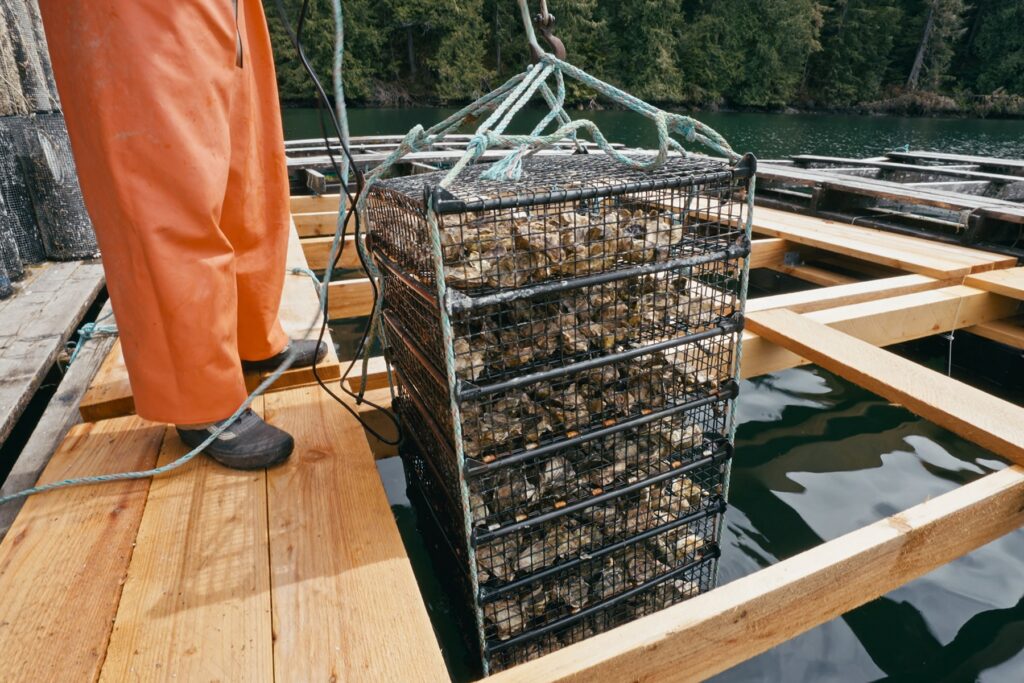
Back in Naukati, Jimmy Greeley and Katie Bode are busy harvesting, tumbling, sorting, and shipping their oysters, while looking forward to seeing the shore-based mariculture facility finally built. That will allow them to scale up their business and, they hope, hire workers. The couple thinks it would be nice to be able to leave and have a vacation at some point. “Maybe one day, if we’re lucky, right?” said Greeley.
Maura Scudero, owner of the Alaskan Oyster Shack in Ketchikan, regularly buys oysters from Naukati farmers, including Tommaso Shellfish and Blue Starr Oysters. Most of her customers are off cruise ships. Business is booming, Scudero said. It’s to the point where she’s opening a second location later this month.
“I have customers from all over the country,” she said. “I consistently hear them say, ‘These are the best oysters I’ve ever had.’ I hear that over and over every day.”