This feature is part of a six-month series from Magic Canoe’s Contributing Writers. Four writers were selected to cover one of four topics: Salmon, New Economies, Environment, and Indigenous Leadership. This story is the first for the Indigenous Leadership Desk. Meet our contributing writers here. Major support for the Contributing Writers Series is made possible by a gift from Priscilla Bernard Wieden, in loving memory of Dan Wieden.
In the beginning, there was a river. A broad, heavy river. Deep and cold and undammed. The river spoke. A sound for the place where water met boulder. Where water fell. Where water brushed thin over cobble. And where water dove through canyons. The river had language. The way rain sounded when meeting runoff. The silence of trout leaping and the slap of their return. The river called herself nacó’x kuus, though I wouldn’t hear that until later.
It was a May morning alongside the great Salmon River in West Central Idaho. In my left hand was a paper cup full of cold river water. It was only a small cup, but it felt heavy, as if I were holding more.
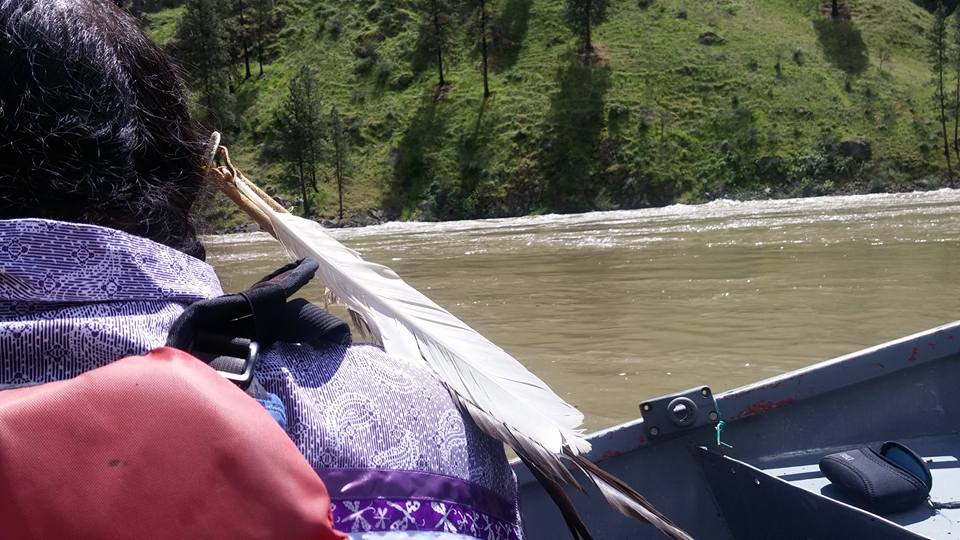
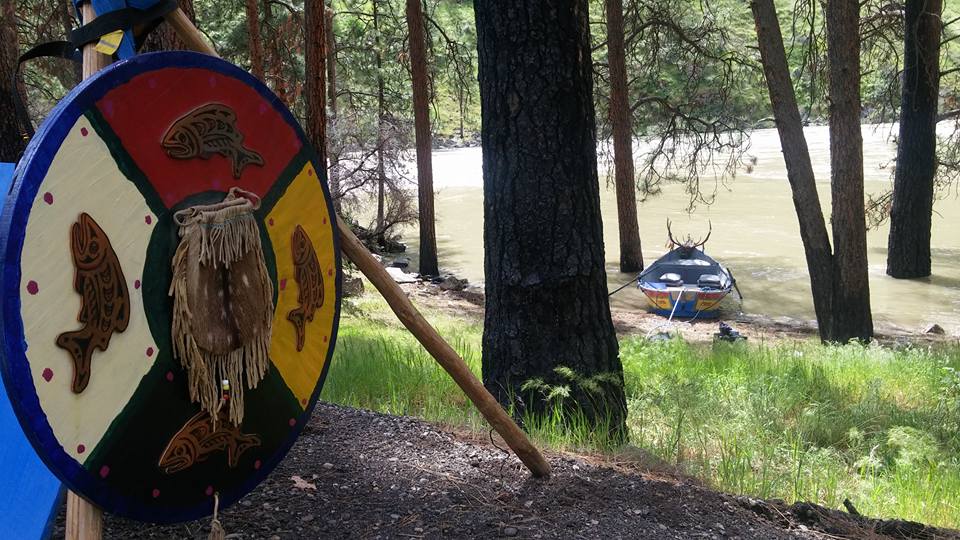
Around me, in a circle, other Natives and white people gathered. Old Ponderosa, who had stood here for a thousand seasons like this, offered shade. The river sang. Gary, a descendant of Chief Joseph, had just offered the Salmon his voice — just as this river had heard voices like his before. Earlier, we had made three large circles in a wooden canoe on the water, like a prayer finding its shape.
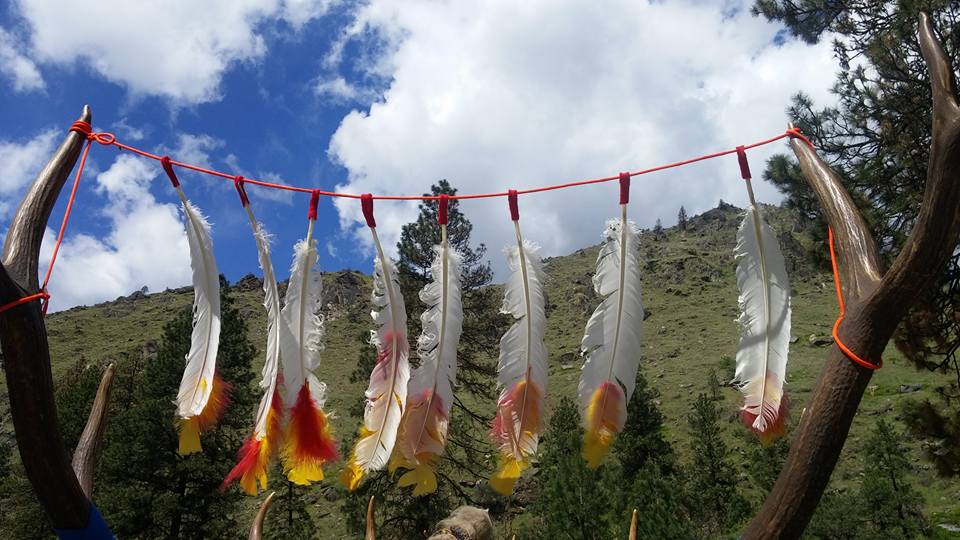
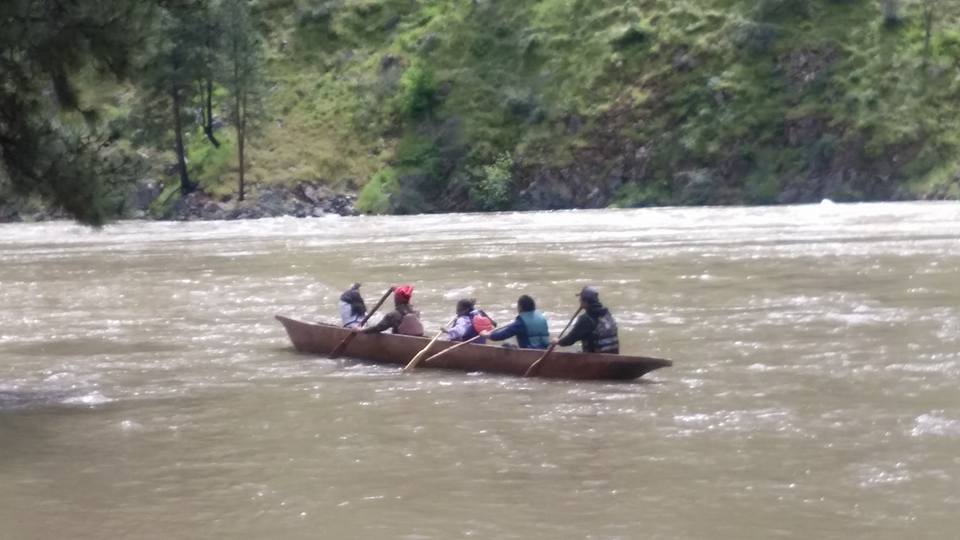
“Each paddle is prayer,” Gary said. I was not paddling, but sat directly behind Gary. Silent. Waiting. Listening. Trying to feel what the words Gary was saying, some in English, many in Nimíipuutimpt, trying to feel them in my body. We lifted as we moved against the current and glided as we flowed with it. Like a falcon riding a spiral. Like the seasons of beings we were there to honor. The young who rode the current toward the ocean. The elders, strong from the sea, passing their progeny — and us — on their way back to natal waters.
“What do you want to say to the river?” Gary asked.
We were back on land, riverside now, beneath the old and giant Ponderosa. I was still holding the small cup of water. I looked up at him. Back to the river. Around at everyone else in the circle. I have an old relationship with river. Not all of it gentle. When I was young, a river scoured the canyon near where we lived and brought with it homes and lives of classmates and families. Debris that we, as children, picked through until we were scared. Then, 30 years later, a river carried the body of my lifeless husband to me. He had drowned while riding currents much like we had that day. What the river took with his life still echoes deep and hollow inside me.
“What do you want to say to the river?” Gary asked.
I have come to know this about River. She has a mind of her own. And though I would not go so far as to say that she is apathetic towards the wants of humans, she does not hold us above other beings. Perhaps she knows what we have yet to accept — that the beings who come to her shores, who live in and by her waters, are no less important than humans. That she is no less important than humans. Despite our attempts and manipulations. Despite our engineering and our assumptions.
I also knew, even then, that she was not deaf to the songs we sang to her that morning. I was silent still in that circle of humans gathered on the shore until, shyly, I whispered into the cup. We all spoke into the water, then poured it, words and prayers, back into the river. I still think about those words and where they may have gone. My attempt at gratitude and understanding. Do our utterances live in the transformation cave of Caddis Fly? Perhaps in a bed of Mussel? Or has each syllable made it to the ocean, to cycle past me again one day? Walking away, I felt I was listened to, but perhaps not understood. Coming to the river was one gesture, attempting her language, a very different one.
A few months earlier, I had been in Tepoztlán, Mexico, at a writers residency. I was walking down a dark road, back to my lodging, after being told explicitly not to walk these roads after dark alone. I still do not speak more than a few words of Spanish. There were others approaching. I could hear their footsteps coming toward me. I stood taller, shoulders back. I did not want to look afraid. Like a tourist. Nor to be afraid. Like an American. What I wanted was to greet them. Customarily, kindly, conversationally. What I know about language is about relationship—that it can both create and destroy. As the others flowed by, I raised my hand slightly, “Buenas noches,” and kept walking. Had they done more than return my greeting, I would have nothing more to give.
“Kuus,” I said to Angel, my Nez Perce language teacher. “Kuus,” she repeated back to me, emphasizing the uu, reminding me there is no “w” sound at the end. “Kuus,” I said to her. She nodded. Yes, water.
What I know about language is about relationship—that it can both create and destroy.
I was only months into language immersion and struggled with sounds that were new in my mouth, that did not echo any English words I knew, but reflected the land in which they were born. By this time, I had been in the Salmon River mountains of Idaho for a handful of years, and already I was in love. And yet I was struggling to not only profess love to the land and beings, but to understand them in the way language helped me to understand other English-speaking people, to build relationship. I was learning something else as well — that language was more than sounds we made. For the Nez Perce, as for many Indigenous peoples, language is a form of leadership. When I became a program coordinator for the Indigenous Knowledge for Effective Education Program — IKEEP — at the University of Idaho, I would learn leadership as the five R’s:
Respect. Relationship. Responsibility. Reasoning. Reciprocity.
To know someone’s name, a given name, and to use it. To learn their language, at least make an attempt. To keep language alive and to protect those who carry it. To understand what each word held beyond what it pointed to, story and survival.
To finally stand beside moving water and know, in however small a way, what to offer her.
I raised the cup. The river moved past me, indifferent to nothing.
Qe’ciye w’yew’, thank you, in a language first spoken by humans to water. Qe’ciye w’yew’, kuus. Qe’ciye w’yew’, nacó’x kuus.
It still feels like a beginning. It may always.
Over the next six months, I want to travel Salmon Country with you. To follow the language keepers. To listen for the words that were born of this land and to ask what they still have to teach us — about leadership, about stewardship, about what it means to be in right relation with the more-than-human world. However we speak, whatever language we carry, that question belongs to all of us.
As I was on the river that day in May, I am here: a student. The words offered throughout this series are drawn from tribal dictionaries, linguistic archives, and the generosity of contemporary speakers. Language is as fluid as nacó’x kuus herself — pronunciation, spelling, and usage vary between nations, communities, and individual voices. These words are not artifacts to be collected, but breaths to be shared. The land remains the ultimate teacher of her own names. May we approach them accordingly.
In the beginning, there was nacó’x kuus — wide and strong. Deep and cold and free. The river spoke. A sound for the place where water met boulder. Where water stilled. Where water brushed thin over cobble. And where water dove through canyons. The river had language. The way rain sounded when meeting runoff. The slap of wet skin that leapt and returned. The river knew her name. Along her shore stood a woman born of distant red rock country. She stood in humility. She placed her right hand over her heart, and to the water cupped in her left, she spoke. And for a moment, deep in their bellies, there was understanding. One may even say love.