
Photography by Kaïa Kirkbride
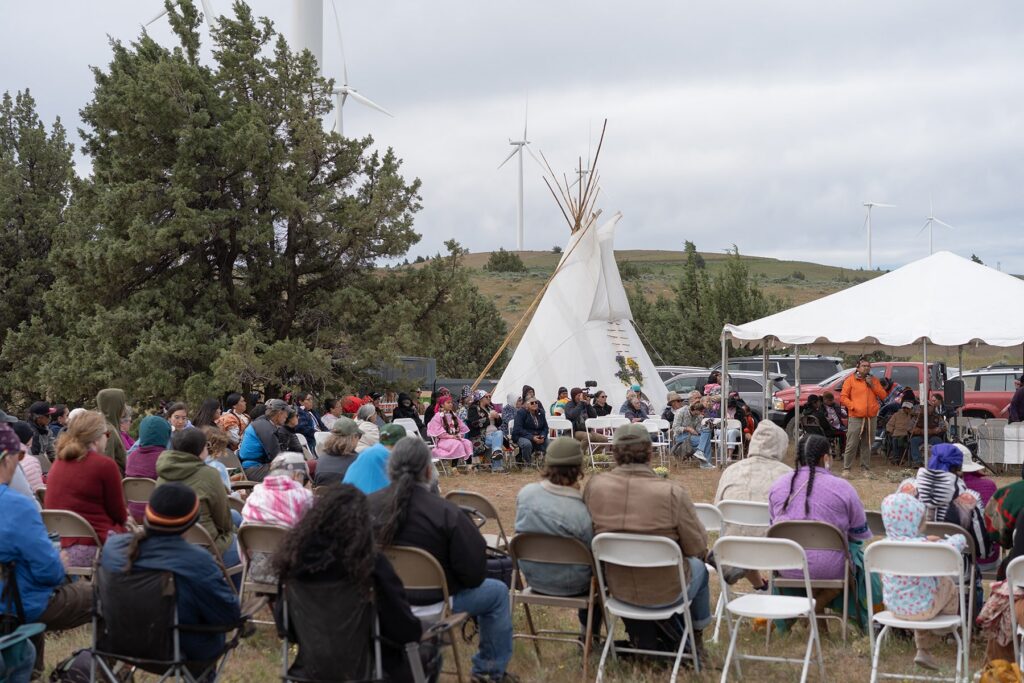
“This is our sacred mountain,” said Yakama tribal member and Indigenous lands advocate Elaine Harvey, during a May 8 gathering near the summit of Pushpum, one of the Yakama Nation’s most treasured sacred sites. “We’re very concerned for it.”
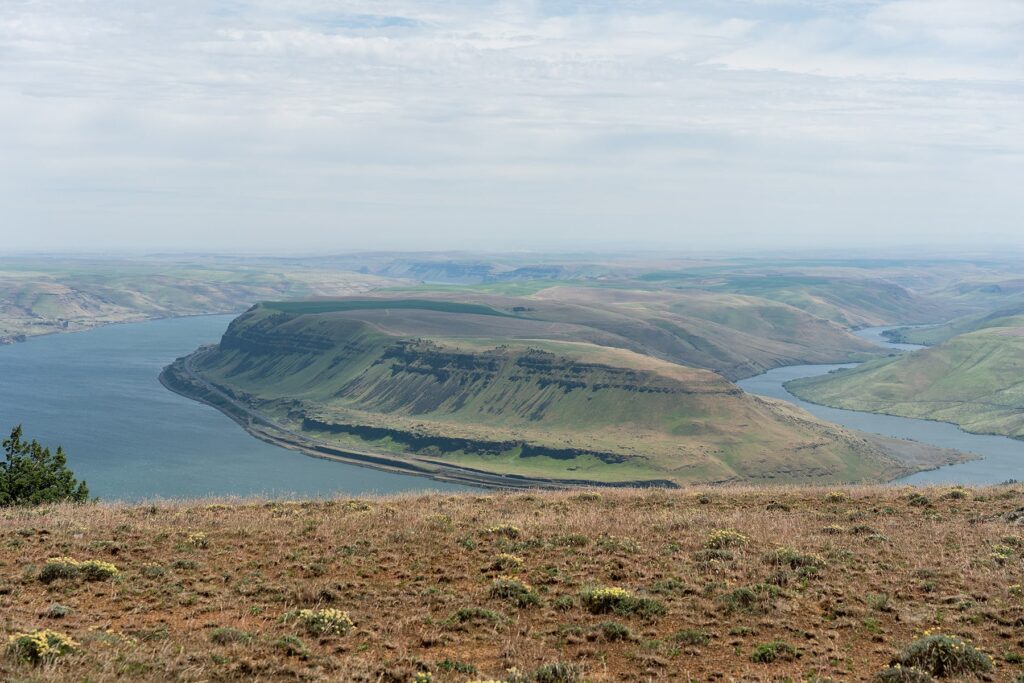
Pushpum, or “Mother of All Roots,” is a promontory along the Washington side of the Columbia River Gorge, sacred to the Kah-milt-pah Band of the Yakama. It’s also the site of a proposed renewable energy project that would alter the landscape irrevocably.
If built here, the Goldendale Energy Storage Project would generate power by running water through a tunnel connecting two reservoirs—one on top of Pushpum, and the other hundreds of feet below at the base of the ridge. Electricity, largely generated by nearby wind turbines, would pump water up to a higher reservoir, where it would remain until needed to fill in for intermittent renewables like wind and solar.
The project’s developers call it green energy. However, the Yakama, who have gathered traditional wild food plants at Pushpum since time immemorial, firmly oppose it.
“Renewable energy is coming too fast, like the dams did,” Harvey said, addressing a crowd of about three hundred people just below the future reservoir. “I believe we can go green, but in a responsible manner that doesn’t destroy the shrub steppe.”
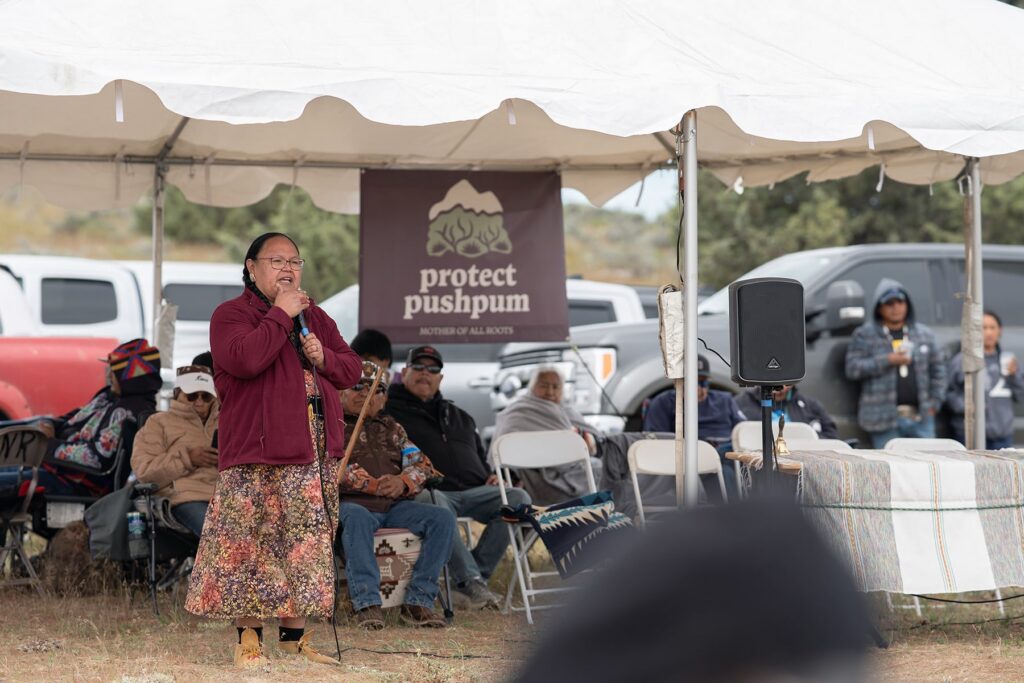
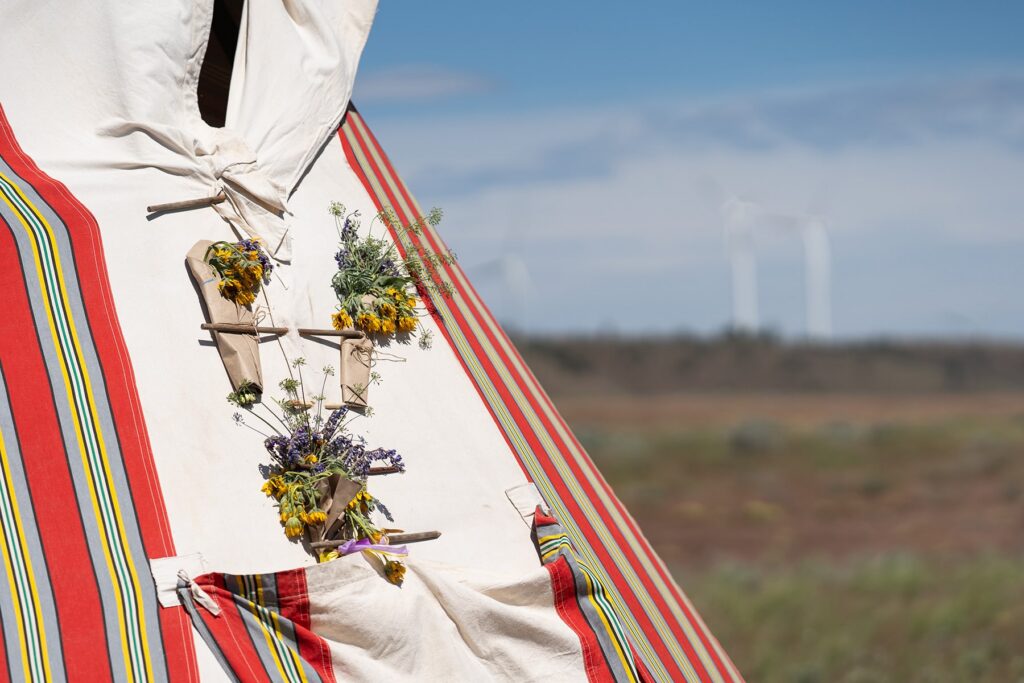
Near where Harvey stood, purple lupines and yellow buckwheat flowers nodded in the wind, while gusts tossed about limbs of junipers. The breeze turned the slowly rotating blades of wind turbines along the ridge, producing a sound of a distant jet engine. A ravine just below the ridgetop sheltered chokecherries, a traditional food of the Yakama, while, much farther down, the waters of the Columbia River glinted in the sun.
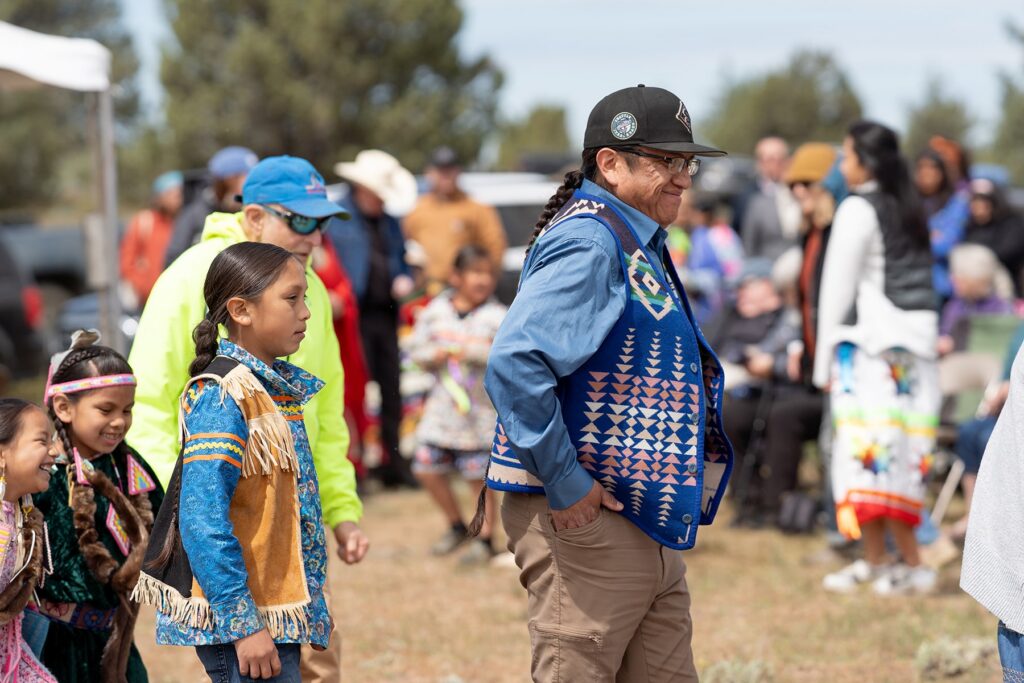
Members of Yakama Nation convened the gathering at Pushpum to voice their opposition to the Goldendale project. Speakers included Harvey, Chief Bronsco Jim Jr. of the Rock Creek Band of the Yakama, and leaders from environmental groups.
“There are new forms of energy we need,” said Susan Woodward of American Rivers, when her turn came to speak. “But there are appropriate places to build them, and inappropriate places.”
Harvey, who helped bring the gathering together, is a key figure in the struggle to protect Pushpum and many other efforts to secure Yakama control over lands they have inhabited since long before colonization. Her current official title is Watershed Department Manager for the Columbia River Inter-Tribal Fish Commission (CRITFC), a coalition of tribal governments including the Yakama who work to restore salmon in the Columbia. However, she is a longtime advocate for salmon fisheries, traditional huckleberry harvesting practices, and more.
Much of her work involves exercising rights protected under treaties with the U.S. government.
“We have a treaty-reserved right to be here,” Harvey told the crowd at Pushpum. Harvey has earned the respect of tribal members and environmental groups, and enmity from some industry power brokers. The unifying theme of her work is the desire to protect and restore the Yakama’s traditional foods and practices, something she’s been pursuing tirelessly for more than two decades.
Restoring Rivers
Fish put Harvey on the path to becoming a prominent voice for Indigenous land rights and tribal sovereignty. In the early 2000s, soon after college, she began working as a fish technician for the Yakama Nation. She spent nearly eighteen years employed by the tribe as a fisheries biologist. In 2022, she became the environmental coordinator for Yakama Nation Fisheries.
“I was drawn to the role because I saw our traditional foods and gathering grounds being impacted by wind, solar, and energy storage projects. In the process, developers were failing to consult the tribe.”
Elaine Harvey
The Yakama have dealt with unwanted energy development on their traditional land at least since the 1950s, when completion of the Dalles Dam flooded the Columbia’s Celilo Falls, an important fishing ground for the Yakama and other Indigenous nations. Another hydroelectric project, the John Day Dam, was completed in 1972, and is visible from Pushpum today.
“Dams have turned the Columbia into a long series of reservoirs,” Harvey said. “It’s not really a river anymore.”
In 2023, Harvey began her current role at CRITFC focused on ensuring sustainable salmon fisheries. Today, salmon face a host of threats, from dams, to climate change, to habitat degradation caused by industry and agriculture. Yet, opportunities to restore salmon runs also abound.
After the successful 2012 removal of a dam on the White Salmon River, which is a Columbia tributary, Yakama Nation Fisheries led an effort to remove massive sediment deposits that had built up behind the dam and were swept downstream when it was breached.
“Sediment was burying the river’s deep water refugia that salmon need to cool off,” Harvey said. “We’re trying to restore that habitat.”
The tribe dredged sediment from the river, using it to rebuild the bank’s natural contours with islands and side channels. Planting native vegetation helped hold sediment in place while benefiting wildlife.
“If you walk through the site now, it’s a haven for animals,” Harvey said. “There are coyotes, deer, and nesting birds.”
The White Salmon River project is an example of work the Yakama and other tribal nations are doing throughout the Columbia watershed to restore traditional foods, from salmon to native plants like bitterroot and wapato.
“I can tell you today every one of our traditional foods are under threat,” Harvey said during the gathering at Pushpum.
For her, the struggle to restore and protect traditional foods extends from Pushpum, where the Goldendale Energy Storage Project would decimate edible root and berry habitat, to the White Salmon River—and to nearby Gifford Pinchot National Forest, site of one of the most high-profile fights over access to native berries.
The Huckleberry Harvest
Just as Pushpum serves as a refuge for steppe plants like bitterroot and chokecherry, the Cascades are where the Yakama have gone for millennia to gather wild huckleberries. In recent decades, though, they’ve had to compete for this resource with well-financed commercial picking operations.
Gifford Pinchot National Forest in the Washington Cascades was, until recently, one of the few national forests to hold a commercial huckleberry harvest. Pickers would arrive by the busload every summer and descend on berry fields Yakama families had used for generations. Whereas the Yakama practice a tradition of picking one berry at a time, commercial harvesters use rakes to remove dozens of berries at once. The resulting damage to bushes hurts the following year’s crop.
Some commercial pickers were openly hostile to Yakama—often girls and elder women—harvesting berries in their ancestral areas. “It created a threatening environment,” Harvey said. “We had tribal women, elders, and kids getting harassed for picking berries. It got so bad we started bringing the biggest men from our families to act as guards.”
In 2023, Yakama leaders asked Harvey to serve on the Biden administration’s Northwest Forest Plan Federal Advisory Committee, which was updating management guidelines for 24.5 million acres of national forest lands. An increased focus on tribal inclusion was a stated goal for the amendment process, and Harvey used her place at the table to discuss the tribe’s inability to safely harvest huckleberries. The right of the Yakama to gather berries on their traditional lands is protected under the Treaty of 1855.
Harvey’s persistence, and a spate of media attention to the huckleberry controversy in early 2025, contributed to the Forest Service pausing that year’s commercial harvest. The pause was extended into this year. Harvey and others celebrated the win, though they still want a permanent ban.
“Last summer, for the first time in many years, we felt safe harvesting berries in our traditional areas,” Harvey said. “We could fill our baskets again.”
The Green Energy Onslaught
Evidence of the Northwest’s energy transition is clearly visible from the gathering at Pushpum, the Yakama’s sacred food gathering site. Rows of wind turbines dot the ridge along the edge of the Gorge, extending into the distance in both directions. South across the river, more turbines spin above Oregon farm country.
Both Washington and Oregon have committed to generating all their electricity from carbon-free sources—Washington by 2045, and Oregon by 2040. To meet those ambitious goals, many more large wind and solar farms need to be built.
The Yakama Nation supports climate action and is developing its own clean energy projects, but wants to leave sacred sites untouched. The turbines at Pushpum, which are part of Tuolumne Wind Project, were installed without the tribe’s consent.
While most energy consumption in Washington happens west of the Cascades, a majority of utility-scale renewable projects are proposed east of the mountains. Harvey estimates that 80 percent of proposals for wind and solar in the state are in the Yakama homeland.
“We’re currently trying to review and comment on over 60 wind and solar projects,” Harvey said. “We have staff who were hired to be wildlife biologists suddenly needing to divert time from their regular duties to work on this. And now we’re dealing with transmission lines, too.”
The Pacific Northwest states are off track to meet their clean energy goals, largely due to a lack of transmission lines for moving electricity over the Cascades. The recent push for data centers in the region will further strain the grid.
Accommodating growing demand while meeting the Northwest’s clean power goals requires a mass deployment of renewables as well as new power lines. Tribes could be valuable partners in making this build-out a reality, but only if they are involved from the beginning.
“Tribes need to be invited into the conversation at the earliest possible time. Whereas now, energy companies tend to develop projects in secret and don’t consult us until the very end.”
Elaine Harvey
“Tribes need to be invited into the conversation at the earliest possible time,” Harvey said. “Whereas now, energy companies tend to develop projects in secret and don’t consult us until the very end.”
When developers want to build an energy project, they typically spend months or years working with state agencies on a draft environmental impact statement (EIS), which the public can then comment on. By that time, opportunities to meaningfully shift the project’s direction are limited. Harvey says tribes need to be involved much earlier.
“After spending millions of dollars on plans and studies, a developer will bring an EIS to the Yakama and tell us we have sixty days to respond,” Harvey said. “That’s not meaningful engagement.”
In addition to concerns about tribal gathering places and sacred sites like Pushpum, the Yakama want to protect wildlife. No one better understands the needs of animals in their homeland than the Yakama Nation itself.
“We have to protect the shrub steppe,” Harvey said. “It supports deer migratory corridors, sage grouse habitat, and ferruginous hawks, all of which are impacted by solar and wind.”
These dual goals—conserving wildlife habitat and cultural resources while also building out renewables to combat climate change—led tribes along the Columbia to outline their own vision for regional energy development that avoids pitfalls associated with the Goldendale Energy Storage Project. It could provide a path forward for ramping up renewables while respecting tribal sovereignty, if Indigenous nations are allowed to take the lead.
Tribal Vision
In the northeast part of the Yakama Reservation, just south of the city of Yakima, nearly a hundred miles of canals and drains crisscross the landscape. Construction of the Wapato Irrigation Project began over a hundred years ago, and the canal system still supplies water for crops. Eventually, it could also generate renewable energy that avoids impacting sites like Pushpum that are important to the tribe.
The Yakama Tribal Solar Canal and Hydro Project would involve replacing the existing network of open-water canals with underground pipes. It would produce electricity using solar panels installed aboveground, and by harnessing energy from pressurized water moving through the buried pipes.
In 2024, the Yakama Nation received a $32 million grant for this innovative project from the federal government through the Bipartisan Infrastructure Law. Permits needed to implement it have become tied up in red tape, but the project provides a tantalizing glimpse of how sustainable energy development on tribal land could look.
The CRITFC Tribal Energy Vision, created in 2022, lays out priorities for renewable energy deployment. Among its recommendations are that “federal, state, and tribal governments work together on a regional plan for locating renewable resources and providing expeditious siting.”
“The idea is to cite energy projects so they’re not negatively impacting tribal resources or wildlife habitat,” Harvey said. Efforts are underway to update the 2022 vision document.
At Pushpum, the crossroads facing energy development in the region are stark. The ridge is already affected by the energy transition, its wind turbines having been built without Yakama tribal consent. The planned Goldendale Project would only further damage the area—but construction isn’t inevitable. The project received a key federal permit earlier this year but still needs state and local permits.
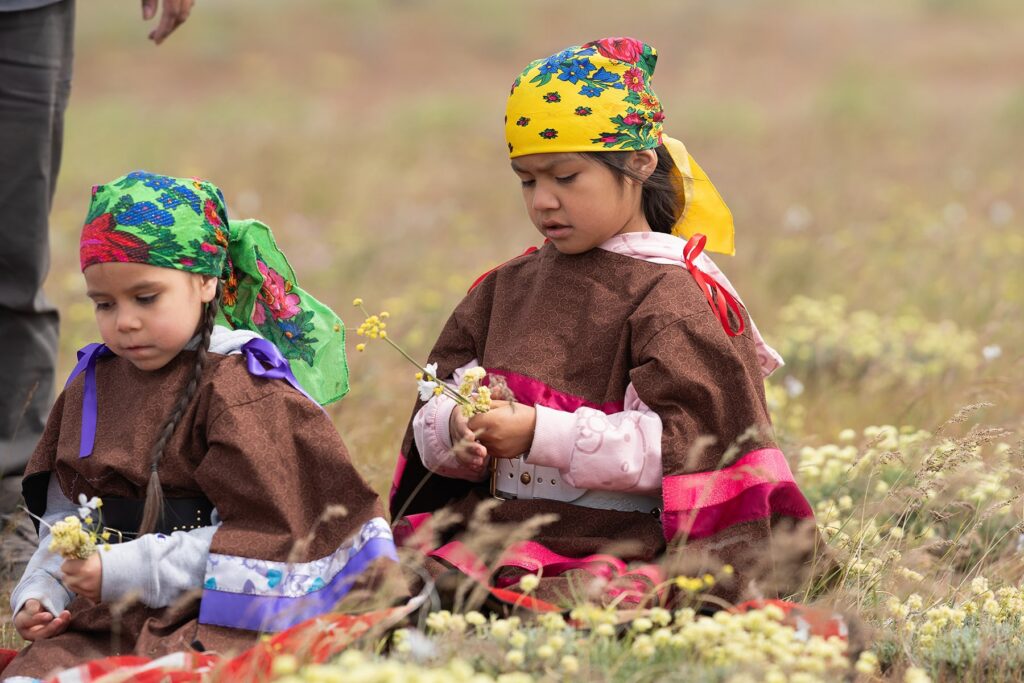
“There are no shovels in the ground yet,” said Simone Anter, a senior attorney for Columbia Riverkeeper, at the Pushpum gathering. “That means we can still stop it.”
Opposition to the Goldendale Project has elevated the Yakama Nation’s wider concerns about energy, generating widespread media coverage and even helping the tribe regain access to the sacred site that had been denied for years.
These Sacred Hills, a documentary about the struggle for Pushpum made by independent filmmakers in collaboration with the Yakama, has been shown at multiple film festivals and public events. A Tuolumne Wind Project employee saw it and helped secure permission for the Yakama to cross the wind farm’s land to access the spot where the recent gathering at Pushpum took place.
For now, at least, the ridgetop is still home to plants and animals who have shared the landscape with the Yakama for thousands of years. Meadowlarks sing from junipers, while pink bitterroot flowers push up from the soil.
“Everybody says we’ve got to go green,” Harvey said. “As the Yakama Nation, we say, yeah, let’s go green—but in a way that respects our sovereignty.”
Take Action:
- Sign the petition from Columbia Riverkeeper to protect Pushpum.
- Watch a webinar on Diné (Navajo) solidarity with defending Pushpum.
- Read an article by Underscore News about the event.