
Clouds hang low over the Salish Sea, their dark underbellies mirroring a glassy slate gray ocean. As Gary Sutton maneuvers Ocean Wise’s research boat, Skana, away from the marina on Hornby Island, British Columbia, fishermen watch him with a curious eye. Usually, few other boats are out during Sutton’s late winter field days motoring between Vancouver Island and the mainland, but this March the herring spawn has just begun.
Surrounded by a constant squabble of birds, we approach the milky blue waters swirling with schools of fish. The milt from the spawn clouds visibility; in some places, you can see just a few inches underwater. Sutton swivels his head toward the sound of a large, misty exhale at the surface. Sea lions. He resumes scanning the horizon to see if the lively commotion attracts what he’s really looking for: orcas.
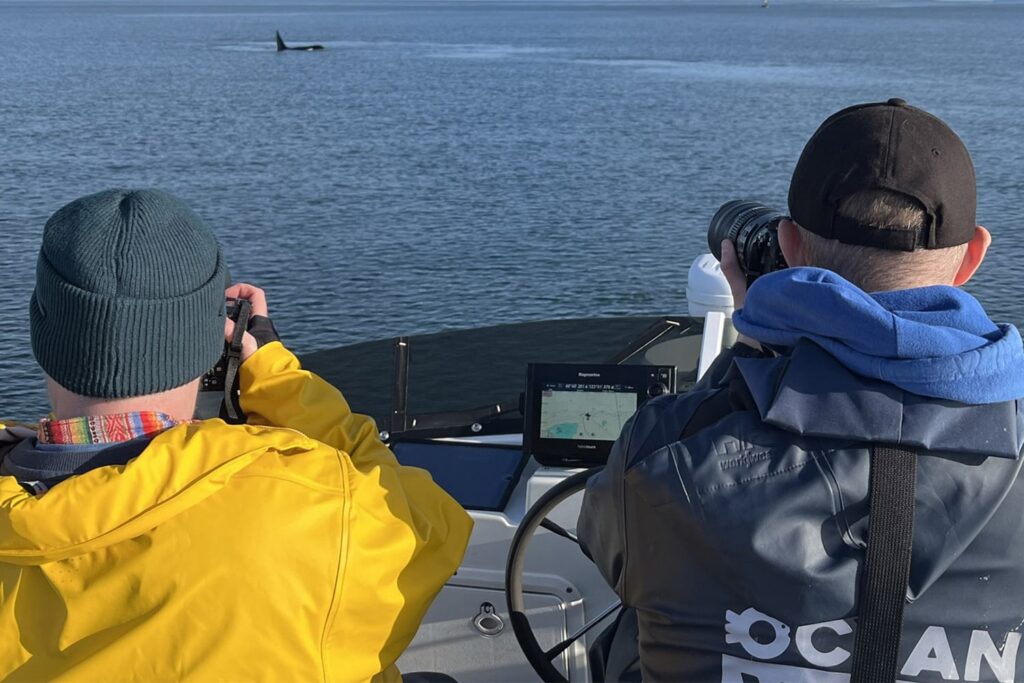
As a captain and research specialist with the Whales Initiative at Ocean Wise, a global environmental conservation organization launched in 1951, in Vancouver, British Columbia, Sutton has spent the last four winters following whales.
The study was started to create a general baseline about where humpbacks and killer whales are going in the Salish Sea in the winter, but they soon narrowed their focus on the seventy-four remaining southern resident orcas. Their territory is full of boat traffic, noise, and environmental contaminants, but less food.
“In terms of killer whales, one of the biggest questions out there is: What are they feeding on during the winter months?” says Dr. Chloe Robinson, director of the Whales Initiative at Ocean Wise.
What Orcas Eat in the Winter
Ten years ago, scientists noticed the endangered southern resident killer whales abruptly shifting away from their usual summers in Puget Sound and southern British Columbia. Instead, they have been foraging in waters off southwestern Vancouver Island and even down off California.
The Salish Sea is critical orca habitat, not just for foraging salmon, but for social bonding. Orcas are creatures of habit who avoid both risk and change. They hunt where their mothers hunt, eat what their mothers eat. But if those fish runs are diminished—by overfishing, climate change, pollution, increasing industrial presence, or other pressures—hunger may force the whales to alter course.
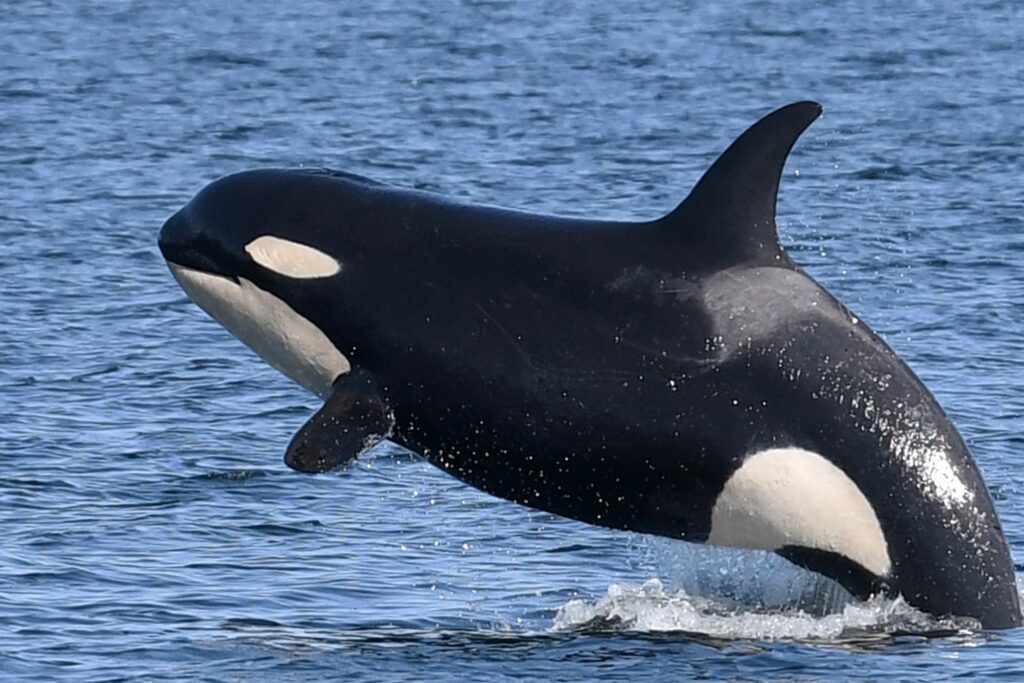
“This is obviously an important place for them, so understanding what rivers specifically are important is going to give us a better chance at making targeted conservation efforts,” Sutton says.
Southern residents are one of the world’s longest-studied populations of orcas, yet winter has historically forced a gap in whale research. There are fewer boats out on the water, so fewer reports of whale activity. The days are shorter, the weather meaner. At this time of year, seeing orcas five days a month is considered good by research standards.
“Sometimes we’re the only boat around for miles, besides ferries and freighters,” Sutton said as he warmed up after a frigid day the previous field season. They had to break up ice around the boat to leave their slip. Whatever information they can gather is vital. What the killer whales are doing in the summer has “been studied to death,” so current recovery strategies draw heavily on this data. But it’s not the full picture.
“Data gaps are a threat in themselves,” Robinson says.
As we circumnavigate Hornby Island and head into the Strait of Georgia, Sutton and the other researchers are looking not only for the pods themselves, but for what they leave behind, including bright flesh or the silver glint of scales.
These prey samples result from whales catching a salmon, bringing it to the surface, and ripping it apart to share it among the pod. The fish scales are shed into the water—if the team gets there quick enough, they can scoop up the scales, place them in ethanol, and deliver them to Canada’s Department of Fisheries and Oceans (DFO) to identify the exact species, its age, and stock—its river of origin.
Essentially, the research team must find the orcas to find the salmon scales to find the rivers to protect the salmon to protect the orcas. The Ocean Wise crew is searching for the specific rivers these specific salmon come from, to stitch together missing data, but this information can only be gathered when the two species collide.
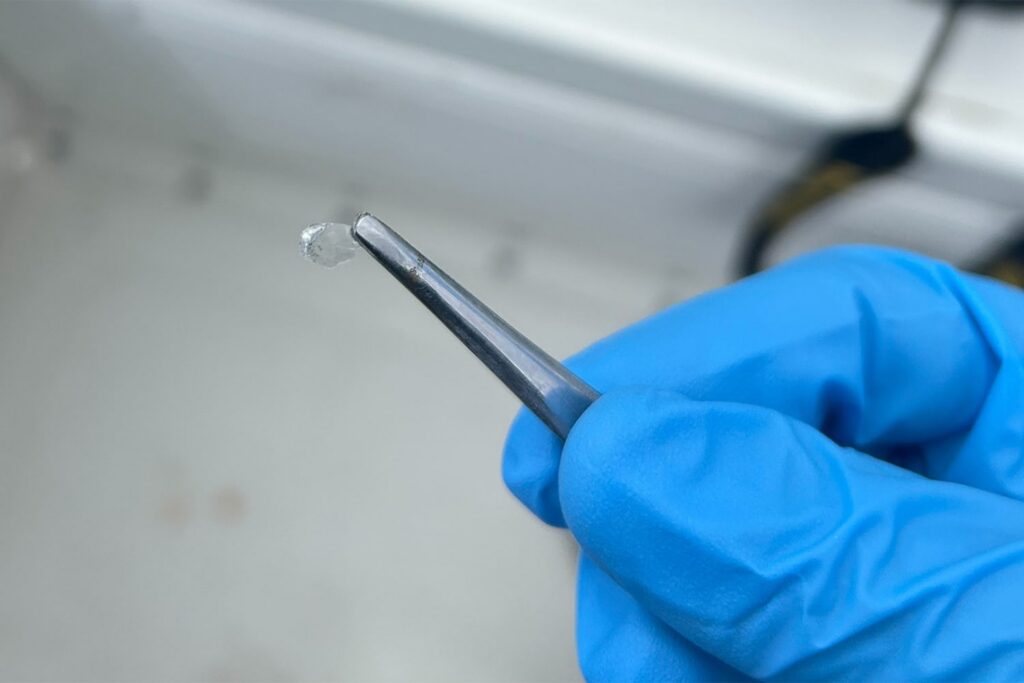
Robinson, a self-proclaimed true-crime buff, sees this collection of data as similar to building an evidence case. Researchers hope that information from DFO analyses could then help policymakers make an evidence-based action plan for orca conservation based on prey availability, whale diets, and environmental threats to protect the whales’ food sources before it’s too late.
Thomas Doniol-Valcroze leads DFO’s Cetacean Research and Monitoring Program, which is mandated with monitoring all populations of cetaceans in Canadian Pacific waters. His program determines abundance and trends, and advises on identifying critical habitat. Doniol-Valcroze says it was a huge step forward when his predecessor Dr. John Ford discovered that the whales prefer chinook salmon.
“In recent years, with concerns around the population trajectory of the southern resident killer whales, there’s been even more effort not just to continue this work but to go deeper and to better understand, if really the southern residents are not doing great because they’re food-limited, why is that?”
While they’re out on the water, the team also collects photographs, acoustic recordings, and water samples to advance the use of environmental DNA, or eDNA. Robinson hopes developing and testing this new methodology will provide more data with less stress on the whales.
They also share their data with colleagues south of the Canadian border. Southern resident killer whales provide the most famous case of a transboundary population, Robinson says. Like the Salish Sea, this science straddles the border between Canada and the United States, bringing scientists together as collaborators. Having a common goal in collecting data and protecting southern residents allows them to stretch their limited resources and reduce the number of boats around whales.
Surprising Results
With this research underway, Doniol-Valcroze says DFO will likely need a few more years of collected samples. So far, DFO has found that chinook salmon are among the prey samples collected. This doesn’t surprise Robinson, since chinook are the preferred prey of both southern and northern residents. Robinson is surprised, however, that some of the salmon are identified as hatchery fish from Vancouver Island.
“Sometimes there’s a bit of controversy around hatcheries, but from the very few samples we’ve collected, we’ve found there’s a positive influence from hatchery fish,” Robinson said. They are excited to get more samples to see if hatchery fish in whales’ diets could be a trend across a larger sample set.
Essentially, the research team must find the orcas to find the salmon scales to find the rivers to protect the salmon to protect the orcas.
From her own research on hatchery fish in the U.K., Robinson knows the effects of hatchery fish are hard to calculate. She’s cautiously optimistic to see them being eaten by whales. “That gives me a bit of hope that the whales are finding food, but [also] that some of the work that we’re doing to increase chinook in areas that are important to them is working.” If hatchery fish are really representative of these whales’ diet, Robinson says, that work could be ramped up.
Doniol-Valcroze says there’s no doubt they see fish from hatcheries in the diets of southern and northern residents. “But the real question is: Are they eating as much as expected from the abundance of those fish?”
The samples will need to be considered in the context of how different stocks of fish appear in nature, to see if the whales are over- or under-selecting certain stocks. The results from a recently published study using prey samples collected in summer showed the southern residents were mostly eating fish whose numbers had not been heavily enhanced by hatchery efforts.
The study noted that hatchery fish may be important prey for orcas in other time periods. Killer whale “preferences were not necessarily known when some of the salmon stocks were chosen to be enhanced,” Doniol-Valcroze says. The goal for salmon enhancement programs, he adds, is not just for killer whales but for salmon stocks in general.
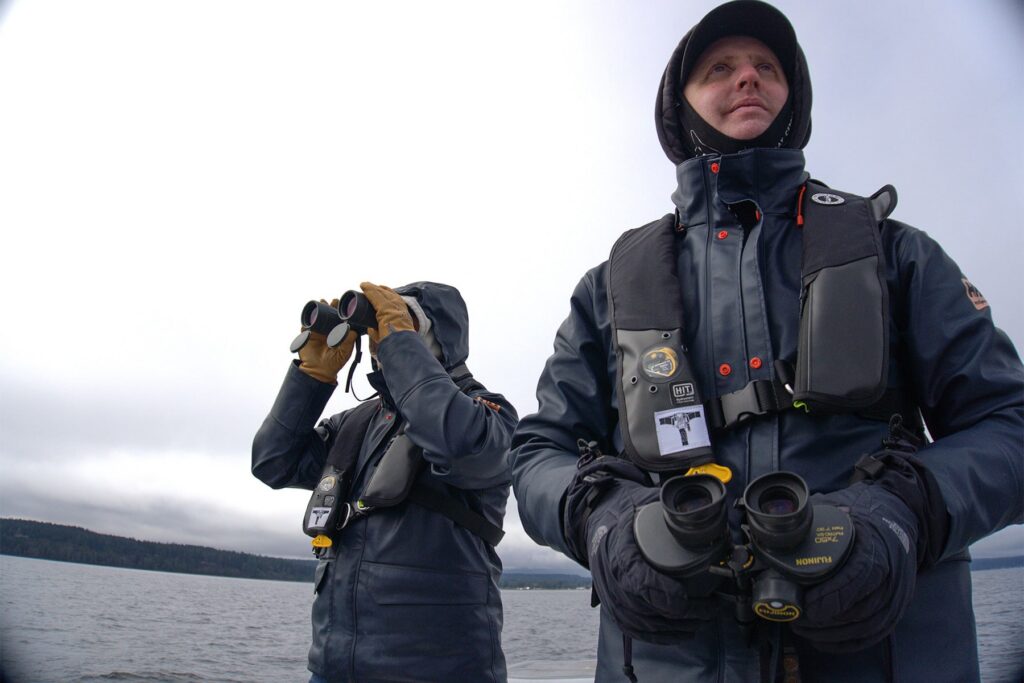
While he doesn’t work in the salmon enhancement program, Doniol-Valcroze says the managers at DFO could try to improve salmon stocks shown to contribute most to the diet of the southern residents, or they could implement other measures to make the salmon more available for killer whales.
For Robinson, the exciting trend is that scientists globally are thinking of an ecosystem-wide approach to management. The starting question may be whether there are enough adult fish available for killer whales, but that leads to thinking beyond the fish: Are the spawning habitats healthy for different stocks of salmon? What’s the water quality like? Are the rivers impacted?
“All these factors play into how many of those fish will survive into adulthood, where they are then available for the killer whales,” Robinson says. “And that’s the biggest way that we can all come together really to support this work to protect the whales,” they continue. “It doesn’t start in the ocean. It starts in the rivers and the streams where these salmon live and they come back to spawn.”
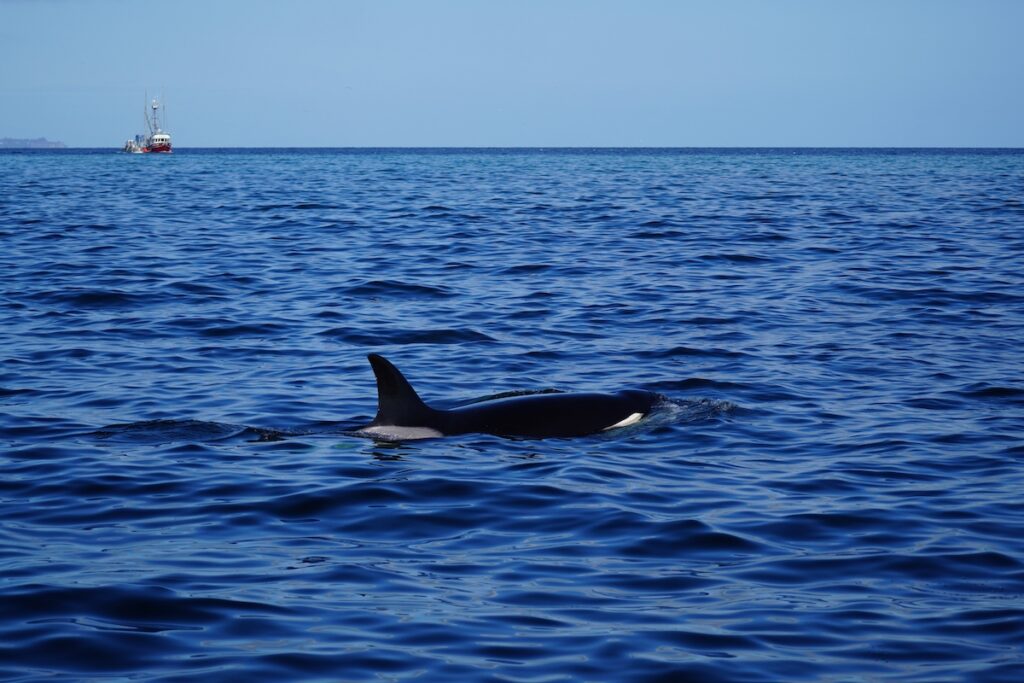
The first field day near Hornby Island slips by without seeing a single whale. Though we find orcas immediately on the second day, after the initial excitement, crew member Michael Judson is let down. These are transient orcas—mammal-eaters who’ve come to snag seals drawn in by the herring spawn. There won’t be any salmon samples to collect today. Even though we can still try to draw eDNA from the water, the urgency to help the southern residents weighs on him.
As we wait for the right moment to collect samples, Sutton shows me a video on his phone from another research day. In it, Judson leans against the railing at the bow, armed with a pool skimmer. Orcas ahead lunge silently through the water—the hunt is on. In the whales’ wake, or the “flukeprint,” the boat pushes forward on its own chase. Out of frame, Sutton can see the orcas have caught their prey.
“Yeah, they got it,” he tells Judson, as Judson tries not to turn in the direction of the whales—he has to keep his eyes trained on the subtle flukeprint. It’s visible by the absence of rippling: slick like an oil splotch. Quickly, as if he’s spearing a fish, Judson darts a net into the water. He brings it back up to his face to look closely and says, “Oh, baby!”
From behind the wheel, Sutton asks, “You got one?”
Judson stretches the net toward Sutton, so that he can see the single glint of salmon silver, and calls out: “One scale!”