
This article was originally published in Civil Eats. Photo: Kiliii Yunan
I come from the Lhaq’temish—the Lummi—the Salmon People, the People of the Sea. When I get to speak with our youth at the school on the Lummi Nation, outside Bellingham, Washington, I like to point out that where we sit right now is a reservation. We were put here, right? So, it’s home, but not really home.
We come from the San Juan Islands. And that’s important, because the youth need to know that the islands are the place we need to protect, where our people have come from since time immemorial. I have never counted how many islands there are in the Salish Sea, but every single one is so different from the one next to it. They’re all so unique and they’re beautiful. You’ve got the salmon there and you’ve got the orca and the eagles.
When I’m out on my boat with my sons, Luke and Kyle, it feels like home. There’s nothing better. You can finally breathe. We pull out of the Bellingham harbor and head out toward the islands [to fish], and I’m at peace. Even though you’re about to do something totally stressful and busy, you can breathe. I wish everybody in the tribe still got the chance to feel that feeling.
Our people harvest clams, oysters, sea urchin, and geoduck, but we are primarily salmon fishermen. I’ve heard it said that salmon is culture, and our culture is salmon—it’s really our foundation. They used to say that during the time of the treaty signing [in 1855], you could walk across a river on the backs of salmon. They were that abundant.
The Lummi fishing fleet used to have 30-plus purse seiners. I think we’re down to nine of us now actively fishing. But we’re still the largest tribal fishing fleet overall. And we still have quite a few gill netters and skiff fishers who fish the Nooksack River and the Salish Sea, but we rely on the bigger seiners to bring in enough fish for the whole tribe. The tribe takes those fish and freezes them so that we can access them for all our events, funerals most importantly. There’s nothing better than being able to bring fish in for the tribe.
It all comes back to Lhaq’temish—the People of the Sea. We have a saying, “When the tide is out, the table is set.” I love that phrase. And I love the fact that in our language we don’t have a word for “starvation”—because we never, ever starved. The sea was always there.
Fish Hungry
In the 70s and 80s, there were so many fish. Then the salmon runs got to a point where they weren’t really sustaining us anymore. I can remember when we used to fish six weeks out of the summer, and now we’re lucky to get two or three days.
Many years, we don’t even get to fish. We’ll spend the money getting the boat ready to go, and then not enough salmon return on their spawning runs for us to harvest. They say that today we only have 5 percent of the salmon we had at the time of the treaty signing. But we still have plenty of Dungeness crab, shrimp, and halibut to harvest.
It used to be that everyone always had freezers full of salmon. But when you can only fish sockeye once every four years, and pinks are every other year, and the number of fishermen has dwindled, then families don’t necessarily have enough fish to fill their freezers anymore.
I see how fish-hungry the community is. Because of the bad years we’ve had, I’ve seen the damage that is done by not being able to fish. That’s the scary part. You only have to drive around our reservation to see that sense of loss.
I believe it’s also because people don’t know what they are missing. People don’t know why they feel empty inside, because they don’t get to hop on a boat and get out there and realize, “This is what I need to fill myself back up.”
A Lifetime on the Water
My dad was born here in the Lummi Nation, and he was a fisherman. Fishing took him from Togiak, Alaska, all the way down to San Francisco Bay to fish the herring runs. My dad was also Air Force, a jet-engine mechanic.
When he got out of the Air Force we went to Seattle, where he worked for Boeing, and then he became an ironworker. He built a skiff in our garage in Seattle and would fish weekends on Bellingham Bay. After I finished fifth grade, we moved from Seattle back to Lummi. My dad built our seiner, too, which he called the Eleanor S., after me.
When I was 22, Peter Pan Seafoods hired me to work at the canneries in King Cove, Alaska. I was a bull cook, which meant that we went in and made the beds and cleaned the bathrooms. It was an all-day job. The next year, I worked in the laundry room, which was from 7 in the morning until 10 at night, seven days a week. And Dad was like, “You know, if you want to work this hard, I think you could probably make that amount of money working for me.”
Before me, my dad never had a girl work for him. It was sort of a change in gender roles. The men would go off and fish the sea and the women would fish the river. But a few skippers [the men] started bringing their daughters onboard. Fishing with my dad was awesome—it was the best of times. He just loved what he did, and it was wonderful just to be together.
When I was growing up, my Auntie Dora Lee Solomon was always a fisherman and always had her own skiff. She would take that little river skiff out into the Salish Sea all the way to San Juan Island. It takes four and a half hours to get there in our big boat, and I can’t even imagine how long it took in a skiff like that.
Once we came up to her in my dad’s boat and you could see there were so many fish hitting her net—and they were leading out and going around it. So, we set our net behind her and the fish all funneled into our seine. It was too big of a bag to bring over the back end of the boat. We ended up “brailing”—meaning we had to scoop them out. I remember my auntie jokingly saying, “Those were my fish.” My dad sent her to Hawaii that winter, so she got a trip out of it.
She was also a certified diver and she scuba dived for our aquaculture [the Lummi Shellfish Hatchery.] She was the first woman to serve on the Lummi Natural Resource and Fish Commission, so I followed in her footsteps, and I’ve been on the commission for 12 years now. She was the aunt that took us everywhere to show us where we harvested everything. She also spoke the [Lummi] language, so she was always using the language and teaching us that.
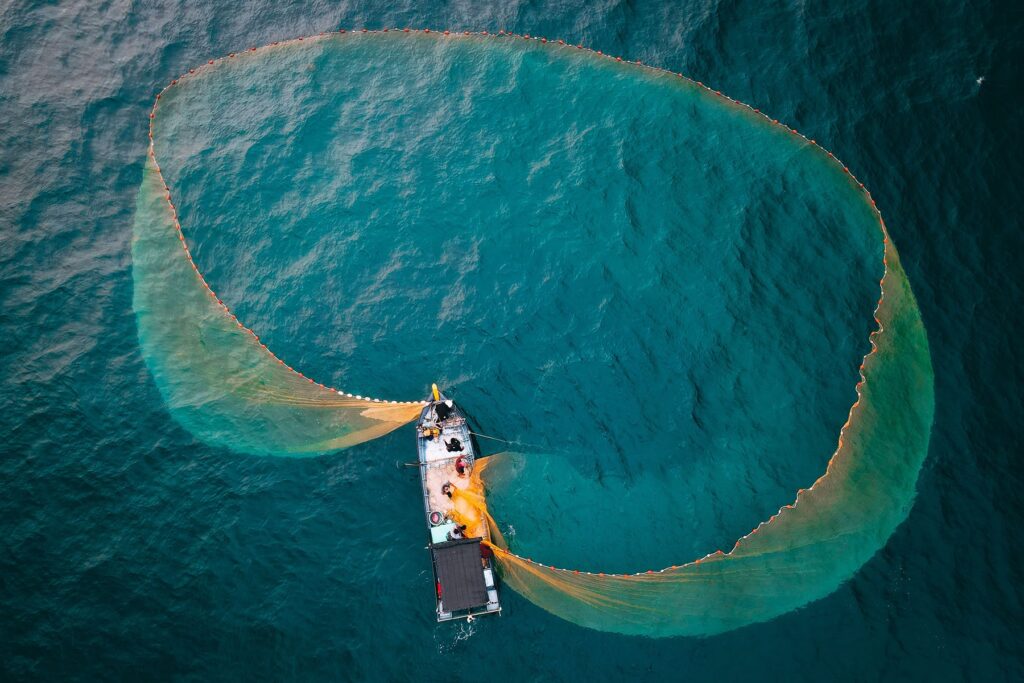
In 1993, I married Larry Kinley, and he too was a fisherman. But I didn’t start fishing with Larry until after my dad passed away, in 1999. I wanted to stay fishing with my dad.
I got to do things when fishing with Larry that I didn’t do fishing with my dad. I’d throw my weight around, joking, “Well, I’m a [half] owner of this boat.” There would be things that Larry would want done, and I’d be like, “Well, that’s not how my dad would do it.”
My husband, who was the Lummi tribal chairman for 12 years, was a very thoughtful, calm person when it came to politics. But you put him on the deck of a boat, and he was a whole different man. There was a lot of yelling, and everything had to be done fast. Had to be done his way.
But he had the reputation of being a very good fisherman. Larry was a risk taker, and that is what fishing is. Every time you put your net in the water, you don’t know if you’re going to get it back, never mind catch fish. And then you get the net back, and you’re like, “Okay, let’s go to the next spot, and let’s try that again.”
Larry passed away from cancer in 2018. When his father died, my son Luke had to take over, and he’s been skippering for nearly 8 years. Both my boys are fishing. Kyle has his own boat, and Luke has two, and then I have the seiner. When we’re on the seiner, Luke runs the boat, and Kyle and I work on deck.
Life doesn’t get better than that. Because we’re doing what all our ancestors have always done—we’re harvesting from the Salish Sea.
Low Prices, High Costs
I love salmon fishing. I tolerate crabbing. I’m only crabbing to pay the bills. There’s a big difference. We fish for salmon even though we don’t make money all the time.
It’s funny. I will come across a file—I’ve found files of Larry’s fish tickets from 1976—and we’re basically still being paid the same amount as what we were making back then. And that’s because in many years you’ve got Alaska producing so many salmon that it keeps everyone’s prices low.
But the cost of diesel fuel is no longer 80-something cents a gallon. Insurance is sky high. Groceries are now one of our biggest bills, up there with fuel. When we take our seiner out, we all sleep on it, and I cook. You need to feed the crew and you have to feed them well, and you have to feed them three times a day.
So, every other expense has gone up like that. But what we earn, it’s not as much. And that is tough.
Hatchery Salmon Versus Farmed Salmon
We’ve had a couple of hatcheries for quite a while, and we will always fight for hatcheries, because hatchery fish are the mitigation for the damage that’s been done. And a lot of that damage to the environment can never be undone—unless everyone wants to move out of Washington State, right? If we were down to just the wild fish that were going up the river, there wouldn’t be any fisheries. So hatcheries are where it’s at.
People need to be able to know the difference between hatcheries and farmed fish. I don’t have any concerns that the hatchery fish are weakening the wild fish stocks, and neither do any of the biologists that work for the tribe.
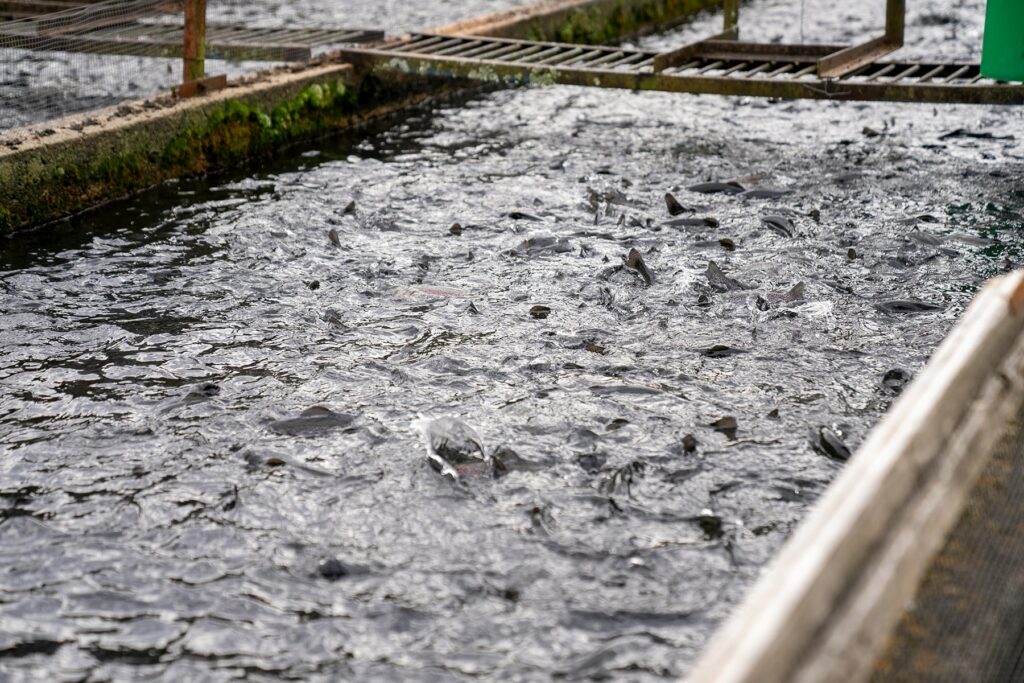
A hatchery fish is a fish that’s come from the wild. When they started the hatcheries, what they did was they grabbed the fish from the actual rivers and they took the milt [fish sperm] and they put them together. The eggs are incubated and the number of baby salmon that come from those is so much higher than what happens in the wild. In the wild, a pair of salmon will lay the same amount of eggs but only so many those hatch, and of those, only a quarter make it down the river. Whereas of those same eggs in a hatchery, most of them survive.
Farmed salmon, on the other hand, are Atlantic salmon, and they don’t even come from the West Coast. They come from the East Coast. Pacific salmon can’t be raised in pens—they just die. But Atlantic salmon, I guess, survive in pens. When a salmon is being raised in a pen, it’s being fed pellet food. It grows up not having any color in its meat. It’s gray. And then, before harvest, they start adding all this dye to the pellet food to color the meat.
The farmed fish are infected with sea lice and some viruses. And the sad part about these fish is that Canada’s got about 400 sea pens that are right in the pathway that the wild fish take when they come down the Fraser River and go out to the ocean. So the baby salmon have to pass under and through those pens.
The pens are lit up at night to attract the baby salmon to them, because the baby salmon are free food [for the farm-raised fish]. And when they’re passing through them and under them, they pick up lice and they pick up those viruses. My whole thing about farmed salmon is, you should be able to do it, but go do it up on land. Don’t be harming the wild stocks.
Return of the Reefnet
Reefnetting is a gift from the Creator to the Lummi. A reefnet is an artificial reef. They were put in the water near where kelp was already growing. There were two canoes, and then two lines going forward from them and lines strung across that with grasses tied to them.
It would look to the fish like the bottom was coming up, a reef, and they would have to swim up and over it—and into a net. You could see the fish there, and everyone pulled up on the net, trapping the fish. It’s a very patient way of fishing. You’re waiting for the fish to come to you, versus searching for the fish
What I’ve always loved about the reefnet is that the net had a hole built into it, so you didn’t catch the first salmon and you didn’t catch the last salmon. It’s really such a beautiful way of fishing.

But when [industrial canning company] Alaska Packers came along [in the late 1800s], they put all their fish traps in front of all our reefnets—because our reefnets were in the spots where all the salmon could be caught. [The canneries] proceeded to wipe out run after run, not realizing there wasn’t an infinite amount of salmon, and not following the rules of allowing certain number of fish to go past before you start harvesting. And when [the state of Washington] banned the traps [in 1934], they banned the reefnet.
Well, we all moved on to other ways of harvesting.
Around 2015, before he died, Larry got this idea to build a reefnet. When the salmon runs started being not so healthy and we started losing fishermen to other jobs, there were children being raised who didn’t know fishing, and Larry could see that. Reefnetting would be one of the ways we could teach them.
We couldn’t bring them out on the seiners—there’s too many moving parts; it’s too dangerous. But a reefnet, that’s two pretty good secure pontoons that you can have people out on. [In 2016] Larry chose to anchor the reefnet at Cherry Point, and we dropped 12 anchors up there, which is where they had planned to build a giant coal port.
A modern reefnet has two aluminum platforms and a tower and cameras, so we know when the fish have gone over the false reef. I get to sit in a little shed on one of the platforms watching the cameras, and then I’ve got a lever I can pull when the fish come, and that starts one of the lines lifting to pull up the net, and everyone else pulls their lines, too. Then you can check out the fish. If we’re fishing sockeye, then the kings and the silvers [and any other bycatch] can just be rolled back into the water and on their way they go.
“To know who you are, you’ve got to know where you come from.”
Larry Kinley
Reefnetting is so important because it gets back to our family structure. Larry used to say, “To know who you are, you’ve got to know where you come from.” Our fishing sites were throughout the islands. They were family owned. So, if you know where your family’s fishing sites were, then you know your family history.
Salmon Are Resilient
I just love all the buzz about reefnetting now. But I think it’s been three or four years since we had the reefnet platforms out on the water—that’s because of the cost, and the need to keep the seiner running. It’s just me and my boys now and it’s hard to have the time to get both the reefnet ready and the seiner ready for the same season. When it comes down to it, we’ve got to do the one that supports us.
But while we were fishing the reefnet, people came out to witness it. You could feel and see the enthusiasm.
I really do have hope that that we’ll understand the importance of the Salish Sea. And we are hopeful that the salmon will come back. Because salmon are resilient, and we know that.
How many times have they already come back? Think about the first big rockslide on the Fraser River—that was Hells Gate [in 1914]—which blocked millions of spawning salmon. That came back to being one of the biggest runs of sockeye that we used to fish. Look at the Klamath River. You pull down the dams, and that year—that same season!—the fish started going back up the river. And then this year, there were how many documented spawners? It doesn’t take long for it to come back.
Fish are resilient. We haven’t thrown too many things in their pathway yet, I guess. We just got to give them the chance and they will come back.