
We live in a time of billionaires. And yet, what a billion dollars can do depends on which version of the future the person with deep pockets wants to live in.
In one version, someone might spend $1 billion to send three hundred pounds of cargo into orbit on a SpaceX Rideshare rocket. In another, $1 billion could build a new White House ballroom. Or, a billion dollars could retrofit a mid-sized city’s climate infrastructure with 22,000 energy-efficient remodels, 25,000 portable A/C units, 15,000 trees planted, and a fleet of electric buses.
That’s how the city of Portland, Oregon, has invested its billion-dollar-plus climate adaptation dollars, administered through the Portland Clean Energy Fund (PCEF). By awarding grants to community-led climate justice projects in the city, the fund is designed to ensure that the frontline communities most impacted by the effects of climate change have resources to develop locally appropriate solutions.
In 2018, Portland passed a ballot initiative to impose a one percent surcharge on large corporations operating within city limits. The surcharge requires corporations earning more than $1 billion to pay one percent of their sales as a PCEF surcharge.
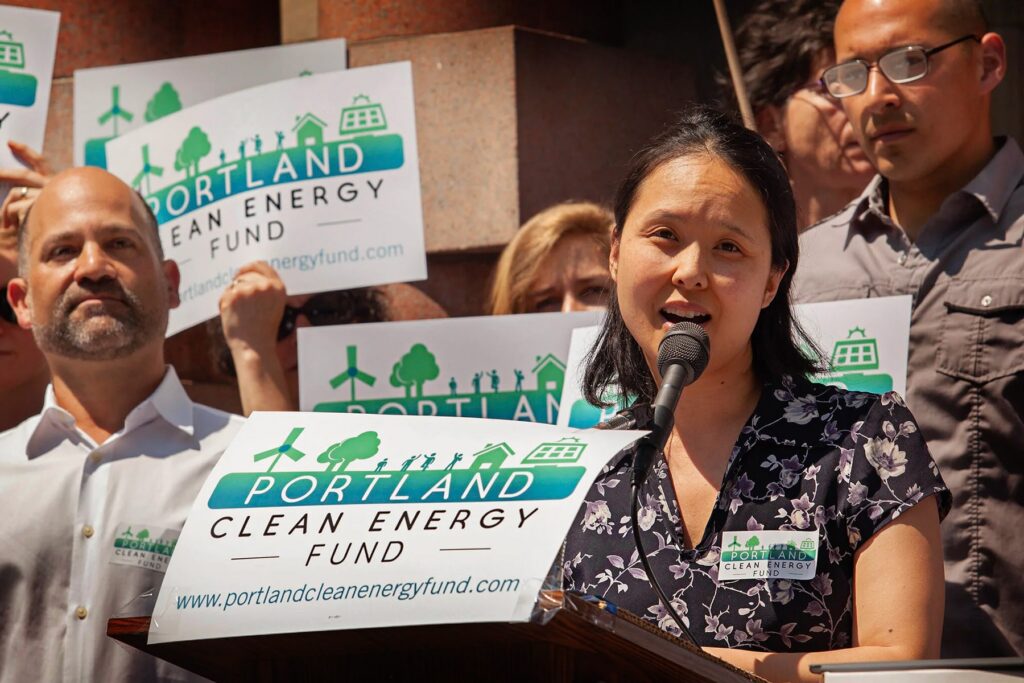
The surcharge proved to be incredibly lucrative. For the first time in U.S. history, a city had a billion-dollar climate change budget. The funds have now made Oregon’s largest city a national leader in municipal climate financing. In addition to awarding hundreds of grants to community-based organizations (CBOs), PCEF also provides energy efficiency upgrades to eligible individuals, and manages multimillion-dollar capital investments in carbon-reduction infrastructure.
That the city might pass a ballot initiative specifically for climate justice, and not just climate change, was conceived from a collaboration between the National Association for the Advancement of Colored People (NAACP) and the nonprofit 350PDX for fossil fuel resistance. Eventually, other frontline-serving CBOs like the Coalition of Communities of Color, the Asian Pacific American Network of Oregon, and the Native American Youth and Family Center signed on. The PCEF ballot measure passed by 65 percent.
By focusing on funding CBOs, PCEF’s implementation has been designed to mobilize historically overlooked populations among whom “solutions had already been drafted in church basements and kitchens and on job sites,” says Raffaele Timarchi, PCEF’s External Affairs Manager. “PCEF starts with a really simple but powerful question: What if those who are most impacted by climate change are the ones who are designing the solutions?”
This was an essential question because climate change’s deadliest impacts are more significant in people who are poor, disabled, or of color—and what type of impacts a person faces is often correlated to their demographic.
In the U.S., households in the lowest income bracket—especially those less likely to have access to appropriate infrastructure—spend twice as much of their income on electricity to stay safe during ever-intensifying winter storms and summer heat events. Black people are more likely to lack access to adaptation-related investments, infrastructure, and technology. Latinos who work in the agricultural sector will see significant workforce reductions due to warmer temperatures. And people with disabilities are more likely to live in poverty, in flood zones, and to have physiological sensitivities to heat.
Members of these communities are also more likely to die in heat domes—extreme weather events that trap high-pressure systems and causes dangerous levels of heat—as sixty-nine Portlanders did in 2021, when temperatures reached 116 degrees Fahrenheit. A medical examiner’s office analysis of that event, which caused more than six hundred deaths in the greater Pacific Northwest, found that most people died in lower-income neighborhoods where people of color tend to live—areas with fewer trees but more highways, parking lots, and industrial plants. Overwhelmingly, they were over sixty, had a medical condition, and lived alone.
The city’s failure to anticipate the needs of vulnerable communities was so egregious that, on July 28, 2026, the American Civil Liberties Union filed a lawsuit against the city, Multnomah County, and top elected officials, “alleging that the jurisdictions’ emergency management systems fail to protect people with disabilities before, during, and after disasters.”
“Climate change isn’t just about rising temperatures,” Timarchi says. “It’s about rising inequality. It’s about the working-class family that has to choose between groceries and their energy bill.”
Windfall for a Warming City
When PCEF passed in 2018, it was forecast to generate $40 to $60 million a year. But the surcharge was significantly more lucrative than anyone had planned.
By the time city council began drafting its Climate Action Plan, which would outline how awards from PCEF would be allocated, it was clear the fund would have $750 million dollars to disperse over five years. It took a full year for the city council—which is charged with allocating the funds—to approve the first plan.
Two months after its approval, financials were updated: There would be $540 million more than expected. It’s now projected to reach $1.6 billion by 2029.

This has allowed PCEF to invest in solutions that are both more nimble and more expansive than what was established in the initial five-year plan.
In 2021, following the heat dome, the PCEF steering committee launched a portable A/C distribution program called Cooling Portland, designed to target communities that experienced the highest fatality rates during that year’s heat dome: people who are elderly, have existing medical conditions, or who live alone.
The Portland Housing Bureau did not require affordable housing units to have air conditioning until 2021, a change that was only made after dozens of local residents—six of whom lived in low-income housing units operated by Portland Housing Authority—died of preventable deaths. During the heat dome, many affordable housing unit managers handed out blackout curtains and fans.
As of this year, Cooling Portland, administered by the nonprofit Earth Advantage, is on track to distribute 25,000 units by the time the five-year program concludes this year. Earth Advantage has also won additional PCEF investments to install more permanent A/C units in 105 housing communities, including several existing affordable units.
“What if those who are most impacted by climate change are the ones who are designing the solutions?”
Raffaele Timarchi
“Cooling Portland is a program that allows people to age in place with community members around them,” Timarchi said. “It’s not just a climate change initiative. It’s a dignity program.”
Adaptation as Reparation
While PCEF’s windfall funding has allowed the program to be more expansive than originally envisioned, it’s stayed true to the ballot’s intentions of funding frontline community leaders—like Taking Ownership PDX, one of 262 nonprofits that has been supported by PCEF’s community grants to date.
Founded in 2020, Taking Ownership PDX’s mission is to renovate Black-owned homes so that more Black Portlanders can safely age in place. They were first awarded PCEF funds in 2025—and intend to use them to expand the proof-of-concept work they’ve already been doing in Portland’s Black community for years.
Following the 2021 heat dome, Taking Ownership PDX’s founder Randal Wyatt began a portable A/C drive. When volunteers went to drop off a unit at a local veteran’s house, they learned his home had no plumbing.
“He somehow made it through the heat dome in that house with no A/C and no water,” Wyatt says. A few months later, the Taking Ownership PDX team came back to redo the plumbing and install a new water heater—for free.
In Portland, Black homeowners are more likely to have extensive, delayed maintenance needs due to a history of discriminatory lending, local redlining, and urban renewal-related displacement occurring in historically Black neighborhoods. Together, these barriers kept Black Portlanders out of generational homeownership—and even among those who own their homes, few can afford up-to-date units.
As historically Black neighborhoods in Portland continue to gentrify, white neighbors move in and file maintenance reports with the city. According to a 2021 ombudsman report, Black and other non-white homeowners are disproportionately hit with city fines related to maintenance. (Since then, only one of the report’s three recommendations to reduce this discrimination has been implemented.)
“We’ll do maintenance to keep them from getting liens put on their homes,” Wyatt says. In the past, Taking Ownership PDX has done everything from repairing burst pipes to deploying volunteers to pick up garbage after a neighbor’s service has been cut off due to unpaid bills. To serve their four-hundred-household client base, they’ve registered seven hundred volunteers.
Because of their three-year, $2.9 million PCEF grant, Taking Ownership PDX will now be able to provide $63,000 in upgrades to thirty-five Black-owned homes—covering climate-adaptation renovations like insulation, HVAC systems, and any deferred maintenance required to make such upgrades possible.
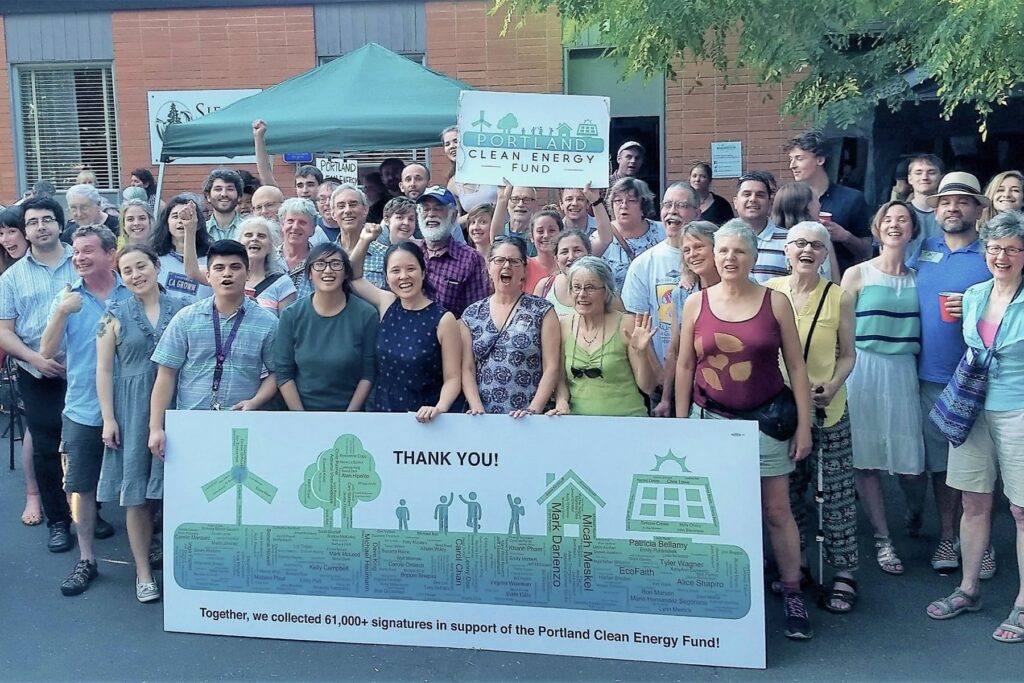
Taking Ownership PDX is just one of the dozens of organizations that’s been awarded energy efficiency-related grants. PCEF also directly administers energy efficiency upgrades via the Community Energy Project funding stream. Across all of these programs, more than 22,000 homes have been upgraded since 2023.
One participant—whose upgrades included insulation, duct tightening, a heat pump, and solar panels—has seen her energy bill drop 20 percent. “She’s saving $1,000 a year,” Timarchi says, “though it’s not just about the savings. The real value is in everything else she’s gained: comfort, security, and resilience in her own home.”
Resourcing the Next Generation of Portlanders—If PCEF Can Keep Its Funds
Housing-specific funding is only one of PCEF’s priority areas, which include regenerative agriculture, workforce development, renewable energy, and transportation. Projects range in scale from depaving a single thousand-square-foot parking lot to a transit revitalization project stretching the length of an entire bus line. This will improve transit options for ten thousand daily users and establish a pedestrian corridor in one of the most dangerous parts of the city for walkers, bikers, and wheelchair users.
Across all of its project areas, PCEF’s climate mitigation impacts have been tremendous. As of 2025, completed PCEF-funded projects have led to a 34,847-metric-ton reduction in greenhouse gases—the equivalent of removing 7,575 gas-powered cars from the road—and generated 533 megawatt hours of renewable energy, enough energy to power forty-four homes for a year.
But despite PCEF’s measurable impacts on the city’s climate initiatives—and the likely lifesaving impacts for the city’s residents—many municipal employees have attempted to redirect these funds elsewhere.

In 2023, for example, City Commissioner Rene Gonzalez (who, after a series of scandals that included campaign finance violations, lost his bid for reelection in 2024) said that PCEF’s emphasis on serving the most vulnerable frontline communities was driven by “permanent racial grievance,” and suggested redirecting millions of dollars to the Bureau of Transportation, which was facing a funding shortfall.
Commissioner Carmen Rubio (who ran a failed mayoral campaign that year) proposed, in 2024, reallocating $540 million from PCEF to various city bureaus; in the end, she succeeded in transferring $7 million to the general budget in a resolution that allowed a one-time interest transfer.
This year, a proposed ballot measure sought to reallocate PCEF funds. If it had passed, the so-called “Safer Portland” initiative would have redirected 25 percent of PCEF funds to the city’s police department. After weeks of legal scandals, the measure failed to gather enough signatures to make it onto the November ballot.
Before the organizers had even submitted their ballot petition to the secretary of state, that office opened an investigation into the campaign when voters and campaign organizers alike filed dozens of complaints. (As of early July, seventy-seven complaints had been filed.)
Among other complaints, these filings allege that canvassers were trained to use a misleading canvassing script that incorrectly claimed the funds would be used to increase mental health responders, even though the text of the bill shows the funds would have been used to hire more officers. Under state law, it is a felony for any petition circulator to make false statements about a petition.
If the ballot measure had passed, the funding would have been taken from existing commitments. “We are reliant on those future resources coming through June 20, 2029, to finish multiyear projects where funding has already been promised,” says PCEF program manager Sam Baraso.
“Climate change isn’t just about rising temperatures. It’s about rising inequality. It’s about the working-class family that has to choose between groceries and their energy bill.”
Raffaele Timarchi
These efforts to undercut PCEF belie its popularity—locally and elsewhere. Shortly after Portland’s plan was passed, Denver successfully adopted a similar measure. Two hours south of Portland, Eugene has its own version of a similar initiative slated to appear on the ballot this November. And for the residents’ who have received home upgrades—between the energy-efficiency upgrades and A/C unit distribution, more than 47,000 Portlanders have been directly impacted, or almost 7 percent of city residents—the impacts could prove lifesaving the next time a heat dome or an ice storm arrives.
So many repeated attempts at reallocating the alleged PCEF balance comes down to a failure to think at the right timescale, Timarchi thinks. “Climate change has a long timeline. And these big projects have a long timeline. One hundred affordable housing units don’t go up overnight.” Climate change’s impacts are long-lasting; they’re also forecast to expand exponentially. “We don’t have the resources to address what’s coming in the next five years, let alone the next thirty.”
In Portland, PCEF’s advocates continue to remind council members that PCEF passed in a landslide. And while it has been mired in controversy and threatened with cuts ever since, none of these have had to do with its operations, implementation, or impact. That the financial engine behind it has been so powerful might be seen as a lesson for other agencies in deficit. PCEF isn’t a honeypot; it’s a means-tested model. And the lesson? Relatively small surcharges on billion-dollar corporations work.