
This feature is part of a six-month series from Magic Canoe’s Contributing Writers. Four writers were selected to each cover Salmon, New Economies, Environment, or Indigenous Leadership. This is the second story for the Salmon Desk. Major support for the Contributing Writers Series is made possible by a gift from Priscilla Bernard Wieden, in loving memory of Dan Wieden.
Kris Knight braced for the worst. As he and his colleagues drove toward Rimrock Ranch, about twelve miles from the Central Oregon town of Sisters, they were anxious to see if years of hard work had gone up in smoke.
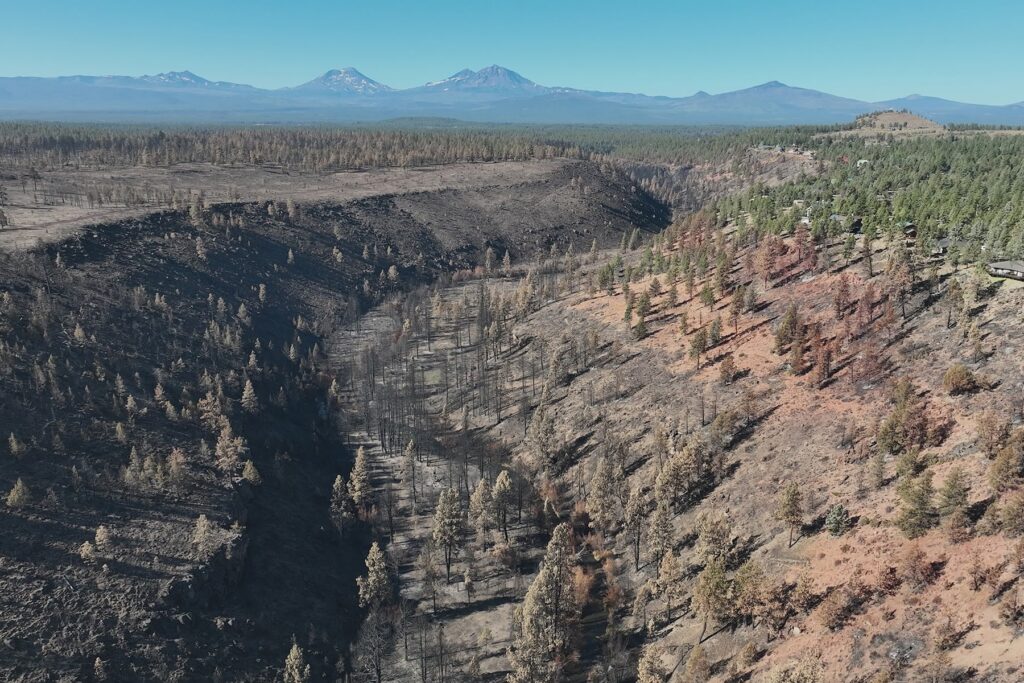
A few weeks before, on August 21, 2025, the Flat Fire had run through the area, burning more than 23,000 acres. Driving in, they saw a blackened landscape of incinerated grasses and charred hulks of ponderosas and junipers. The only splashes of color were houses doused pink in flame retardant.
Thanks to firefighting crews, most residents still had their homes, but the vegetation surrounding their properties hadn’t survived. That didn’t bode well for Rimrock Ranch.
The former cattle ranch is now a wildlife preserve owned by the Deschutes Land Trust. For years the land trust has been part of a collaboration working to restore a stretch of Whychus Creek that runs through the ranch and its Whychus Canyon Preserve just upstream. The group, known as the Deschutes Partnership, also includes the Upper Deschutes Watershed Council, where Knight serves as executive director, and the Deschutes River Conservancy.
Whychus Creek, a forty-one-mile-long tributary of the Deschutes River, offers a highlight reel of the watershed’s geologic blessings. Hikers trek here to see its cascades, anglers chase redband trout in its glacially tinted waters, and golden eagles perch on basalt columns as the creek descends into rocky canyons.
Historically, the creek also served as a stronghold for salmon and steelhead trout, but water diversions and dams had blocked them from the watershed for decades—a loss felt by the whole ecosystem. When salmon return from the ocean to upstream waters, their bodies carry marine-derived nutrients that nourish more than a hundred species of plants and animals. The fish are also critical cultural and economic resources for many communities and tribes.
Recent efforts to reestablish populations of salmon and steelhead in the region have hinged on removing obstacles, restoring more natural stream flows, and improving habitat. Whychus Creek was a hopeful example. Had the fire set back some of those efforts?
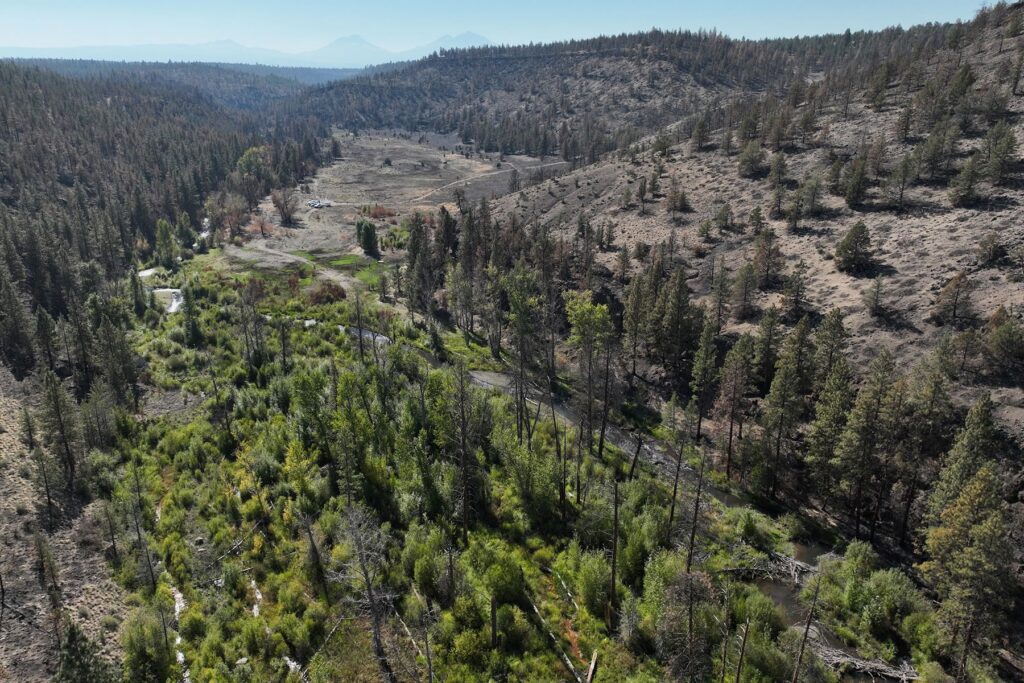
“As we drove out there seeing the burned landscape, I was preparing myself to be super sad,” says Knight. But when they got to the property and peered from the ridgetop to the river valley below, they saw a ribbon of green among a sea of black. The uplands and ridgetops had totally burned, but not the riparian areas along Whychus Creek.
“As we got down in the valley, we had lunch at one of the spots where we were checking on some of our monitoring equipment, and you wouldn’t know there had been a fire,” he says. “We were under a canopy of trees and surrounded by green. We like to imagine that it served as an oasis during that fire.” That oasis wouldn’t have existed if the fire had moved through this area a decade earlier.
In 2021, the Deschutes Partnership embarked on a massive effort to employ a relatively new restoration technique known as Stage Zero. It was a continuation of work that had begun in 2016 in Whychus Canyon Preserve upstream.
Before their efforts, the creek had become incised, cutting a deep trench that disconnected the channel from its floodplain. It hugged one side of the valley floor, leaving the rest high and dry for pasture. But the Stage Zero restoration raised the water table, reconnecting the creek with the floodplain and allowing the water to spread out across the valley floor in multiple braided channels and pools. It’s reminiscent of what beavers historically did to this landscape, and many other places, before trappers began eradicating them from the area in the nineteenth century.
“We’ve learned that the more you can allow water to spill out of its banks, the more we can restore the natural processes,” says Mathias Perle, restoration program manager for the Upper Deschutes Watershed Council.
The effort stemmed from a need to create habitat for imperiled salmon and steelhead, but the Flat Fire revealed another benefit that may become just as valuable in the West: wildfire resiliency.
Wildfire is a natural part of the ecosystem. Across the bioregion, climate change is driving up temperatures, decreasing snowpack, and increasing the frequency and intensity of drought. As warmer and drier conditions collide with more than a century of fire suppression policies, wildfire season has become longer and more severe. Could river restoration projects such as those on Whychus Creek help the West handle increased wildfire risk while also working to revive salmon populations?
Whychus Creek appears to be proof of that concept.
Troubled History
Whychus Creek gathers its waters from snowmelt draining from Broken Top Mountain and the Three Sisters Wilderness on the east side of Oregon’s Cascade Mountains, in the high desert. The creek runs northeast through steep pine forests before slowing to a jog near the town of Sisters, and then passing through Whychus Canyon and Rimrock Ranch.
Spring-run chinook salmon and summer steelhead historically took full advantage of abundant spawning and rearing habitat in Whychus Creek, although it wouldn’t have been a quick or easy trip to get there. When these intrepid travelers left the Pacific Ocean, they swam two hundred miles up the Columbia River, climbing nearly two thousand vertical feet as they ascended another 121 miles up the Deschutes to reach Whychus Creek.
When they got to the property and peered from the ridgetop to the river valley below, they saw a ribbon of green among a sea of black. The uplands and ridgetops had totally burned, but not the riparian areas along Whychus Creek.
Beginning in the late 1800s, things got even harder. Newly arriving ranchers and farmers built dams and diversions to siphon the creek for irrigation. The oldest irrigation district in the Deschutes watershed, the Three Sisters Irrigation District, claimed its water right in 1895, and more followed in the next few decades.
To mitigate the impact of floods, residents removed woody debris, and bermed and channelized the creek, helping to move water more quickly and drying out floodplains to graze cattle or grow crops. Their manipulations severed the creek from its floodplain, eliminating pools and wetlands that provided nurseries for fish.
Braided channels became a single gauntlet that ran straight and fast—if it ran at all. In many years, water withdrawals and diversions meant the creek often went dry in summer. The prevailing mentality at the time was that water still flowing through the creek was wasted.
Things got worse for salmon and steelhead in the 1960s with the construction of Pelton Round Butte, a series of three hydroelectric dams on the Deschutes River just downstream of its confluence with Whychus Creek. Construction of the dams, co-owned by Portland General Electric and the Confederated Tribes of Warm Springs, blocked access to 250 miles of upstream habitat for salmon and steelhead. A three-mile-long fish ladder failed to allow juvenile and adult fish to pass effectively. For decades these sea-run fish were cut off from vital upstream habitat, including Whychus Creek, where they once flourished.
But when the dams’ owners applied to relicense the hydroelectric project in 2005, they agreed to restore passage above the dams for salmonids. Adult fish that migrate upstream from the ocean now pass two dams on the Columbia River with the help of fish ladders. When they reach Pelton Round Butte, they’re collected and trucked around the hydroelectric complex.
This “trap and haul” method works in both directions: It shuttles adult fish headed upstream to spawn around the dams, while a $108 million underwater tower mimics natural currents and attracts juvenile fish migrating downstream toward the ocean to the collection point, bypassing the structures.
With this taxi service in operation, managers began reintroducing chinook and steelhead above Pelton Round Butte in 2007. And the Deschutes Partnership jumped into action to rebuild upstream habitat altered more than a century before.
“Our job is to restore habitat to help this reintroduction be successful,” says Knight.
Creating Lasting Habitat
In the last two decades, the Deschutes Partnership has worked to make Whychus Creek hospitable for salmon and steelhead. The work has been done in partnership with other entities, including the Forest Service and the Three Sisters Irrigation District, which takes the lion’s share of water from Whychus Creek.
Thanks to their efforts, Whychus Creek now runs free. All the man-made obstacles for salmon and steelhead have been removed or retrofitted, and all diversions have been screened, which keeps fish from taking a fatal turn by straying into irrigation canals. Three Sisters Irrigation District has converted all but one mile of their open canals, which lost 20 to 50 percent of water to seepage and evaporation, into pressurized pipes. The upgrades have helped maintain minimum flows in the creek to keep it wet throughout the year, and that’s enabled large-scale restoration work to improve habitat.
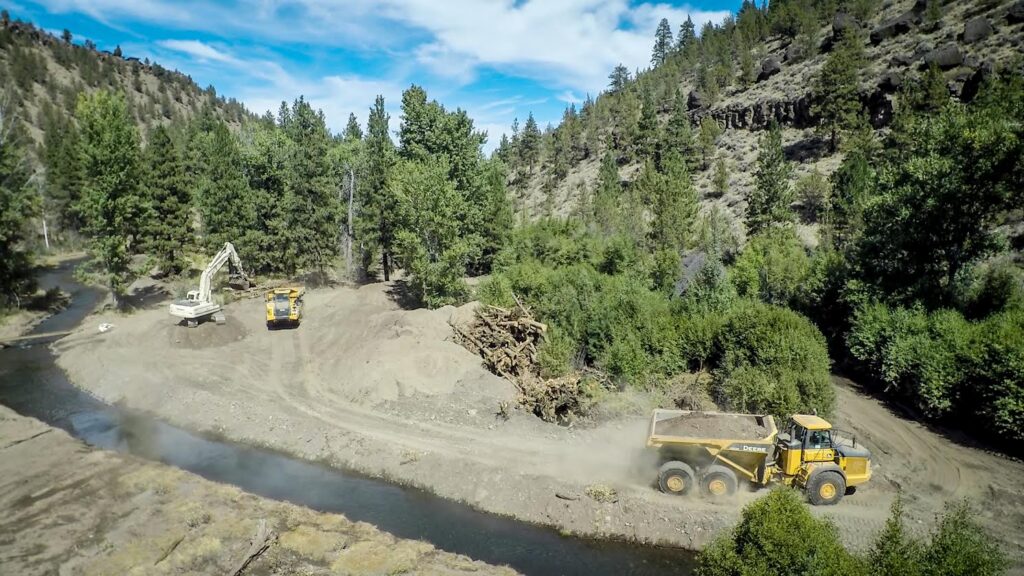
Stage Zero restoration projects, like the one at Rimrock Ranch, are generally done in lower-gradient, broad floodplains. The river channel is filled in with dirt, raising the water table and allowing water to spread out across the landscape and weave through multiple braided channels.
At Whychus Creek, more than six thousand trees were laid out on the valley floor to create logjams to slow water, trap sediment, and provide safe places for fish to hide from predators. Crews sowed native seeds and nearly ten thousand plants over three years. Willows and cottonwoods have now taken root and will grow up over the years, adding shade and eventually more fallen wood.
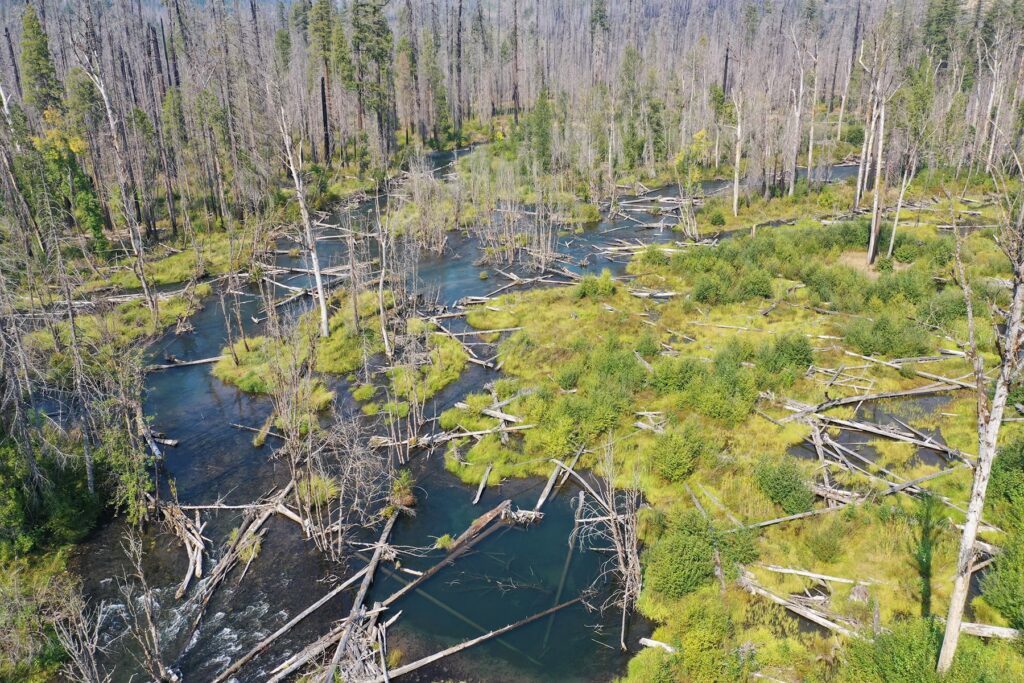
“We’ve come to realize that there are real values in these natural systems,” says Knight. “All that wood and all those meandering and braided channels across a floodplain served a purpose. They are very important for all life stages of salmon and other fish. So that’s what we’re trying to re-create here.”
Building Fire Resilience
At Rimrock Ranch, they recently received the help of a new resident beaver, who is employing similar techniques. Elsewhere, researchers have found that wetland complexes created by beavers provide numerous ecological values, including helping plants and animals survive wildfires.
“These ribbons of fire-resistant riparian corridor may be particularly important for species that are unable to physically escape wildfire,” reports a study by Emily Fairfax, an assistant professor of geography at the University of Minnesota. “They can provide temporary habitat for fish, amphibians, reptiles, small mammals, wild and domestic ungulates, and birds that are unable to outrun/outfly the spread of flames.”
It seems that human-created wetlands and healthy riparian areas that function similarly are likely able to provide the same value. As the Flat Fire moved upriver through Whychus Canyon and encountered the restoration project, it split and went up both sides of the canyon, leaving three miles of the braided creek and its floodplain green and unburned.
“You can see where the fire started in some riparian trees right on the margin, and one would expect with how windy it was, that it would have carried through the canopy,” says Jason Grant, a river restoration specialist for the Deschutes Land Trust. “But I think the moisture content was just so high in all that vegetation that it just didn’t carry at all.”
That wasn’t the case for other areas of the wildlife preserve in Whychus Canyon. In unrestored sections where the creek was still a single channel, the fire spared no vegetation. It burned from ridge to ridge, crossing the creek channel. The restored section, though, offered refugia—a safe haven for plants and animals—and remained unburned.
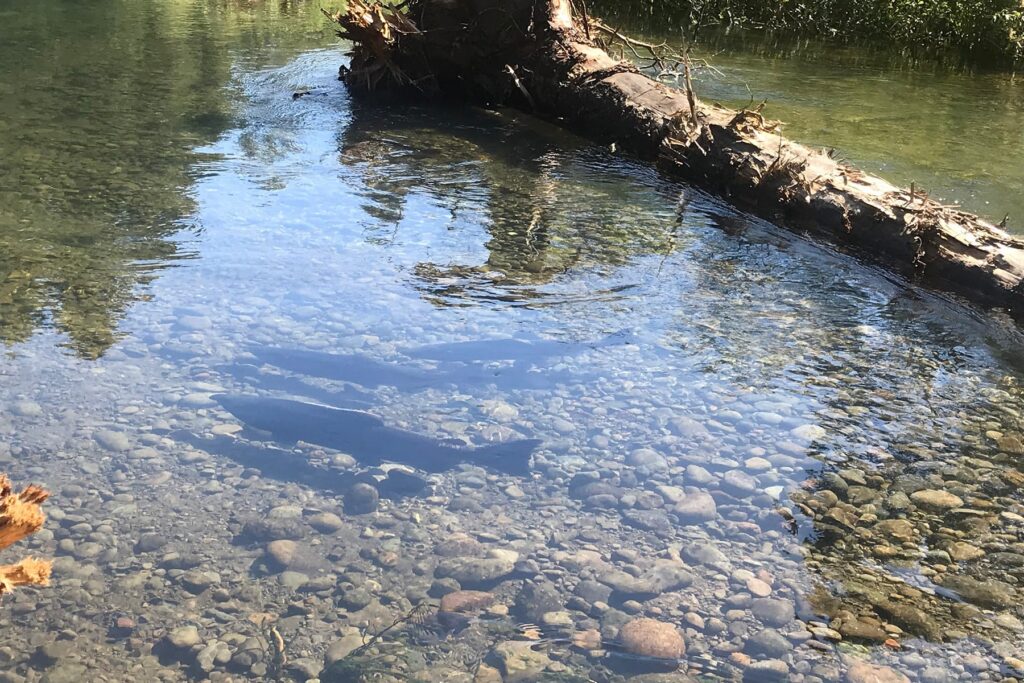
Since the fire, surveys done by the Deschutes Partnership have found steelhead spawning nests in the restored reach of the creek, creating hope that salmon and steelhead will continue to utilize this habitat.
“We had a feeling of hopefulness, that the restoration we did was worth it,” says Knight. “It spared this floodplain and this habit that we’re trying to create—for anadromous fish, and for resident fish and all the wildlife.”
It echoes similar work being done in the bioregion. In the McKenzie River watershed just over the Cascade Mountains, the 2020 Holiday Farm Fire scorched more than 173,000 acres. But when the fire passed through a Stage Zero restoration project created to improve fish habitat and water quality on the South Fork of the McKenzie, it only burned in patches. This allowed wildlife to find refuge, High Country News reported. In some parts of the project area, the braided floodplain actually served as a firebreak, providing a vital break for wildlife, too. A USFS camera trap captured a blue heron fishing in this reach during the fire.
“We’ll see more fire and drought, but with these restoration projects, the same amount of water is able to support a lot more.”
Mathias Perle
As wildfires continue to test these kinds of river restoration projects, people are taking note of their benefits. According to a recent report from the Forest Service, which highlighted work on Whychus Creek, restoration that helps keep more water on the land can increase fire resilience. “Intact wetland complexes and streams connected to their floodplains can better withstand wildfires, provide refuge from fire for fish, wildlife, and plants, then capture ash and sediment following wildfires,” the report found.
These projects not only create refugia, but could also be a proactive tool to aid in wildfire and forest management by providing “wet fuel breaks” that function as control lines during prescribed burns, or could slow or stop wildfire progress.
This is likely welcome news across Oregon, which suffered record low snowpack this winter and is facing severe drought and increased risk of wildfires this summer. Additional phases of restoration efforts are underway on the South Fork of the McKenzie and planned for Whychus Creek, both of which can marry salmon recovery with wildfire mitigation.
“It’s interesting to see these landscapes become more resilient to climate change,” says Perle. “We’ll see more fire and drought, but with these restoration projects, the same amount of water is able to support a lot more.” And that offers hope for people, plants, and fish—all weathering a hotter and drier future together.