
If our world is indeed on fire, how then might we reach a critical mass of understanding about what we need to know, to collectively and consciously shift course? What’s the best approach to communicating with expertise, clarity, and inclusion about the most urgent topics of the day, to catalyze deep structural change from within without being didactic or dumbing things down?
That’s what Faye Cox, a longtime systems changemaker based now in Santa Barbara, California, envisions for her publishing company, Hourbooks.
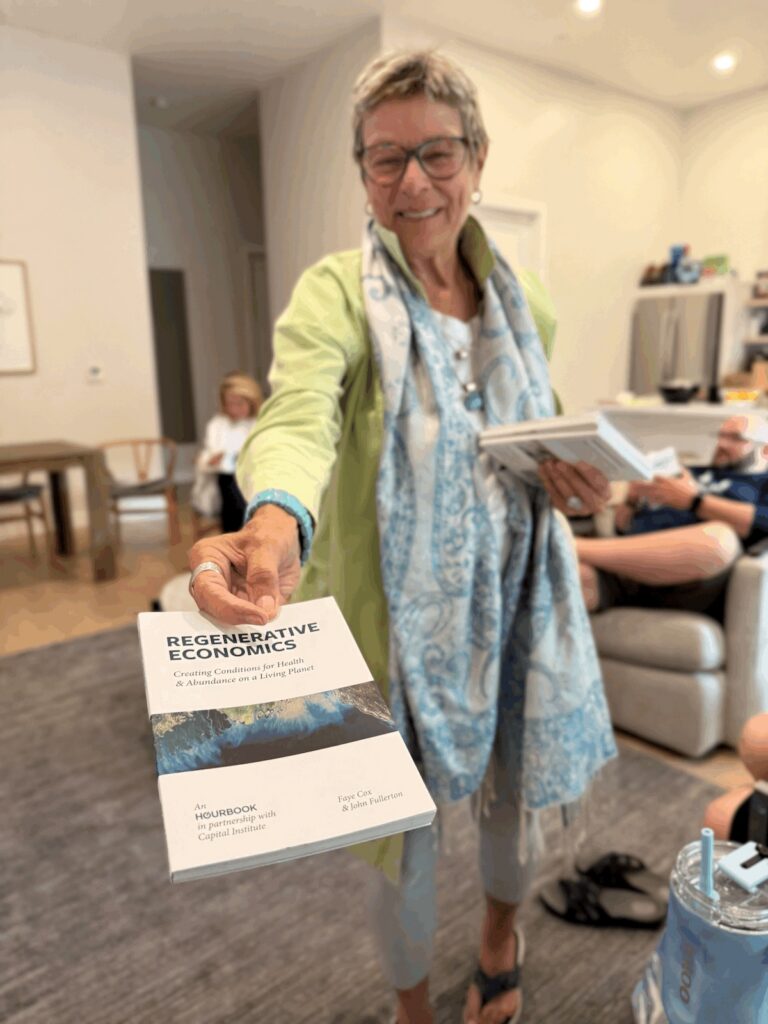
The mission: to create a series of books that make transformative knowledge widely available at a time when we are facing critical challenges that threaten life on Earth. The hope: to deliver millions of printed books directly into the hands, minds, and hearts of strategic readers—not as commodities but as gifts.
“Everything exists in relationship,” she says, “yet our modern human systems remain rooted in an outdated mind-set of separation. So many are still focused on parts rather than the whole, when what’s now required is learning to think from the whole to the part.”
Learning to think from the whole first, then the parts. What would our human systems be like if they were grounded in that worldview? That’s what Hourbooks is attempting to do, to work with leading organizations to co-create a series of books on necessary topics that can be read in about an hour.
“For a topic to become an Hourbook, it has to combine two pillars: one that honors the best of our scientific understanding, and another that honors wisdom from spiritual traditions centered on care for the whole,” says Cox. “Scientific sense, spiritual sense, common sense. Today’s ecological crisis is an opportunity for profound awakening, a time to reshape our human systems in alignment with how living systems actually work. Transformation begins with informed, engaged communities, and books remain the ultimate means for education and change.”
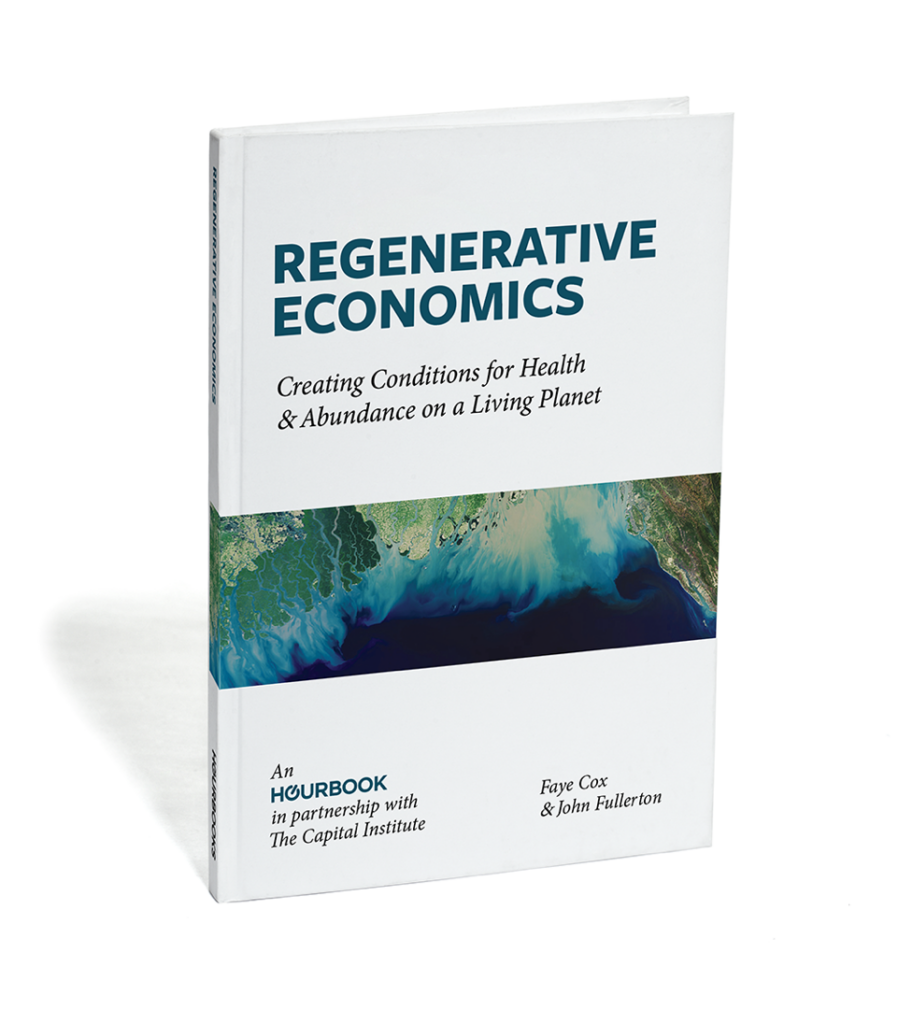
Magic Canoe caught up with Cox to learn more about Hourbooks and about the first book, Regenerative Economics, published last year in partnership with John Fullerton and our friends at Capital Institute.
Where did you first come up with the idea of Hourbooks?
A pivotal event in my life was meeting Willis Harman in 1995, at a Rebirth of Business Conference in Vancouver, British Columbia. I was engaged in creating an art and retreat center at the time, but I followed a strong inner sense about how the economy must be in good relationship within an ecosystem—how economy and ecology actually fit together. Later I learned that the “eco” in both is from the Latin oikos meaning “home.” So knowledge and management of our home must go together.
I was moved to tears as Harman spoke. He said so beautifully what I’d sensed at a deep level. I had an opportunity to meet him at the end of the conference, and he turned to me and said: “I want you to go to these events.” So I did. I went to a retreat where I met Lynne Twist and Bernard Lietaer.
At another conference I met Hal Brill who was instrumental in the early days of socially responsible investing. Hal went on to lead Natural Investments, a thriving company that recently followed Patagonia’s steps in creating a purpose trust. Hal and I started working together as I began turning the retreat center into a learning center for what we described as a “green village” in Christina Lake, B.C. That’s when the concept landed: Hourbooks—books that take only an hour to read about the shift in worldview that we need.
I immediately knew the “why”: to make transformational thinking accessible. I also knew the “what”: small but smart and beautiful books. But I had no idea about the “how.” I had no publishing background—I just knew the idea was powerful. Every person I talked to about it would say, What a great idea. I knew that. But I didn’t know how to do it.
With no background in publishing, I spent several years trying to give the idea away while I worked to change systems, from the “green village” in B.C. to a sustainable living initiative in Santa Barbara. Slowly I realized that without an educated community, systems don’t change, and that Hourbooks was mine to do.
OK, so the “how.” Tell me about the sponsoring gift model behind Hourbooks.
After starting Hourbooks, my core question became, How do we get the most books to the most people to make the biggest difference? I knew that traditional publishing wasn’t the way forward. That would just be joining the fray of trying to capture attention to sell books. I wanted to seed books strategically into communities and networks where real change can happen.
“Without an educated community, systems don’t change, and that Hourbooks was mine to do.”
For six weeks, I sat in front of a birch fire in B.C. with the question. Suddenly, one night, it came. The books need to be gifts, gifted by people who really get the importance of transformation, of this wisdom and knowledge, so that there’s the energy of care and connection. Of commitment to the profound level of change we need. And of relationship and trust.
Robin Wall Kimmerer wrote about the reciprocal energy of a gift in her book, The Serviceberry. There is reciprocity in our gifting model because the people who sponsor Hourbooks are being given a powerful way to share this essential mind-set shift with their significant networks, personal and professional.
Regenerative Economics is your first Hourbook. How’d that emerge?
I had followed the work of John Fullerton for years because we share an interest in a long lineage of transformational thinkers such as Donella Meadows and Buckminster Fuller. So when I saw he was teaching a course on regenerative economics, I signed up for his Capital Institute course. During one session, he spoke about the work of Bernard Lietaer, one of the designers of the euro and a man who profoundly understood money. He co-wrote a book called Money and Sustainability, which I helped edit.
We connected over this love for Lietaer’s work, and I shared Hourbooks with him. He totally got it. We agreed that I would create the first Hourbook based on his writings and the course. It was truly an act of co-creation. It was not just an “hourbook”; it’s our book.
It took two years to craft the design and template and to hone the accessible and clear language that will now be hallmarks of all future Hourbooks to follow. Every Hourbook will have four parts:
- What’s happening now and the old mind-set behind it
- What’s emerging as a new worldview takes root
- What difference does it make: stories of what is already happening
- What you, dear reader, can do
Now the template and design are well developed, as is a process to create future books more easily. First, we’ll work with our partner (individual or organization) to outline the content for the four parts, followed by recorded interviews. Our writers will then craft the transcriptions into the Hourbooks. As editor in chief, I’ll oversee the clear language and style. And of course, our partner will have input along the way and the final say.
“Sure, this is a book about economics, but it’s really a book about transforming where we think and see from. We need to learn to see wholeness from wholeness.”
Anything else you care to add?
I believe that the eight principles of regenerative economics John Fullerton distills in his Hourbook, about how life works, can profoundly transform our economic system, which is the key driver of what’s happening on the planet. So that’s how important I feel this content is.
Sure, this is a book about economics, but it’s really a book about transforming where we think and see from. We need to learn to see wholeness from wholeness. This applies to every human system, every way we are behaving on the planet.
Perhaps I’ll end with the last page of the book:
“We may discover that the task of bringing our economic system into alignment with the regenerative process of life is like turning a canoe downstream after a long struggle against the current. When we put our own unique oars in the water with others and paddle toward what we truly desire, we can know that our every stroke will make a difference in the great and evolving web of life.”
Go Deeper:
- Sponsor and gift a bundle of Regenerative Economics
- Sign up for an upcoming course with John Fullerton’s Capital Institute
- Read the eight principles of a regenerative economy.