This feature is part of a six-month series from Magic Canoe’s Contributing Writers. Four writers were selected to each cover Salmon, New Economies, Environment, or Indigenous Leadership. This is the third story for the Indigenous Leadership Desk. Major support for the Contributing Writers Series is made possible by a gift from Priscilla Bernard Wieden, in loving memory of Dan Wieden.
It is September in the Salmon River Mountains, a dozen years ago. The prevailing color of the understory has changed from green to reds and browns and deep purple huckleberries. We try to walk in silence through the riparian area to the edge of the South Fork of the Salmon River, but our steps crunch brown grass, rattle dying Fleece flower. We are near the headwaters, and the river is young here.
My partner, Caleb, is dressed in his uniform. He kneels at the river’s edge, surrounded by dying Salmon and curious fourth graders. Caleb, a fish biologist for the Forest Service, begins explaining the life cycle of Salmon, just as once he explained to me as we lay side by side in the tall grass downstream watching journey-scarred female Salmon pack together nests of small stones—redds—where they leave eggs for warring males to dust with their milt.
I am standing to the side, watching the children’s faces move through wide-eyed awe to lip-twisting disgust, leaning closer with every emotion.
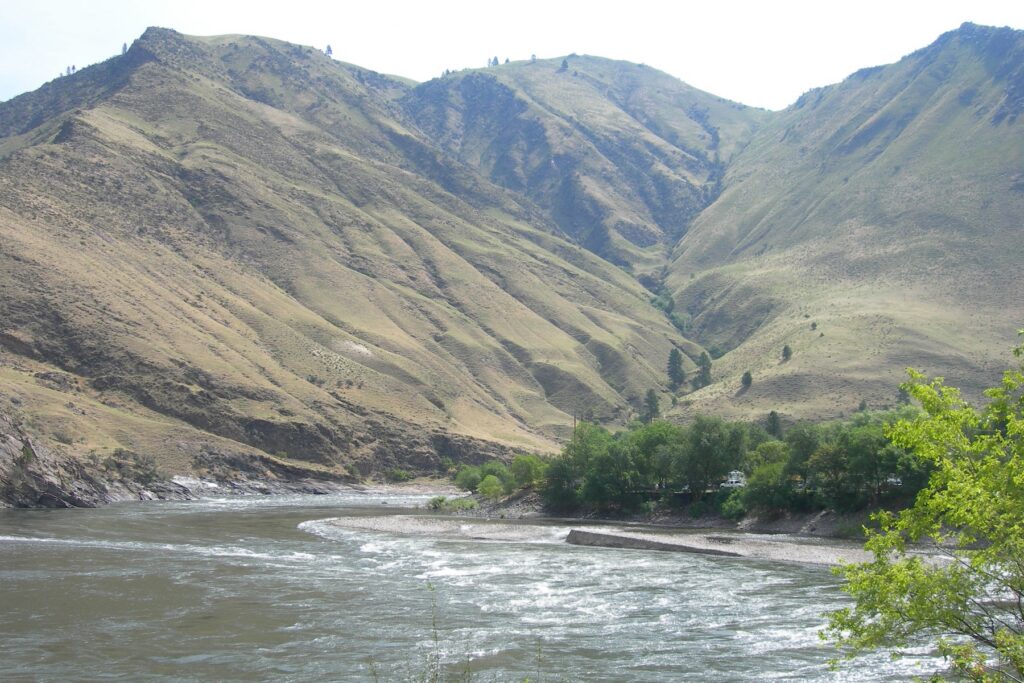
Upstream, hatchery workers are collecting eggs from females who have not quite spawned out. The children have not yet witnessed the club. Neither heard the sound it will make nor watched the knife draw a thin line through the belly and how the carcass is tossed into a bin with other Salmon who will be scattered along the river. In spring, young Salmon will be released here.
Caleb is explaining Salmon’s life cycle to the children when a young girl points and exclaims, “Look!”
Every face turns downstream as another face turns toward us: a young Black Bear, coming to feed. The children tighten their circle around the adults. Their faces are pure delight. Mouths open. Smiles they could not contain if they tried. These mountain children have likely seen Bear before, if not in their backyards, then along another river or lake, or ambling away from beside a road.
Bear regards us only momentarily before walking to the river’s edge, then pausing as any discerning eater might. She gently takes the large body of Salmon into her mouth, turns, and walks back through thick alder into the tall pines.
I watch Bear disappear and think about what her body will carry into the forest. How her waste becomes food for the tree and plant community. How Salmon travels farther than any of us will that day.
To be in relationship with place, to love a river, to know her moods and migrations, does not make that river yours. Relationship is not ownership. But it is obligation.
This is one of the longest migrations of Salmon in the lower forty-eight. These beings have traveled 750 to 800 miles to reach this place in the river. They are miracles. Their bodies change from freshwater to saltwater, then, without pausing for a single meal, carry nutrients like story back from the Pacific Ocean to leave in the gravel.
Then Bear, who carries Salmon into the forest, shares her gifts among beings that may never leave this subalpine terrain. The body of Salmon becomes the body of Bear and birds and the fat red grouse Whortleberries we press to the roofs of our mouths as we walk away from the river’s edge.
As the students climb back aboard the yellow bus, fingers stained and nose full of the smell of autumn, I think about the stories they will carry home. The way Bear carried Salmon. Not as data, but as experience. The way they will relive their day at supper tables. How they will describe Bear to siblings, and whether they will dream of the sound of the South Fork. Some of them, years from now, will remember the awe or the science or both. Others will have abandoned the memory entirely.
I feel the distance between myself and Bear, myself and Salmon, myself and River as something other than time. It is not measurement so much as quiet understanding. Western science would explain in language with phrases like nutrient transfer, allochthonous inputs, and ecological vectors—and these phrases explain a lot, but they don’t touch on the moment we shared nor the intimacy of lives becoming other lives.
The spawning grounds of that fall morning in 2013 live in the traditional homelands of Nimiipuu, Tukudeka, Shoshone-Bannock, and Northern Paiute.
This morning, a dozen years later, I found myself curious. Curious about the intersection of languages at this place and about what relationships might be held in the first words for Bear, Salmon, River. So I went searching.
I found several different dictionary entries. I found websites, both tribal and non-tribal, that offered names and definitions. But something felt wrong. I closed the books. The browsers. I have learned some Nimíipuutimpt through years of study, through relationship and invitation. But this is different. I was tempted to bring these words here the same way I returned to the memory of that morning, and though this story is mine to tell—I was there, I know Caleb, I watched the students—the words are not mine. They live in history, story, cultural context, carried even in DNA. The word, like the knowledge, belongs with the beings who tend it.
I am Indigenous, but not to this region. Not in the way Salmon is. The way Tukudeka, Shoshone-Bannock, Northern Paiute, and Nimiipuu are. I know what it means to have language taken. And what it means to have it returned. And I do not believe respect always means leaving a word unspoken. Languages live because people speak them. But speaking requires invitation. Indigenous knowledge does not become mine simply because I recognize myself within a larger Indigenous world. Kinship is not entitlement.
This distinction matters. We live in a time where all the information we constantly hunger for is at our fingertips. Where a word that exists in a dictionary, a published story, a teaching cited, hangs like the berries we pressed to the roofs of our mouths. Ours for the taking. Yet availability is not the same as invitation. Access is not relationship.
This is not only true of language. To be in relationship with place, to love a river, to know her moods and migrations, does not make that river yours. Relationship is not ownership. But it is obligation. The South Fork of the Salmon River is not mine because I have walked her banks, slept at her edge, and learned her name in another language. She belongs to herself and the people who have tended her since time immemorial. What I carry is not ownership. It is responsibility. And responsibility asks what I am giving back.
Traditional ecological knowledge (TEK) makes the difference visible the way Bear did—not through explanation, but through experience. TEK is more than information about what Bear eats or how Salmon find their way home. It has grown from generations of attention, language, story, song, practice, and responsibility. It is alive because it lives in relationships. Removed from those relationships, like Salmon in an aquarium, knowledge may become data, but it is no longer complete.
Indigenous understanding asks a different set of questions, ones any of us would do well to ask. Not only, What do I know? But also, How did this knowledge come to me? Who has cared for it before me? What responsibilities accompany it? Am I the person through whom it should travel?
These questions matter beyond the river. I ask them of myself as much as anyone. Leaders, teachers, writers, scientists, and others enter communities, institutions, and especially lands carrying the assumption that understanding something gives them the authority to use it. They gather stories and call their extractions expertise. They translate lived experience into reports (even essays) and call it knowledge. Relationship asks more. Relationship asks whether the people who shared that knowledge, the first tenders of that knowledge, remain present in what is made from it. Whether they retain authority over its meaning, and whether anything is returned.
When I return in memory to the South Fork of the Salmon River, I smell it first. Autumn decomposition that will become the gift of spring. I see Bear again and how we all became her students. Bear did not offer us information to collect. She reentered a relationship that is millennia old. Salmon fed Bear. Bear carried Salmon into the forest. And we—children, teachers, biologists, witnesses—drove back down the mountain carrying the story in our hearts and minds and photos. We were permitted to witness the relationship. The witnessing did not make it ours. But it made this story mine. And it offered me something to give back, something to carry forward into this turning season.