
This feature is part of a six-month series from Magic Canoe’s Contributing Writers. Four writers were selected to each cover Salmon, New Economies, Environment, or Indigenous Leadership. This is the fourth story for the Indigenous Leadership Desk. Major support for the Contributing Writers Series is made possible by a gift from Priscilla Bernard Wieden, in loving memory of Dan Wieden.
This morning I woke in the belly of a cloud.
I had fallen asleep there, too. All night the fire lookout was a small glass egg on the bluff of the ridge.
And though this is perfect weather for a warm fire and hunkering in, I wanted to go outside the lookout and wander, as if I had been granted agency in a dream. I wanted to walk down the trail whose line dissolved into the mist. And so I slid into warm gear, tightened the laces of my shoes, and stepped out into the cloud.
I can see only as far as my arms extend. And what I know is the shape of the ridge. I know that I won’t walk off a cliff, and that to stray a few feet from the trail, giving it to the mist, races my heart. I am not scared. My feet know this mountain. And this mountain knows them.
Several years ago, I was hiking a trail that is a stone’s roll down the mountain from me. Thirteen women and I were walking along the South Fork of the Salmon River. Late July. One of the women asked if it was okay to step off trail. To walk among Ceanothus and Arrowleaf Balsamroot rather than merely alongside them. My friend, Sapóoq’is Wíit’as—Ciarra Greene—is a Nimiipuu woman whose ancestors have walked these ridges for generations beyond counting. She answered, “The Earth loves the feel of your feet.” The woman relaxed, thanked Ciarra, then stepped off the trail. Gently and with purpose. As if onto a rock that crosses a river. We all smiled at her and watched her curiosity lead her from one rooted being to another, each step as carefully placed as the first.
Later that day, when we arrived at the meadow where we would camp, each woman found her place on the flat and set up her tent. Then they were off. Some along the trail that led to the river, some to a small ravine where a stream toppled over rocks, and others simply walked around this place that would be home for a few days, letting their genius guide them.
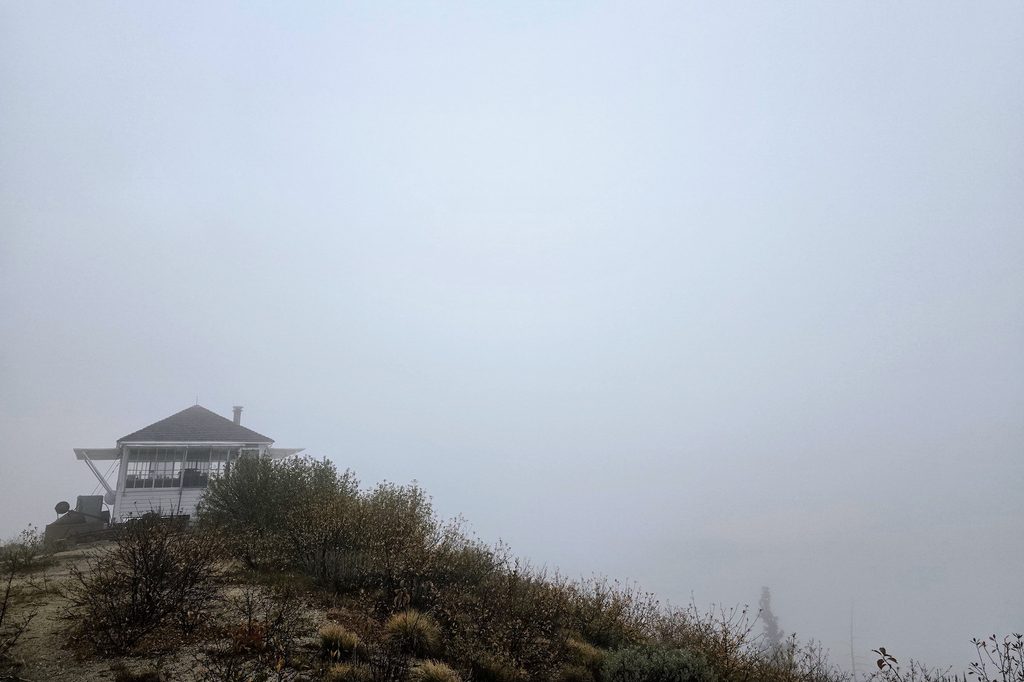
This morning, I am guided by my genius. My spirit. My curiosity. When my view is reduced to the next step and not even a lamp would illuminate the one after, faith returns. When my pant leg brushes the dry leaves of the Arrowleaf, the moist air holds the scratch of their reply a beat or two longer than a clear day would allow. Two seconds of Junco birdsong arrive and are gone, and then it’s quiet again, save for the wind, which reminds me that the cloud, too, breathes.
As I continue, dew gathers on my bare face. I run my hands over my face as if to rub the cloud into me. I am thinking of elders. The spirits of Nimiipuu and Tukadeka and others who walk with me. The spirits of previous lookouts, hunters, and travelers. And even those who have never touched this part of the earth, whose words and ideas accompany me everywhere—on translucent strands of memory or perhaps on the wind—arrive. I gather them around me like tendrils. I hold them like a conch to the ear. Like a hand over the heart. I am never alone.
A breeze rushes by, and the clouds blink open for a glimpse of the mountain, and then she is covered again.
The first night at the lookout, I was startled by the moon. She was huge and terrible and brilliant. Once my breath returned, I sat with it on the steps and watched Moon until she pushed herself free of the horizon and entered the sky the way a body enters a clear blue pool. Even my whole hand could not cover her. Her light spread everywhere and illuminated ridges and peaks, drainages and high mountain meadows. My night mind came to life with memories of trails I walked and trails I had left. Of springs where I filled my cup and drank straight from the earth. Of bear cubs high in a tree and bear cubs bumbling back down, rolling into their mother’s lap and feeding, right there, beneath the Ponderosa they had scaled, the Ponderosa their mother leaned against.
I thought of the many bears I have seen in the last few days. I feel their spirit near me. The spirit of that mama, too. I imagine them passing close, our shapes almost touching, none of us realizing. Only Earth knowing, bringing us close enough that we may inspire each other’s breath and hold inside us a bit of the other.
The second night at the lookout, I was startled by a Cat-Faced Spider. Her brown legs anchoring her moon body, holding her steady in the center of her web. Only a sheer pane of glass separated us, and she was holy in the sky of her making. I greeted her in the old language and asked her to take pity on me. We slept beneath the same roof, but each night she remade her world. I depended on the labor of others. Every night I seek her in her web, and every morning I find her tucked into the eaves for the day. Somewhere in this ritual, I have begun not only to look for her, but to look to her.
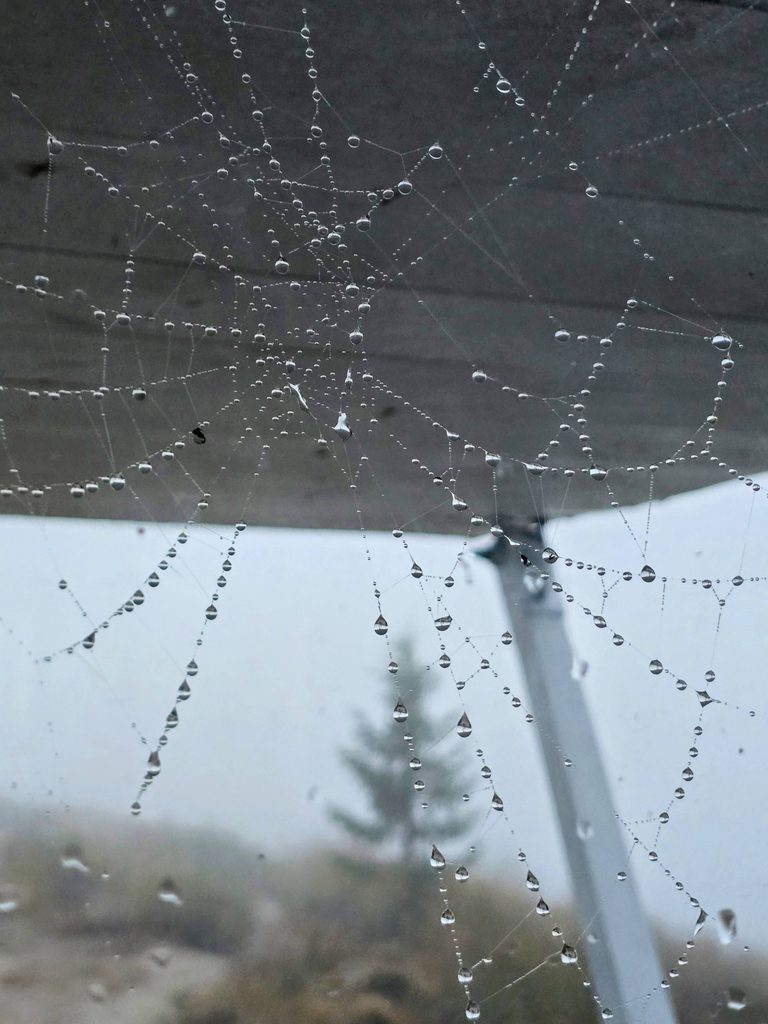
My Nimiipuutímt teacher translates Wéeyekin as “spirit guide.” I have read that Wéeyekin may come as bird, beast, or insect—a guide, teacher, helper, advisor, comforter. I do not know what brought Spider to this particular pane of glass. I only know that somewhere in the ritual of looking for her, looking became recognition.
Many evenings after Spider and I met, I sought her in the night with my headlamp and lit her body and web with its glow. I asked her to watch over me as I slept. To protect this home. A moth flew toward the light and into her web. In seconds, she was wrapped around the moth. I doused my light, slid into bed, and wrapped my blankets tight around me. In the morning, she was back in her eaves, the wind that frequents this ridge having its way with the web she would once again repair at nightfall.
And now I have walked as far as the saddle east of the lookout. I turn and try to see the place where Spider and I live and see nothing, but know that, like the sun and moon and stars and trees and bears, she is there. I turn back around and am knee to cane with Huckleberry, whose leaves are the color of spawning Kokanee.
Somewhere in this ritual, I have begun not only to look for her, but to look to her.
I reach down and touch one, drawing my finger along the finely toothed edge. This year brought drought. A late freeze ruptured the open blossoms, and there were no berries. I hope for grubs and moths to feed the bears before their winter sleep. Nevertheless, I lock my trash away in a metal box. As much as I want to place bowls for all the hungry in this place, I understand what our relationship asks. As my hand leaves the tip of Huckleberry’s leaf, I whisper a prayer into the small, netted veins.
Soon Spider will begin another journey. She will wrap her eggs in a silken cocoon, and then she will die. Her eggs will hatch in spring, and the young spiders who survive, carrying her DNA, the moth, and whatever memories we share, will ride these winds on silk until, at last, they land and make a new home. I do not know what will become of her body. Will it disappear? Fall to the ground to be found by Juncos who flit among the chokecherries? Or will she hang from the sky of her web, like Moon that first evening? I am being so very much my human self when I say that I will want to hold a wake, make a memorial, offer her a burial—and then I remember the moth.
I do not know how far I have walked from the woodstove and bed and windows that make my home. But I know it is time to turn around, to return. I slide my hands into my pockets and pull up my hood. Even though I will not be able to scan the slopes and ridges today, there are still reports to give, forecasts to copy, and books that await me. Eventually, my feet find the trail and the way home becomes obvious.
Before I reach the door, I stop and study the ground. I recall how, a few days ago, I pressed the tip of my finger into the granite and watched it crumble before me. I watched it come apart. This mountain, too, is evolving. Loosening into glittering gravel, her feldspar and mica coming free. The mountain’s flesh is sloughing away, just as my own is—thrust into daylight and beginning to transform the moment rain, frost, lichen, and air touch us. Even if I had deep roots to hold me tight to this place, the eons would eventually wear us both away. As I stand here on her skin, I wonder what I feel like to the mountain. Or if the feeling is less about weight and more about knowing.
I recall a Haida teaching I once read, words that have stayed with me: Earth has eyes and ears and is always watching. Everything is watching. Everything remembers. I hold this admonition alongside Ciarra’s blessing. I hold them like the hands of ancestors and elders, as if I am reaching across a drainage, taking a hand, and offering one to those who come behind. And I offer them downwind and downriver and down these ridgelines to the machines dragging machines up the mountain, even through the fog, to tear unnaturally at her skin. I offer them to decision-makers and agencies entrusted with the care of this place. And I offer them to those who protect her. I want to tell them that Earth knows your feet and will recognize you.
I recall a Haida teaching I once read, words that have stayed with me: Earth has eyes and ears and is always watching. Everything is watching. Everything remembers.
I step through the door and back into the lookout. The woodstove is still warm. The books are as I left them by the bed. I shrug off my jacket and lay it over the chair to dry.
The first night at the lookout, Moon startled me. She was huge and terrible and brilliant. She was not held by the horizon. She pushed herself over it and spilled her light on this mountain, as Spider would later knit her world again in darkness.
Each evening, I look out through Spider’s web for Moon and the stars, for storms when they come and the lightning they bring. In the morning, Sun will warm this cabin. As the sky clears, I will watch water dogs chase each other up the drainages and back into the sky. All around me, the ridges will lift their faces from the cloud.