
As my neighbors in South Eugene, Oregon, prepare to gather for our annual summer block party, I can already hear the conversational drifts: triple-digit temperatures, suffocating wildfire smoke, the best places to get heat pumps and air conditioners, the possibility of water restrictions.
It feels almost inevitable, the litany of exasperated voices and sweating faces, portable chairs grouped in conifer-shaped shade, words volleyed over warming beverages, melting ice, disintegrating coasters.
The thing is, we don’t plan these conversations.
But we have them every year.
Because.
August.
As a geographer and glaciologist who has spent more than two decades studying snow and ice across the world’s coldest landscapes, who was born and raised in the Pacific Northwest, who dreams in the language of glaciers, I’ve begun to see these annual conversations differently. I’ve come to realize that, for snow- and glacier-fed landscapes in this bioregion, August is the season of climate change.
I grew up through the 1990s and early 2000s when global warming melded gradually into climate change; when prime-time news was filled with universalizing stories of hurricanes, floods, wildfires, and heat domes; when the growing internet was deluged with images of the irreversible transformation of coral reefs, tropical forests, and Arctic sea ice; when experts shouted geographically agnostic predictions of mass human migration and water wars and bleak futures pulled straight from Cormac McCarthy.
I’ve come to realize that, for snow and glacier-fed landscapes in this bioregion, August is the season of climate change.
Eventually, it started to seem like we realized that climate change is not experienced everywhere in the same way—be it extreme weather, irreversible destruction, or war—nor at the same scale or time, and that every landscape has its own climate change season, a regionally specific time when the consequences become so blatant, so untenable, they’re near-impossible to ignore.
For the Pacific Northwest—my beloved landscape of mild maritime weather and dampness and tree octopuses and people with exceptionally specific thoughts about compost, where coffee is a personality trait and dogs loiter in cafés and my neighbor apologizes to his cedar tree before pruning, where everyone knows someone who works remotely, where sharing salmon facts over a local brew is celebrated, where many can’t afford an apartment but can afford the hybrid they drive to the trailhead every weekend—climate change was something that happened somewhere else. For years, it seemed as if people here talked about climate change more than they acutely felt it.
That has now changed.
By August of this year, or the last, or the last ten, the Pacific Northwest had reached its limits. The air, land, water are at their warmest. Rivers, streams, and lakes are at their lowest, just as farms, gardens, parks, and moss need more water. Demand for electricity surges as people power on new air conditioners. Salmon struggle as warming water increases metabolic demand while reducing available dissolved oxygen. Hillsides turn brittle, wildfire danger looms, and lighting up a BBQ can feel less like a community potluck and more like pulling the pin on a hand grenade.
This is today’s Pacific Northwest.
As a glacier scientist, when people tell me over sweating beverages how they don’t remember this kind of heat, this much wildfire smoke, or needing air conditioners in their childhoods, I can’t help but think—these are glacier stories. Because, by August, nearly everything we’re bemoaning is about a winter that wasn’t.
August is when the Pacific Northwest runs out of stored cold.
___
As a gangly kid growing up in Salmon Nation, August used to represent my moneymaking hay season. I’d hire myself out to farms across Pierce County, Washington, sometimes working up past Eatonville in Ashford, or other times down by the water in Puyallup or Olympia. At thirteen or fourteen, I drove tractors or stacked hay on slow-moving trailers, racing to build neat Tetris-like lines before the next bale was hucked at me. I found it deeply satisfying, physical work.
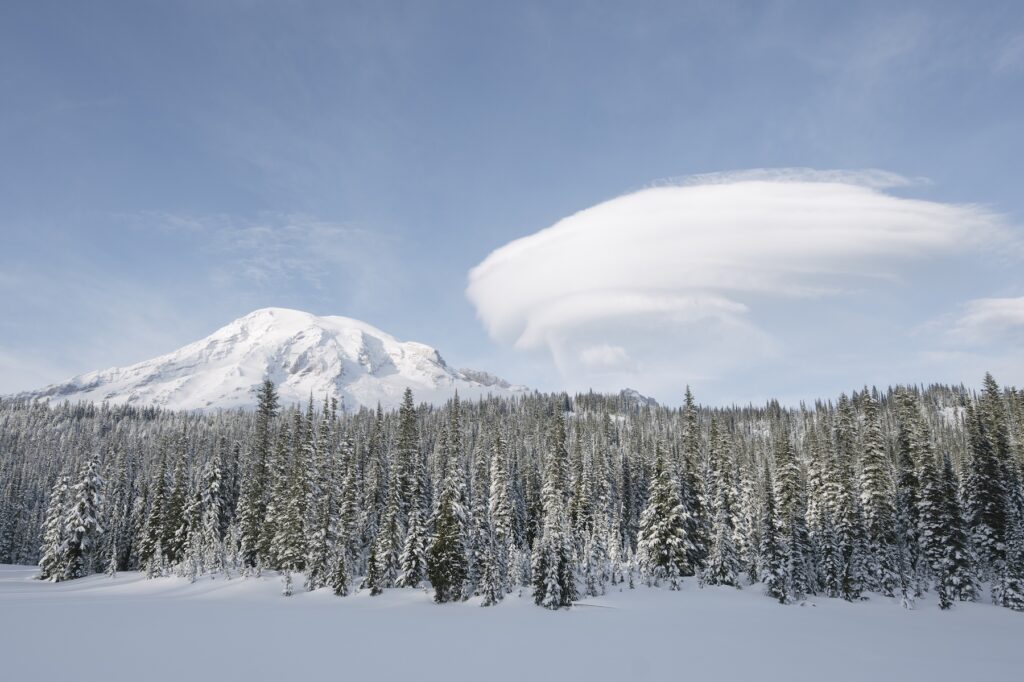
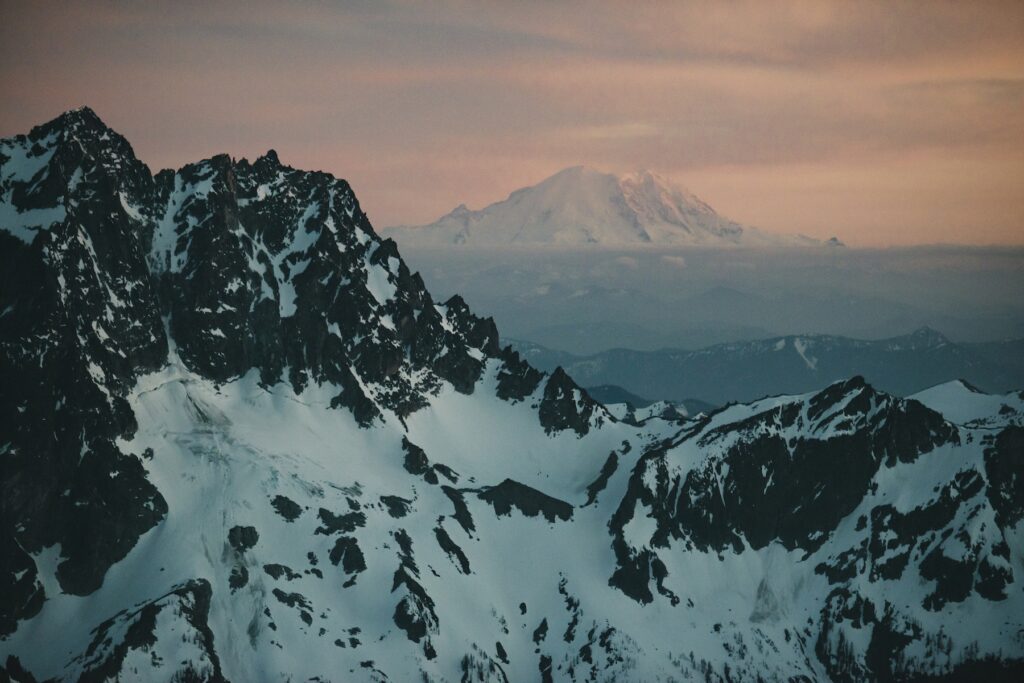
What I remember most, though, isn’t the piles of cash or sore muscles. It’s the evenings. All that long light, golden-flecked and shimmering with chaff and pollen and midges and gnats. When the work was done, I’d climb up the haystacks, make a bale couch, and rest, ensuring almost always that I pointed my feet at that sentinel of the Pacific Northwest: Mount Rainier. From nearly every farm I worked on, the mountain filled the horizon.
I would stare at the mountain’s cool rivers of snow and ice: the Kautz Glacier, Nisqually, South Tahoma, Carbon, and North Mowich. Had you asked me back then, I couldn’t have told you the names of those glaciers, let alone what a glacier was. I was just a kid who liked snow and ice, who looked for occasional glints of blue, and who, when she saw them, was comforted. The white shoulders of the mountain felt permanent, as much a part of my home landscape as the Douglas firs and blackberry brambles and salmon rivers. All part of what it meant to live in this landscape, to belong here.
Today, I can now close my eyes and summon the names of all twenty-eight of Rainier’s glaciers, tell you how they feed five major water systems: the Carbon, Puyallup, White, Nisqually, and Cowlitz Rivers. I can counter any of your salmon facts with glacier facts, how the Carbon Glacier is the thickest glacier in the Lower 48, how it has such an insulating layer of debris covering its snout that it has survived much longer than my colleagues thought possible. I can tell you that the Emmons is the largest glacier on the mountain and that somewhere on its lower flank is probably still a pink-knitted mitten I dropped there in my twenties. I can even tell you why schoolchildren love the Fryingpan Glacier (it has to do with the name), even as many scientists debate whether it has become too small, too stagnant, to be classified a “glacier.”
This is part of what I think it means to live here, in this glacier landscape.
Hopefully all of us living here care enough to learn the bioregion’s toponyms. Understand that not just the ice, but also many of the region’s place-names were assigned by nineteenth-century surveyors, explorers, and USGS staff, honoring themselves or people who had little to nothing to do with the actual glaciers—or rivers, mountains, trees—often blatantly disregarding Indigenous names or ecological characteristics.
One glacier example I often point to: the Kautz Glacier. Named after August Valentine Kautz, a U.S. Army lieutenant who was part of an unsuccessful 1857 expedition to summit Mount Rainier. While the expedition was led by a Nisqually guide named Wapowety, the landscape is not labeled in his memory, but rather Kautz’s, with a glacier, a creek, and the famous Kautz Route climbers take to (hopefully) achieve a summit he himself did not reach. All on a mountain called Rainier, and also Tahoma, depending on different Coast Salish traditions.
Alongside learning the names, part of living here might also ask that you develop an opinion on when and how to count glaciers. On Mount Baker—Koma Kulshan—arguments center on whether there are thirteen or eleven glaciers. The Hadley and Sholes Glaciers don’t descend directly from the summit, so perhaps they shouldn’t be included in the tally? Thoughts?
When I was an undergraduate at Western Washington University, in Bellingham, August hikes up Baker’s flanks were an annual ritual. Baker receives some of the deepest snowfall in the Cascades, burying its top and sides beneath some six hundred to nine hundred inches of winter snow. Fellow students and I would wait to hike up until August, when the seasonal snow had melted away, to sneak glimpses of the blue ice beneath.
Another part of living in a glacier landscape is taking a “wow-stop” when the glaciers are “out.” I admit to being that person holding up downtown Seattle traffic on clear mornings just to catch glimpses between the skyscrapers of the Olympic Mountains. If you squint west over the Puget Sound, you might see clusters of more than two hundred glaciers and perennial snowfields clinging to near-vertical mountainsides. They’re stunning.
The roll call of Olympic glaciers feels good in the mouth. Try it: the Blue, Hoh, Hubert, and Black Glaciers on Mount Olympus, or the Anderson, Queets, Cameron, and Eel Glaciers on other peaks.
All feeding into one of the largest remaining temperate rainforest ecosystems on Earth via the rivers Hoh, Elwha, and Queets, glacial gray waters ribboning through forests thick with trees, moss, lichen, and the eagles and bears who carry salmon carcasses high into the canopy, spreading all those marine nutrients into almost unbelievable arboreal nooks and crannies.
This is living in glacier country.
___
No single place in the Pacific Northwest has a glacier monopoly. Wander around Portland when Mount Hood’s twelve named glaciers are out and you’ll have to navigate strangers and locals, all temporarily statues, faces instinctively turned, staring at the ice. Go farther south beyond Mount Hood, where hundreds more glaciers and snowfields spread on and around Mount Jefferson, the Three Sisters, Broken Top—and even way out in the Wallowas of eastern Oregon. Regional maps—be they physical, political, climate—make many of these glaciers seem separate.
But they aren’t.
The ice of Oregon connects to the seven glaciers south on California’s Mount Shasta, to the ice sprawl on the Olympic Peninsula, to the thirty-eight to sixty-five glaciers of Vancouver Island, northward to the immense ice systems of coastal British Columbia.
Glaciers, in my experience, rarely recognize boundaries, even all-important human ones. They tend to organize themselves by watersheds, glaciersheds, by elevation, climate, slopes, mountain systems. Their meltwater flowed freely across borders long before we drew them, long before we decided what it meant to live in the Pacific Northwest, before we realized our rivers, forests, fisheries, farms, cities, and late-summer conversations were all connected by ice.
Even in Idaho, a state many argue is, or is not, part of the Pacific Northwest.
Last February, I was in Boise giving a glacier talk and I found myself stumbling into a spirited public debate over whether Idaho could still claim to have a glacier. Much of the state was coarsely sculpted by massive flows of ice during the last ice age—just like much of the Pacific Northwest. But today, Idaho is right on the climatic margin of glacier livability. A remnant of those gigantic glaciers sits tucked beneath the north face of Borah Peak, a tiny patch of unnamed ice (possibly) still flowing under its own weight.
Perhaps she’s alive.
Maybe?
Miracles happen. Even in glaciology.
Before the 1980 eruption of Mount St. Helens, the mountain housed eleven named glaciers. But the collapse of the north flank destroyed some outright—remember here the Loowit and Leschi—and ripped apart the bodies of several other glaciers. By the time the eruption quieted, some 70 percent of the volcano’s glacier ice was gone.
But then something utterly remarkable happened. In the deep, shaded-sheltered crater left behind after the eruption, right where avalanches continuously and forcefully deposited fresh seasonal snow, in the exact place that perhaps one or two glaciologists on this planet might label a “nursery,” something took shape.
A new glacier began to grow.
It took decades. But eventually, snow survived long enough to transform. To grow, to flow.
Welcome to the Pacific Northwest, Crater Glacier.
Between 2009 and 2019, the Crater Glacier grew some 13.8 million cubic meters of ice and advanced hundreds of meters. As one of the youngest known glaciers on Earth—younger than many of the people who today climb Mount St. Helens—I think there should have been a global celebration for her first steps, her first crevasse, her first journey around a lava dome. At the very least, she should have an annual birthday party.
Alas.
Of course, one growing glacier does not herald the return of an ice age, nor disprove climate change. But, in my lifetime, in my own regional backyard, it does signal something marvelously wonderful: We have a new glacier. If you haven’t realized: I’m squarely on Team Crater Glacier.
___
This is where it gets hard.
Here’s how the Pacific Northwest is supposed to work—at least, in times not shaped by climate change.
Each autumn, Pacific Ocean–fueled storms arrive. Rain heaves across the lowlands while snow accumulates in the high mountains. Through winter, the snowpack thickens—layers and layers of snow.
Come spring, while a lucky few snowflakes begin the journey of transformation to glacier, the rest melts. Rivers surge. Reservoirs refill. Hillsides ooze with soils saturated with groundwater. The entire Pacific Northwest seems to squish underfoot, our jaunty waterproof layers woefully inadequate.
Then, summer. And a lushness: in the land, the people, the berry-stained mouths of children.
And then, August.
By August, seasonal snow has largely melted from lower elevations. Storms give way to bluebird skies, weeks without rain, rivers whispering. Lakes shrinking. Forests transpire. Gardeners water their hostas, tomatoes, even the moss. Salmon abandon warm main rivers to crowd into tributaries and groundwater seeps, searching for water just a few degrees colder.
Everything needs more water.
Everything needs more cold.
And, in ordinary times, they get it.
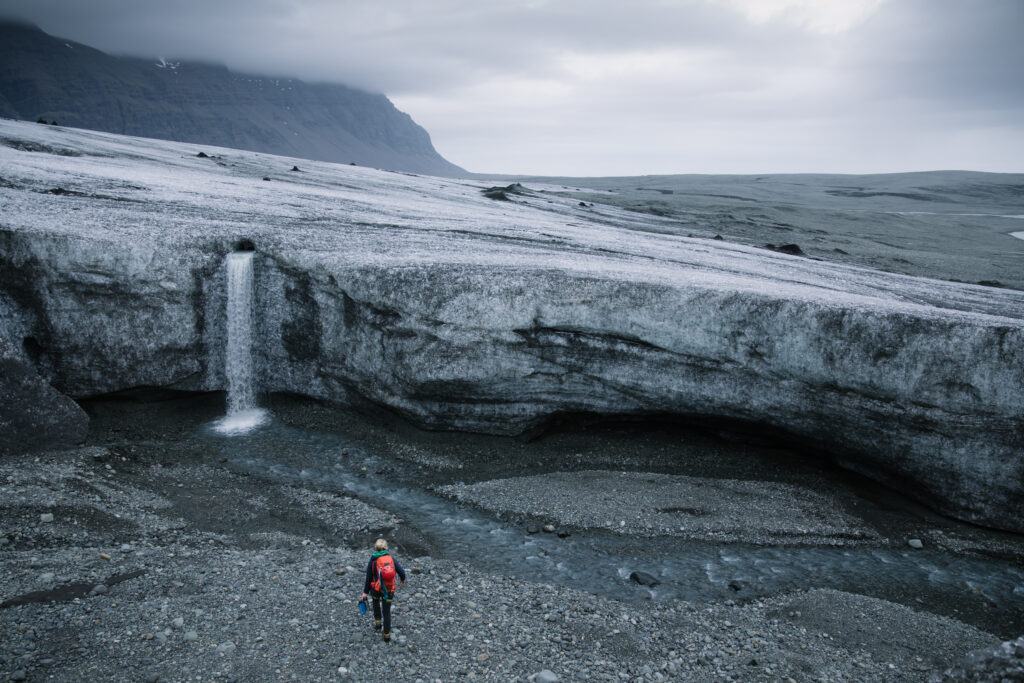
Snow and ice release as meltwater, as cold. Here’s what I find remarkable: All that meltwater wasn’t just from the previous winter. It was often from snow that fell years, decades, even centuries ago, snow that fell, became glacier, flowed downhill as a body of ice, and eventually released into the landscape as cold, as melt.
Pause there for a beat.
What glaciers hold is not simply water. They hold cold.
Seasonal snow stores water and cold across months. Glaciers store water and cold across generations.
The larger glaciers of the Pacific Northwest contain cold from snow that fell before my son was born, before I was born, before many of us alive now were born.
___
Jumping back to today. To August.
August is when I think most about glaciers.
Maybe August isn’t the Pacific Northwest’s climate change season. Maybe it’s just another season of reckoning, when all our bills finally come due.
August is when I mountain bike around Oakridge, or outside Port Angeles, or near Bellingham. When I pause beside streams that seem smaller and warmer than they should. When I buy flats of cherries in Hood River for winter jam and think about the water running through the fruit. When I walk through Seattle or Portland with a cup of coffee and instinctively “wow-stop” to see if the ice is out. When I help farmer friends bring in their hay and remember early childhood summers when I stared at Mount Rainier long before I knew the names of her glaciers.
When my neighbors tell me it is getting hotter.
I’m older now. And while it feels as though I’ve spent most of my life working with ice, it also increasingly feels like I’m witnessing glaciers/cold/time drip through my fingers.
In Oregon, the state I live in now, half the named glaciers have disappeared or functionally died in my lifetime. Named glaciers literally losing names from maps, and with them, some of the most powerful architects of Oregon’s landscapes and waters and wonder.
A similar story is unraveling across California, British Columbia, Japan, Mongolia, the Himalaya, the planet—everywhere I go in the cryosphere. I even kicked around glaciers in Azerbaijan last year. Climate change impacts are increasing everywhere, and the land, air, and water are warming.
And yes, every glacier responds differently. Some retreat at the terminus rapidly. Others thin. Some break from the inside. Others linger below blankets of rock or forest or annual avalanche dumps. The details of their stories differ. But their trajectory, increasingly, does not.
This is what I see. This is what I think about. All the time.
But maybe I’m incorrect.
Maybe August isn’t the Pacific Northwest’s climate change season. Maybe it’s just another season of reckoning, when all our bills finally come due.
Here’s how my more bitter self thinks about this: Imagine your water supply as a bank account. Every winter, Pacific storms deliver a paycheck. Some of that water is spent immediately as rain. Some is tucked away in savings as seasonal snowpack, carrying winter into spring and early summer. And a small portion is set aside for the long, long term, accumulating as rich glacial ice/snow saved for years, decades, even centuries.
Glaciers are our retirement, our generational wealth.
For generations, the principal seemed inexhaustible. Glaciers appeared permanent enough that few ever questioned the balance. We all lived ever so comfortably on the interest. But climate change has not only changed the math; it has upended the entire system.
Across much of the world, withdrawals exceed deposits. We are spending a water inheritance accumulated over centuries while simultaneously shrinking the account itself.
This is why August matters.
Not because glaciers suddenly begin melting. (They’ve been melting seasonally for months.) It’s because August is when the rest of the landscape runs out of alternatives. The snow is gone. The rain hasn’t arrived. The rivers are at their lowest. Everything is overheated and there’s nothing to cool it down.
After we’ve spent everything else, what remains?
For thousands of years, the answer was glaciers.
August is when I look up at the sweltering mountains, wonder how much longer that answer will hold.
Dr. M Jackson’s Three Actions:
- Always vote environment over party.
- Learn the name, the details, and life history, of the glacier nearest to you. Share that learning with your neighbor, your friends, your community.
- The next time you meet a curious person, tell them they could be a scientist. We need them.