
This feature is part of a six-month series from Magic Canoe’s Contributing Writers. Four writers were selected to each cover Salmon, New Economies, Environment, or Indigenous Leadership. This is the third story for the Environment Desk. Major support for the Contributing Writers Series is made possible by a gift from Priscilla Bernard Wieden, in loving memory of Dan Wieden.
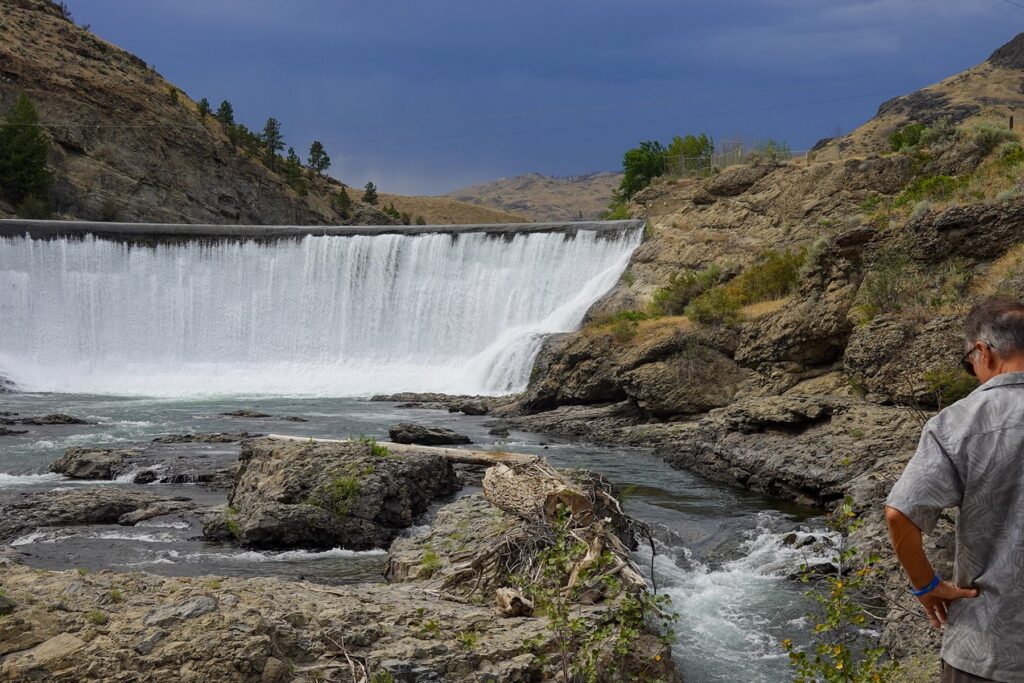
The bottom of Coyote Falls is a churning maelstrom. Thick flumes of green and blue water of the Similkameen River pour over bedrock, tumbling into white-water froth.
Overhead, storm clouds tumble down the valley from the Pasayten Wilderness, north-central Washington State, obscuring the view of Chopaka Mountain, its name a mispronunciation of the Sylix word c̓up̓áq̓, translated roughly as “sticking out mountain.”
This river has sustained life in one of the driest corners of Salmon Nation for generations. To the Lower Similkameen Indian Band, it’s the heart of their traditional territory. The fourteen-foot cascade dubbed Coyote Falls is one of their most important places.
Below the falls, a flash of silver breaks through the white water. A lithe, endangered chinook salmon arcs through the air. Salmon like this one are a big part of why the Lower Similkameen waters below the falls are considered to be of the highest cultural value.
Just a few feet upstream, this salmon will run into a wall. Not a metaphorical one—a physical one. A fifty-four-foot-tall, 290-foot-wide piece of concrete, the Enloe Dam has stood in this narrow canyon for more than a century.
But now, thanks to Indigenous nations, community members, and scientists, that could be about to change.
In the Way
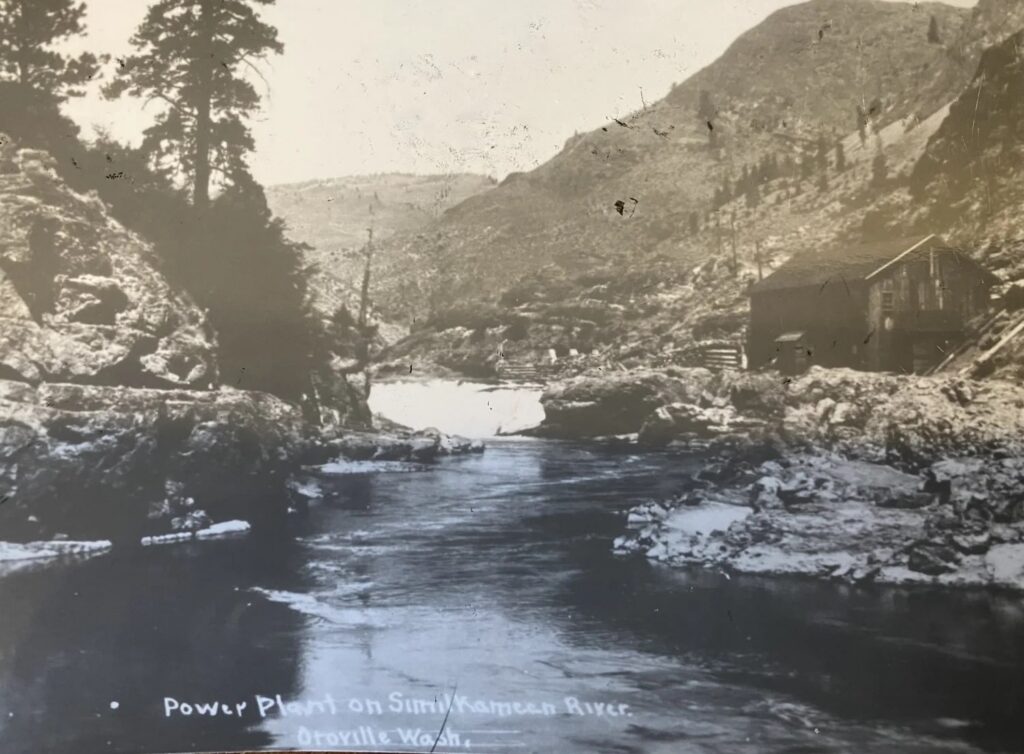
Built in the 1920s to power local mining operations, the last joule of power flowed out of Enloe Dam on July 29, 1958. Locals didn’t notice because they were already getting cheaper, more reliable electricity from the Bonneville Power Administration’s Columbia River project, three hundred miles south. The closure, however, was eclipsed by other big news that day: President Dwight D. Eisenhower announced the creation of NASA, the National Aeronautics and Space Administration.
Since then, Charlotte Axthelm, a watershed analyst with the Confederated Tribes of the Colville Reservation, says the dam has really only had one purpose: “All it really does is block fish.”
Axthelm is part of a team working to remove the dam and reconnect the lower reaches of the Similkameen River to its upper watershed in British Columbia. According to a 2023 National Oceanic and Atmospheric Administration study, this would unlock 1,520 miles of prime salmon and steelhead habitat. That’s more than 160 times the ninety miles of habitat below the dam.
“It’s a pretty astronomical number,” said Axthelm.
Chris Fisher, the Colville Tribes’ lead fisheries biologist, compares it to a road trip. “You could drive from Spokane to Seattle five and a half times to get that same distance,” he said. “It’s a lot.”
But it’s the quality of habitat, not just the quantity, that matters. Roughly a thousand miles of the river are cold-water habitat above three thousand feet (914 meters) in elevation, which is critical for salmon and steelhead survival—especially as climate change reduces average snowpacks and raises summer temperatures. In February, Lauren Terbasket, a Lower Similkameen Indian Band member who works for the band’s Parks Working Group, told a meeting of the Okanagan Similkameen Collaborative Leadership Table that “the water warming trends indicate, we will be looking at an extinction event—in terms of fisheries—by 2040.”
A few months later, the Okanagan Nation Alliance, a transboundary Indigenous organization that brings together Sylix peoples from across the region, issued a “watershed emergency declaration.”
“There is just not enough water in the creeks,” said Jordan Coble, a Westbank First Nation council member and the natural resource committee chair with the Okanagan Nation Alliance. “The fish are running out of the air to breathe, and it’s heartbreaking.”
The good news, Axthelm explained, is that removing Enloe Dam would go a long way toward addressing those issues. “Removing the dam is a major action that can be taken to increase the resiliency of not only the Similkameen itself but also the Okanagan watershed,” she said.
Coyote and Salmon
In June 2015, the Lower Similkameen Indian Band passed a resolution calling for Enloe Dam to be removed. At the time, the Okanogan County Public Utility District (PUD) explored the possibility of “reenergizing” the dam to deliver power to the local community. Reenergizing describes not just turning a dam back on, but also restoring its functions, sometimes requiring significant physical and technological upgrades.
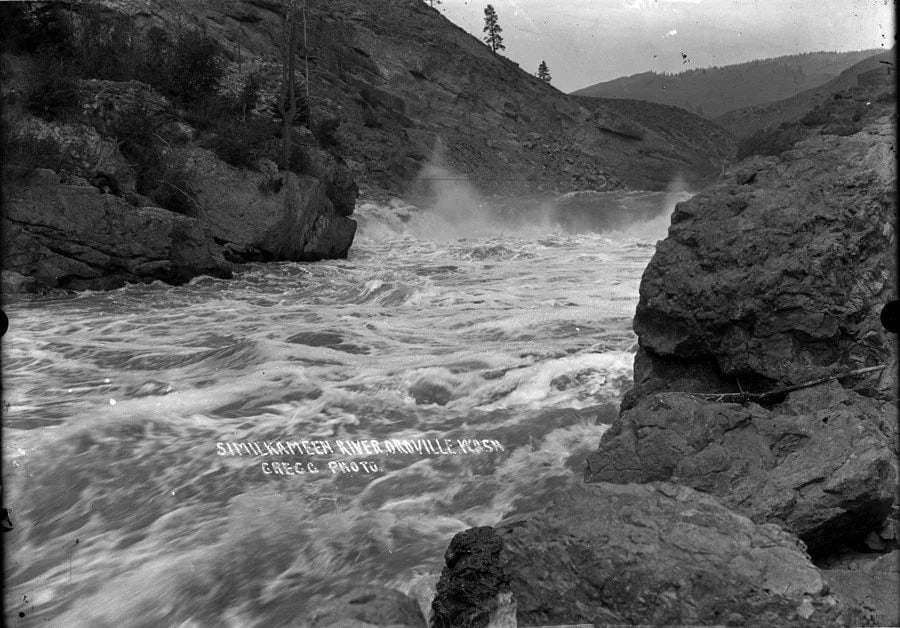
It was the last thing the Lower Similkameen wanted. Enloe had already severed the river for more than a century. The Similkameen and other nations cite a story from their captikʷł, a collection of cultural teaching and oral histories of the region, to recount how these rapids were formed by the trickster Coyote.
Spurned by the Lower Similkameen, Coyote sundered the earth and formed a barrier to block the salmon’s passage. The fish pooled in the rapids’ tall waters, forcing the Lower Similkameen to travel downriver to meet them. The nation still holds a ceremony below the Enloe Dam every spring to meet returning salmon.
Though Westbank First Nation is located in the central Okanagan watershed, Coble still feels connected to the Similkameen through the shared watershed, captikʷł stories, and his work supporting salmon recovery in the region.
“We want to get salmon to the Okanagan, but as we’ve learned, and as our knowledge keepers share all the time, salmon recovery can’t happen without the Similkameen because of the cold water it provides,” he said. “Our traditional stories talk about the Similkameen River and Coyote bringing salmon to the Okanagan people . . . but also that the rapids at Enloe Dam are something that Coyote made to restrict salmon going into that area.”
Those stories are why Indigenous nations have rejected the idea of a fish ladder through the dam, preferring to see the site returned to its natural state—a position Axthelm agrees with. “As a hydrologist and a restoration specialist, removing an obsolete structure from the river because it causes more issues than simply blocking fish is reason enough for me, as a hydrologist and a restoration specialist, to not want to put a Band-Aid on something that could be fully repaired,” she said.
Two years after the Similkameen resolution, the Colville Tribes passed a resolution of their own.
Chris Fisher was officially in the dam removal business. One of his first questions was whether salmon could make it past the rapids. He had heard the captikʷł stories about salmon being blocked, but also had heard about salmon being seen past the rapids.
“We have all of these recorded accounts from tribal members, fathers, grandfathers talking as kids,” he explained. “They remember seeing salmon going over wagon fords [above the rapids]. It was skinny water, but there were fish. There’s evidence suggesting that those fish got over.”
Fisher also had evidence from a hydrological study confirming that salmon could climb the rapids. In 2020, he was sent a video that showed salmon jumping at the foot of Enloe Dam. Reconciling all this fell to a traditional ecological knowledge study. He also learned that some versions of the Coyote Falls story talked about sacred salmon making it past the rapids.
“The ones that clear the dam and make it up there, those salmon are meant to be there,” Coble explained. “They’re meant to spawn in that space, and they’re meant to create stronger salmon for next generations.”
“There is just not enough water in the creeks. The fish are running out of the air to breathe, and it’s heartbreaking.”
Jordan Coble
To fisheries biologists, it sounded like the kinds of regulations they advocated to protect salmon populations. By limiting the catch below the rapids, communities eliminated fishing in the upstream spawning habitat and protected salmon that, by the time they arrived in the Upper Similkameen, were exhausted from their journey.
It’s even more relevant today, since any fish that reaches Enloe will have already passed nine dams on its journey from the Pacific Ocean. Protecting fish in the upper watershed is critical, Chris Fisher explained. Spawning after that journey, he said, is “like asking you to dunk a basketball after you have run a marathon.”
Potential Hazards of Dam Removal
When the Okanogan County PUD’s reenergizing study came back in 2018, they balked at the price tag. Not only would turning back on the dam cost millions, but the electricity produced would come in at $150 per megawatt-hour. That was more than quadruple what local ratepayers were spending on power.
One year later, the PUD passed a resolution scrapping the idea to restore the dam and opened the conversation for its removal.
“I used to say we’d sell [the dam] for a dollar, but now I’d say fifty cents,” Scott Vejraska, an Okanogan County PUD board member, told the Seattle Times’ Lynda Mapes. “I’d take payment plans. Somebody, sign on the dotted line. Just take it from us. Do whatever you want—we will be fine with that.”
But it wasn’t that simple. Some worried that removing the dam could unleash centuries of trapped sediment. There were other concerns about how sand and gravel might affect downstream fish habitat, and whether the silt contained toxins. “[Enloe Dam] was producing power for mining activity, so there was a real concern that we were going to find a lot of heavy metals,” said Fisher.
In 2019, Fisher examined sediment from a few core samples and was shocked to find very few toxins. It was a good sign, but they needed more data. In 2023, Trout Unlimited launched a comprehensive feasibility study that was completed and released earlier this year.
They modeled options for dealing with the dam, from leaving it in place to full removal. Removing the dam, they estimated, would cost between $36.7 and $45.1 million, but after weighing the environmental and economic risks and benefits, they confirmed that removal was the best and cheapest long-term option.
Not only would dam removal restore a free-flowing Similkameen River, but it would also save local ratepayers upwards of $52 million over the next fifty years. Taking out the dam would create 260 local jobs, too, and a post-dam river could generate up to $2.2 billion in “non-market benefits”—a way to codify the value of species, ecosystems, and recreation.
The study also took the contaminant problem head-on, gathering more than a hundred core samples from the sediment beds and testing them for heavy metals and organic compounds.
“The only real contaminants of concern have been arsenic,” said Michael Ward, Trout Unlimited’s project manager and one of the leads coordinating the feasibility study. “We haven’t found any strong concentrations of mercury, lead, cadmium, or copper.”
Arsenic is dangerous, but what they found in the reservoir was at a manageable level, and it was locked up in the silt in a way that kept it largely out of the food chain. What was there, Ward explained, would flush through the system once the dam was out.
“Almost all of [the silt] is going to be transported to the Columbia River in the first freshet,” Ward said, describing the annual spring high-water event when snowmelt floods into rivers across the region. “Within a few years, it would be out of the system.”
Restoring Rivers Across Salmon Nation
Enloe Dam is one part of a broader story about dam removal across Salmon Nation.
Most people know about the Klamath River dam removal, which was finished in 2024, and the Elwha River dams, which fell in 2014. But according to Melanie Klym, American Rivers director of Northwest River Restoration, dam removal is only part of the story.
“Since 1963, the whole restoration community has removed a hundred dams in Oregon and forty-four in Washington that we know about,” she said. “So we’ve got some pretty good momentum.”
Since the early 2000s, Klym explained, around five dams have been removed every year in Oregon, along with two to three in Washington. But that doesn’t mean there aren’t challenges.
In British Columbia, a renewed push for energy development has opened the door to two new mega-dam proposals. Floated earlier this year, BC Hydro is considering dams on the Peace and Homathko Rivers.
In 2023, the Nez Perce, Yakama, Warm Springs, and Umatilla Nations signed an agreement with the Biden administration that progressed plans to remove four dams on the Lower Snake River. But in 2025, the Trump administration pulled the federal government out of that plan, decrying dam removal as part of a “green agenda in the Columbia River Basin.”
While Klym agreed there are challenges, she also pointed out that dam removal on the Lower Snake is still progressing. “The state of Washington actually stepped up and has paid for some of the service continuity studies,” she said. “Planning on what the dam-free Snake River looks like is still proceeding, just without the support of the federal government.”
Removing a ‘Giant Paperweight’
Before joining American Rivers, Klym worked as an engineer overseeing dam removal projects. In that work, she’s seen a shift in how people think about dams.
“There’s a recognition that some eighty-year-old concrete isn’t that old,” she said. “It was an impressive engineering feat for the time, and it solved a need. But I think there’s a recognition that things have changed.” That’s particularly true when it comes to Enloe Dam, a piece of century-old concrete that Charlotte Axthelm described as “not used for flood control, not used for irrigation, not used for recreation, and not used for hydropower.”
“It’s essentially a giant paperweight,” she said.
Add to that the impacts on fish, the financial cost of keeping the dam, and the fact that Michael Ward and Trout Unlimited have “committed to raise the necessary funds if a decision is made to remove the dam,” and you have a strong case for removing the dam.
But the Okanogan County PUD still isn’t convinced. Despite opening the door to dam removal after their 2019 decision, the district board responded to a draft of Trout Unlimited’s study in late 2025 with three pages of concerns. They worried about the cost, project liabilities, and lingering questions about sediment.
“The District’s priority is protecting our community and ratepayers,” a PUD statement explained. “Dam removal projects are a long-term undertaking that can only be successful if community and risk concerns are fully understood and addressed.”
Ward believes that most of their questions will be answered by ongoing evaluation work. But Fisher, Axthelm, and Ward all worry that some decision-makers are still, after all these years, struggling with the idea of dam removal.
“There’s a fear of the unknown,” Klym said. “People know what they have now, and there’s always a question of what the river is going to look like afterwards.”
But Klym believes those fears can be overcome.
“One of my favorite things is to take someone upstream, past where the dam is backwatering,” she said, to be able to show them, “This is your river. It’s still here. It’s just drowned out by the dam.”
This is something Ward does on the Similkameen, taking people above the two-mile-long dam reservoir. There, under the boughs of ponderosa pines, with smells of sagebrush, it’s easy to imagine what a free-flowing river would look like.
It’s even easier to imagine if you’re a few miles downstream on the right day, looking up at Chopaka Mountain and watching salmon jump at the base of Enloe Dam.
–
Editor’s Note: While Fenton reported on this story, the Colville Reservation lightning strikes ignited the Kaiser Canyon Fire near Nespelem, Washington. When Fenton arrived at the Colville tribal buildings, a pillar of smoke was already rising to the east. Thousands of community members have been forced to flee their homes as the fire has spread. If you’d like to support the relief efforts with a donation, you can do that here.