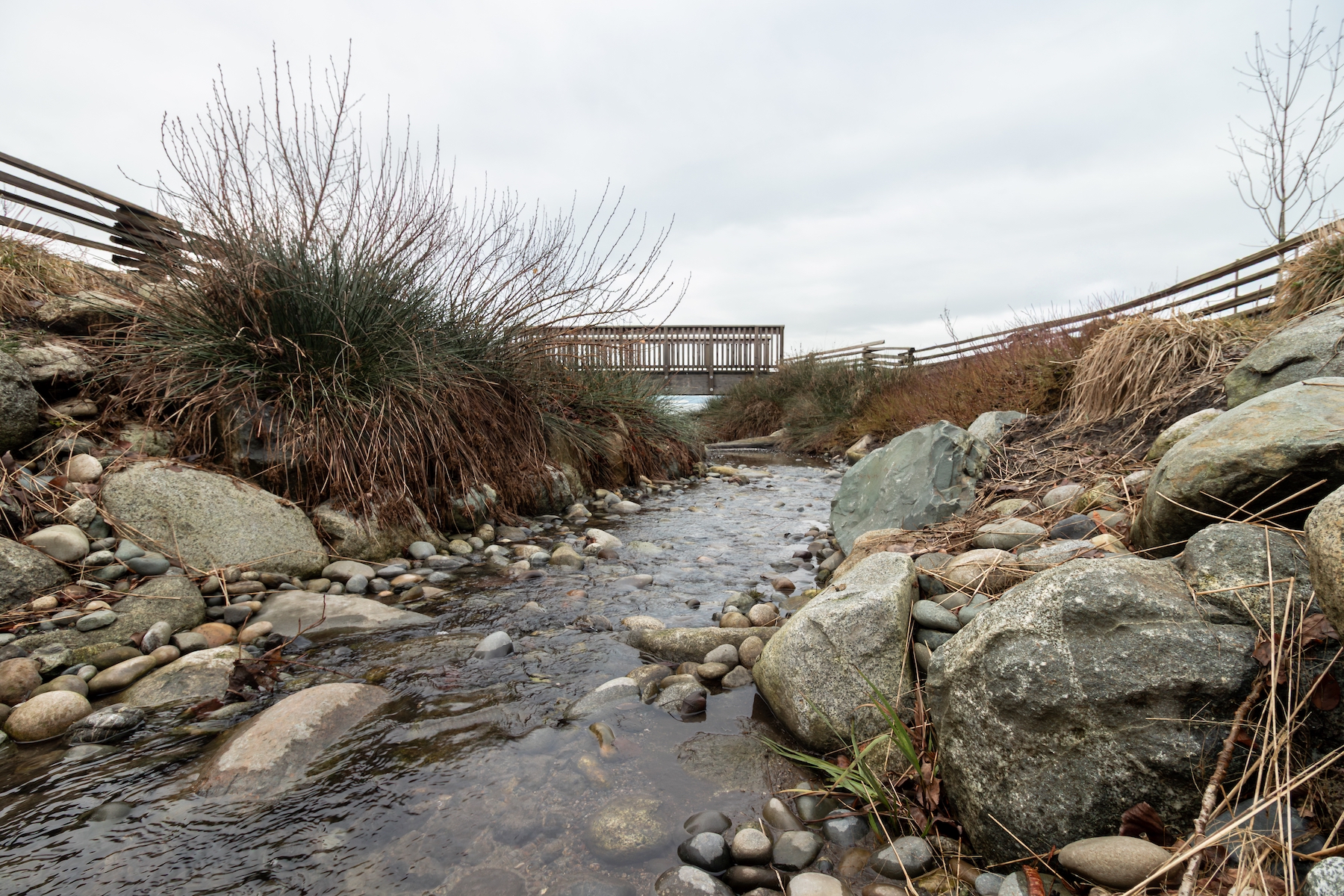
Thirty years ago, Mel Lehan had an idea: he wanted more than anything to bring a stream back to life again. He wanted to “daylight” Tatlow Creek, a stream buried near his home in Vancouver, British Columbia, Canada.
Tatlow was once a vibrant waterway draining into the Pacific Ocean—a creek teeming with wild salmon and trout and surrounded by dense forests of Douglas fir, cedar, and western hemlock—but now it’s nothing but an unremarkable ravine fed with a trickle of tap water.
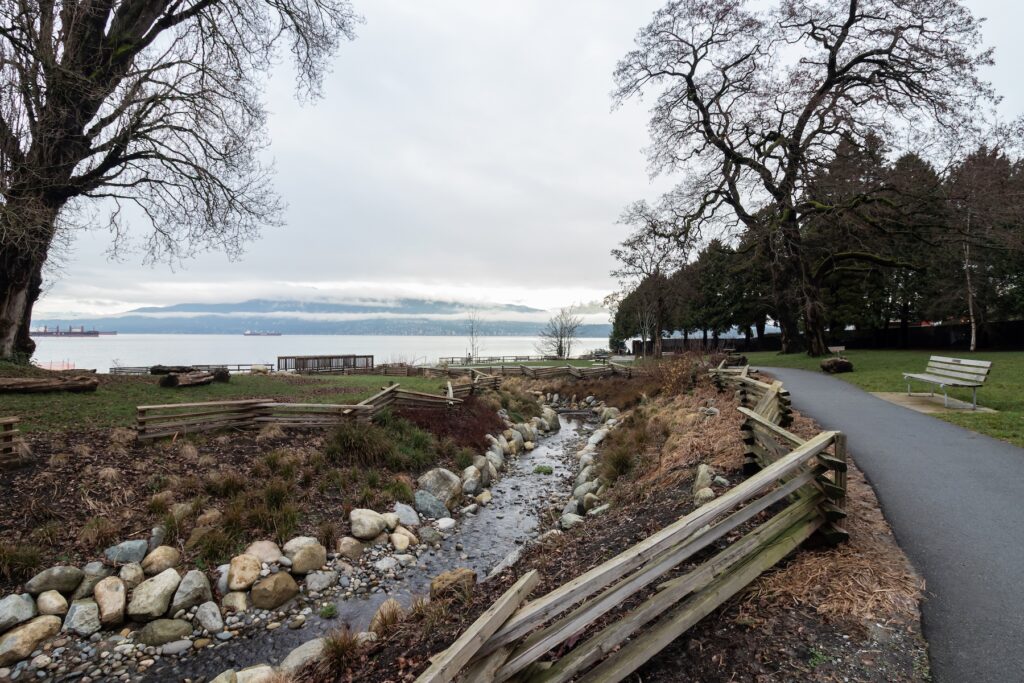
A couple of summers ago, Lehan’s vision was realized: Vancouver’s park board restored a block and a half of stream through two small parks, Tatlow and Volunteer Parks, and planted its banks with native species. Once a quiet pair of urban green spaces, they are now full of life: picnicking couples, people walking dogs and pausing to soak up ocean views, cargo parked ahead of the city’s port, and mountains.
“It’s been more successful than my wildest imagination,” Lehan said. “I don’t think I could have pictured how many people would be using this park in the way they are since [restoring] this stream. It’s just unbelievable.”
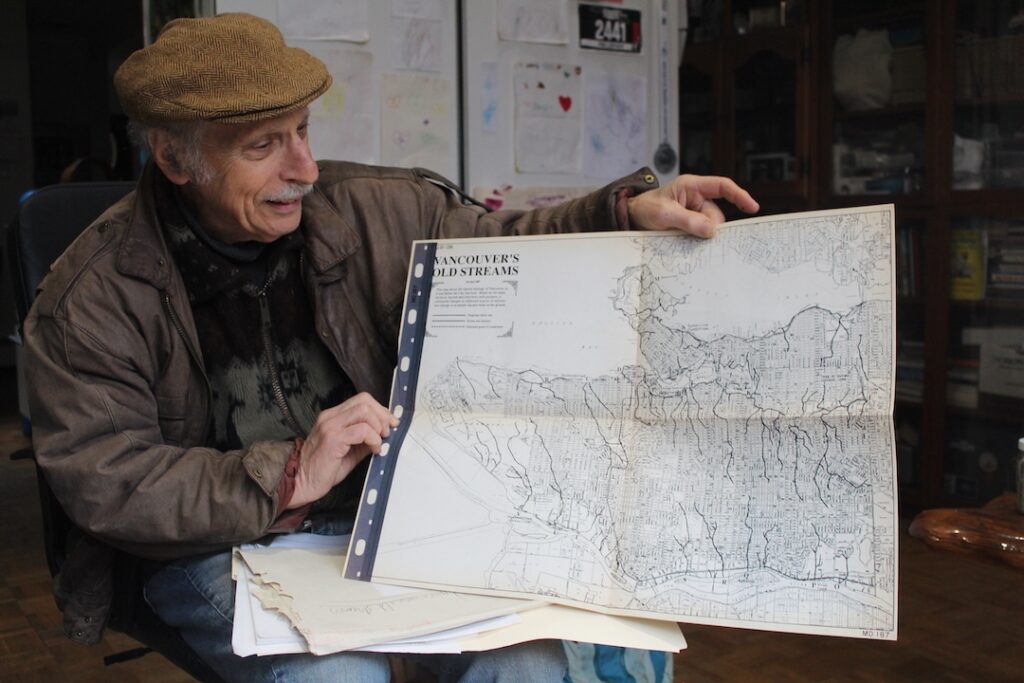
“This Is All a Network”
Tatlow Creek is just one of dozens of creeks and streams missing beneath the metropolitan area of Vancouver and surrounding suburbs with its three million residents.
Historically around the world, as countries developed increasingly larger metropolitan centers, natural waterways were either diverted, buried, or culverted to make way for agriculture and urbanization, with little consideration for the watershed health.
Urban planners would continue to view creeks and rivers as barriers to development. If people could direct water through a pipe, they wouldn’t have to worry about erosion or surface water, explained John S. Richardson, a professor of freshwater and riparian area ecology at the University of British Columbia. “Almost every city in the world has really taken their stream network and buried it into the storm drain network, so that it’s easily managed,” he said.
Waterways are now completely engineered in many of the world’s biggest cities—rivers being turned to sewers beneath London’s streets, streams buried in New York City’s Greenwich Village—and Vancouver was one of those cities, a vast urban landscape roughly the size in square miles of Portland, Oregon, with rows of houses, high-rises, roads, parks, and human-made beaches.
Tatlow’s location was once a vibrant forest with towering old-growth forests and more than sixty miles of streams. The Squamish Nation—who, alongside the Tsleil-Waututh and Musqueam Nations, inhabited the lands since time immemorial—called it K’emk’emeláy, which translates to “the place of many maple trees,” though it could have equally been called “the place of many streams.”
Today, only a handful of streams remain uncovered in the city, including Musqueam Creek on the Musqueam Nation Reserve to the west, and Still Creek to the east. Most of the nearly fifty waterways were redirected into pipes. Most residents don’t know they ever existed.
No one is certain of the full impact of burying streams, and the forests and wetlands that go with them. The scale of what is lost becomes clear in streams where scientists have previously researched extensively to document species health—something Richardson said is challenging, because it takes significant expertise to identify so many creatures, many of whom are small invertebrates.
“We really don’t know what we’re missing,” said Richardson.
For example, one of the most studied streams in the world is the Breitenbach River in Germany, where more than 1,800 riparian species were found along its banks. Though few creeks in the world have been subject to this amount of research, Richardson guessed that most small streams would be home to hundreds or even thousands of species. But instead of a living, breathing, finning stream, much of what lays beneath Vancouver is in pipes. According to Richardson: “There’s not much of an ecosystem in a pipe.”
A functioning creek requires a persistent, high-quality water source. It requires energy from sunshine and things like decaying leaves, seeds, and cones. A living creek has to be in constant conversation with life—algae, bacteria, fungi, and invertebrates. Each individual stream is also part of a greater hydrological network of water moving through forests and wetlands and eventually emptying into oceans.
“There’s not much of an ecosystem in a pipe.”
“It’s not only the stream; it’s a hydrological cycle,” said Francisca Olaya Nieto, a biologist with Vancouver’s park board. “Rainwater comes down to the ground, gets [filtered], and from there it connects into your groundwater, your surface water. This is all a network.”
Nearly a hundred miles of Vancouver’s sewer and pipes are more than 100 years old—roughly the age when such infrastructure begins to experience leaks and deterioration—and yet the city often cannot contain this hydrological system. Several places in the city experience recurring flooding. Nieto warned that flooding could only get worse with rising sea levels, and the city needs to consider where streams used to flow to reestablish space for natural flood patterns.
“If we don’t have any space for that water to go in and out, we’re going to start seeing some failures in some of our structures and some of our areas that are facing the waterfront,” she said.
Why Do Streams Matter?
Streams regulate stormwater and temperature, clean pollution, provide habitat, and often have deep cultural significance. In cities where natural spaces providing these functions are limited, their importance is heightened. Such decisions to take streams underground not only had consequences for ecosystems, but for the Indigenous First Nations upon whose lands the city was built.
Woody Sparrow, a member of Musqueam Nation, said that his grandfather watched as the majority of the streams were urbanized and put into pipes. “This was a sad fact that he had to observe on a daily basis until he passed away. It was a sad thing for him to see progress happen,” Sparrow said. He blames it on urbanization and the city’s linear view of progress.
Sparrow, 57, has worked his entire life on restoring Musqueam Creek. He says it’s one of the only streams that wasn’t lost to development, because it’s on the Musqueam Indian Reserve and under its jurisdiction. Because of their inclusive cultural norms, he explained, they consider not only the environment but also humans and human activity. “Because we’re the major impact, and we’re the ones that needed to change our behavior.”
In 1996, only six chum and six coho salmon returned to spawn to Musqueam Creek. According to a 1999 article in the Vancouver Courier, Musqueam was full of sewage runoff, degraded groundwater, and fecal bacteria from dogs and horses. Its banks had been logged, and therefore were missing the protective shade of trees, heating up the water and making it unsuitable fish habitat.
“It’s not only the stream; it’s a hydrological cycle.
This is all a network.”
In the years since, Sparrow has worked tirelessly to bring wild salmon numbers back up. Sparrow and a team of experts and volunteers spent more than a decade restoring the creek. They planted native trees and vegetation on its banks, cleared out hundreds of pounds of garbage, and replaced its logs and boulders—“adding things in that cities were taking out.”
They worked with the World Fisheries Trust to test DNA, and discovered that the salmon in their watershed didn’t have relatives elsewhere. He called it a “bust-boom effort.” (While the city has worked to find sources of pollution to Musqueam Creek in recent years, low water quality continues to be an issue due to the urbanized surroundings of its watershed—from residential and recreation areas, potential risk of a nearby sanitary sewer, and sediment.)
“We tried using an incubation box. That failed. We tried introducing fish to the system. That failed,” he said. In the 1990s, Sparrow said the common mentality at the time was that “there are other fish streams elsewhere.” But for Musqueam, it was the last salmon-bearing stream in what is now known as Vancouver. Today, because of their work, between fifty to a hundred of both coho and chum return to Musqueam Creek each year.
Daylighting Today
Vancouver has started to daylight other creeks in recent years. In 2025, the city celebrated the daylighting of Canyon Creek, moving through a large, forested park and popular beach to the west. Nearly two decades ago, the city also reclaimed a section of Still Creek, which runs through the highly urbanized area east of the city. Goals vary with every stream, but Nieto said they hope to bring back biodiversity and native species, open up water connectivity, and reconnect the public with nature.
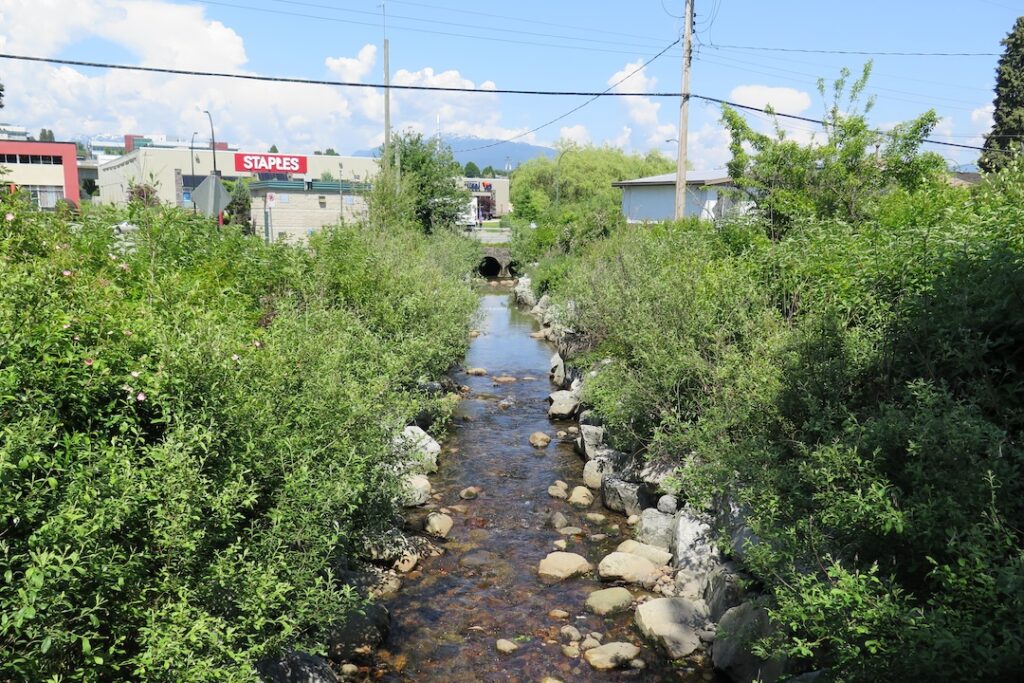
“Some of these projects are more aesthetic than they are practical, in terms of functional ecosystems, and that’s OK. I think that people learn from those kinds of things,” said Richardson. He believes that Tatlow Creek might be more of a project of aesthetics because it exists in an area now surrounded entirely by roads and houses, without access to a forested watershed that can provide consistent flow.
It still provides a chance for people to realize what Vancouver looked like pre-settlement. It also has the potential to save the city money: the creek is fed by rainwater diverted from the city’s stormwater system, water that a wastewater treatment plant would otherwise have to clean.
A Three-Decade Effort Realized
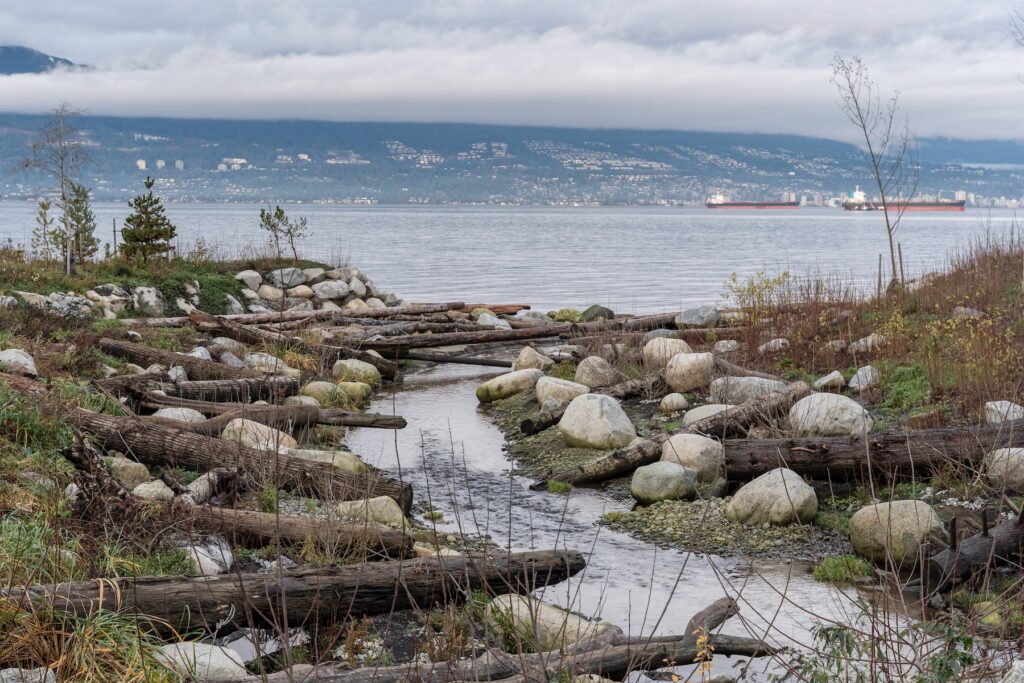
Mel Lehan, 81, often visits Tatlow Creek to take in the view of the winding creek as it empties into the harbor. He likes smelling the ocean air, sitting on a bench that will be named after his late wife. He walks down the path to the beach, peppered with boulders and driftwood logs, one of the few waterfronts in the city that hasn’t been turned into a sea wall or beach.
Lehan has stacks of old newspaper clippings, letters, maps, and reports that provide evidence of his decades of advocacy for Tatlow and for other nearby community projects.
For example, he’s quoted in an article from 2002, published in the local paper the Georgia Straight: “It just doesn’t make sense that it’s taken so incredibly long.” The project had been stalled for six years before it was eventually canceled. In 2016, the city’s park board, assisted by a private donor, restarted the project. And finally, in 2024, Tatlow was finally daylighted.
Lehan still wonders why it took so long. “Thirty years, it’s unbelievable!” But unlike in 2002, he can point to something, proof of concept, a flowing, daylighted stream that enters the ocean, with evidence of life returning.
“It’s a breeding ground for all sorts of life that will start coming back,” he said, pointing toward a pair of ducks swimming in the creek. Just a few years ago, waterfowl wouldn’t have found a single spot to land. “Look, the ducks—I mean, the ducks!”