This story was originally published in Pacific NW magazine/Seattle Times and was supported by the Overlooked & Untold Stories Fund of Braided River.
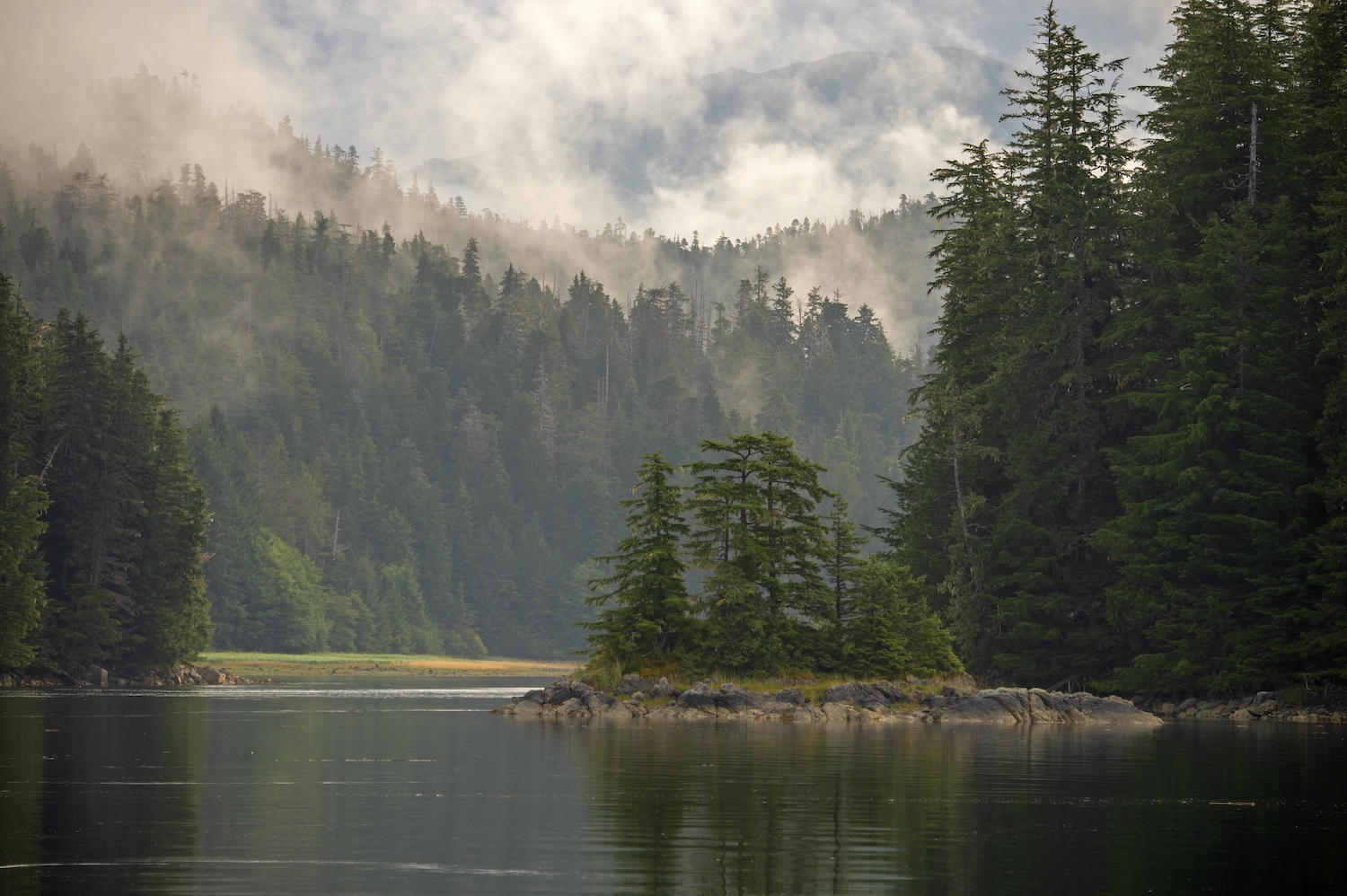
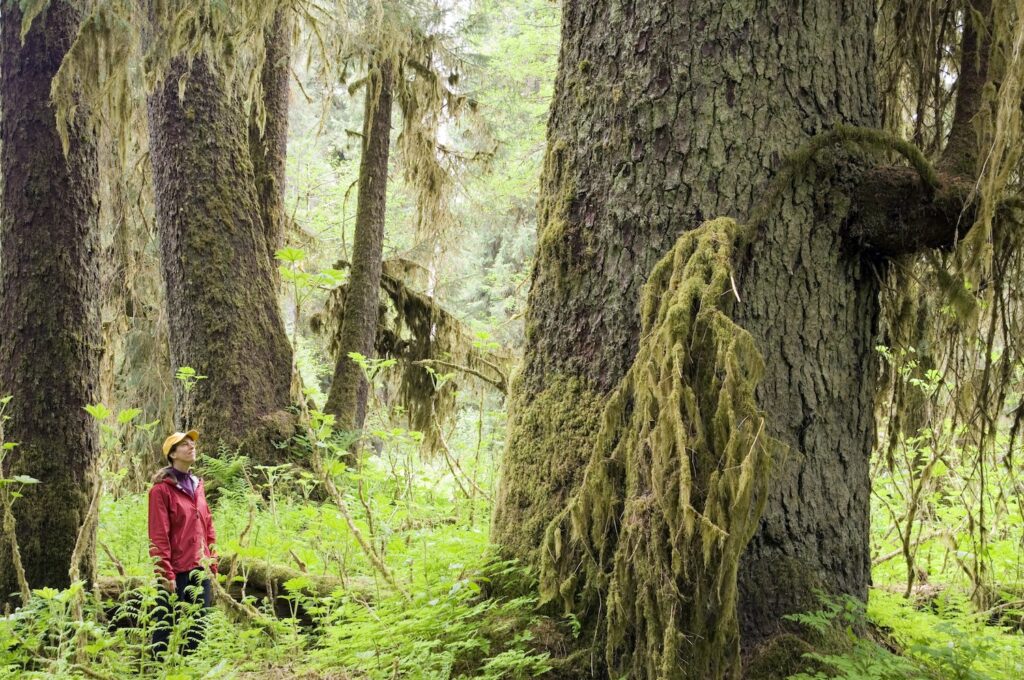
Rain drips from the tips of branches of a grandmother cedar, growing for centuries. In verdant moss amid hip-high sword ferns, the bones of a salmon gleam, picked clean by feasting wildlife. “Gronk,” intones a raven, from somewhere high overhead in the forest canopy.
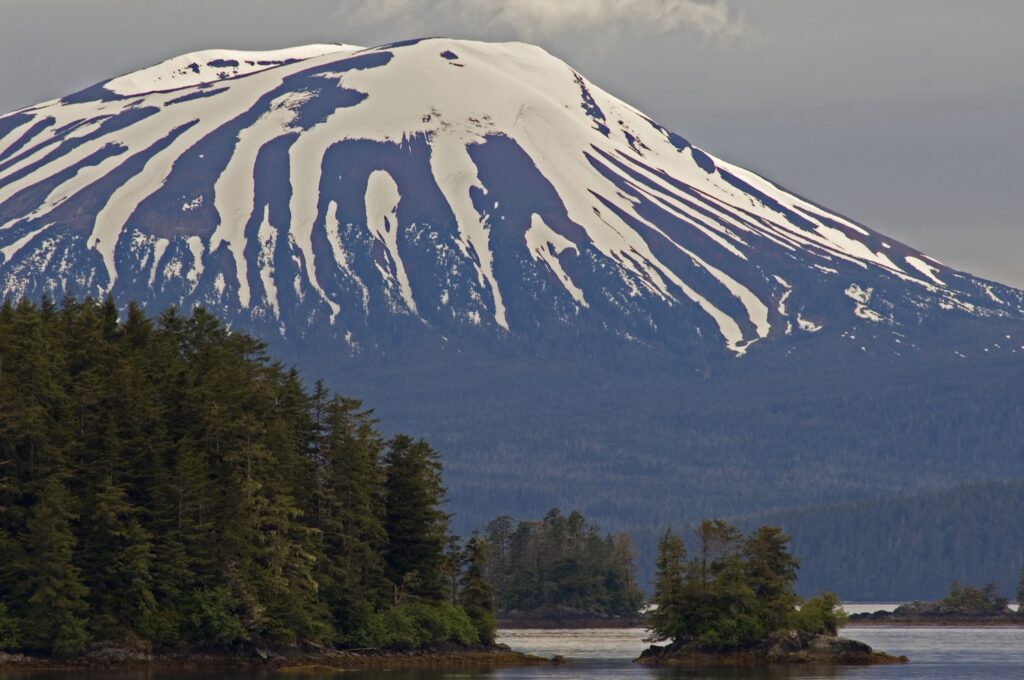
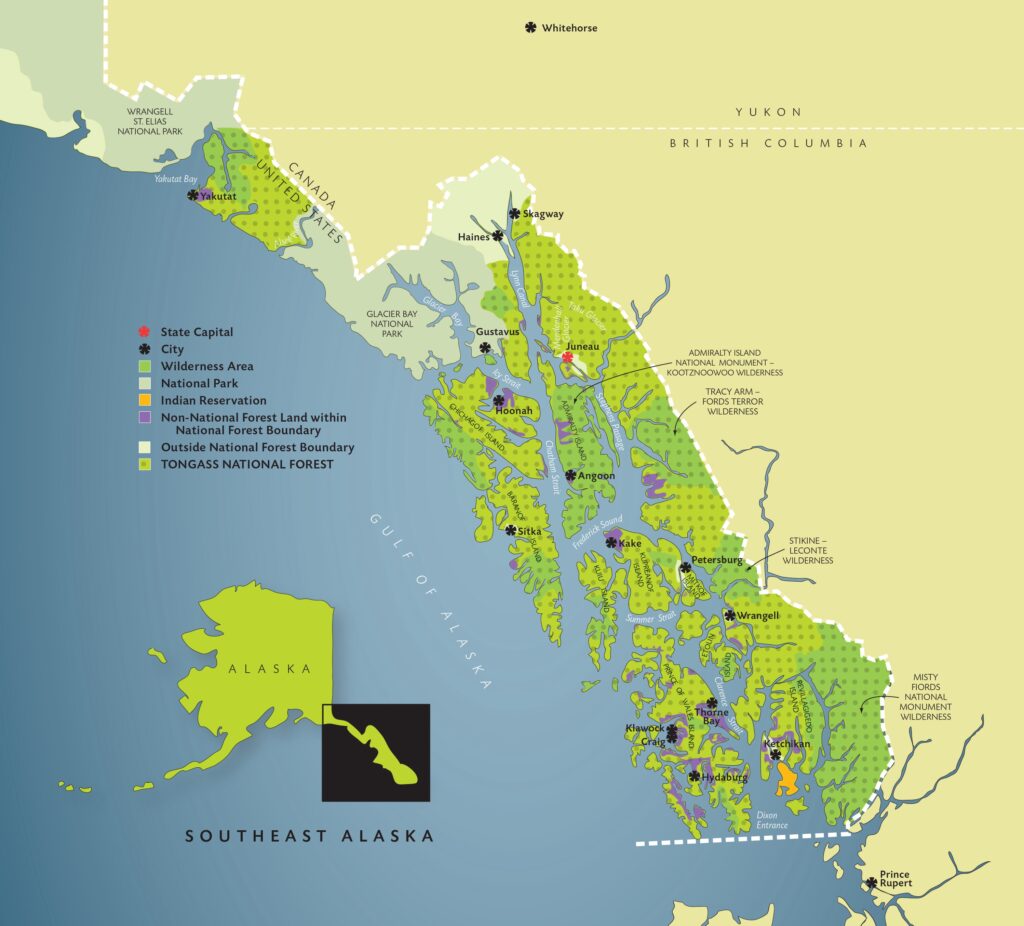
This is the Tongass National Forest, in Southeast Alaska. At nearly 17 million acres, it is the largest national forest in our country by far — and its wildest. These public lands are home to more grizzly bears, more wolves, more whales, more wild salmon than any other national forest. More calving glaciers; shining mountains and fjords; and pristine beaches, where intact ancient forests meet a black-green sea. These wonders drew more than 3 million visitors from around the nation and the world to Alaska from May 2024 through April 2025 — a record.
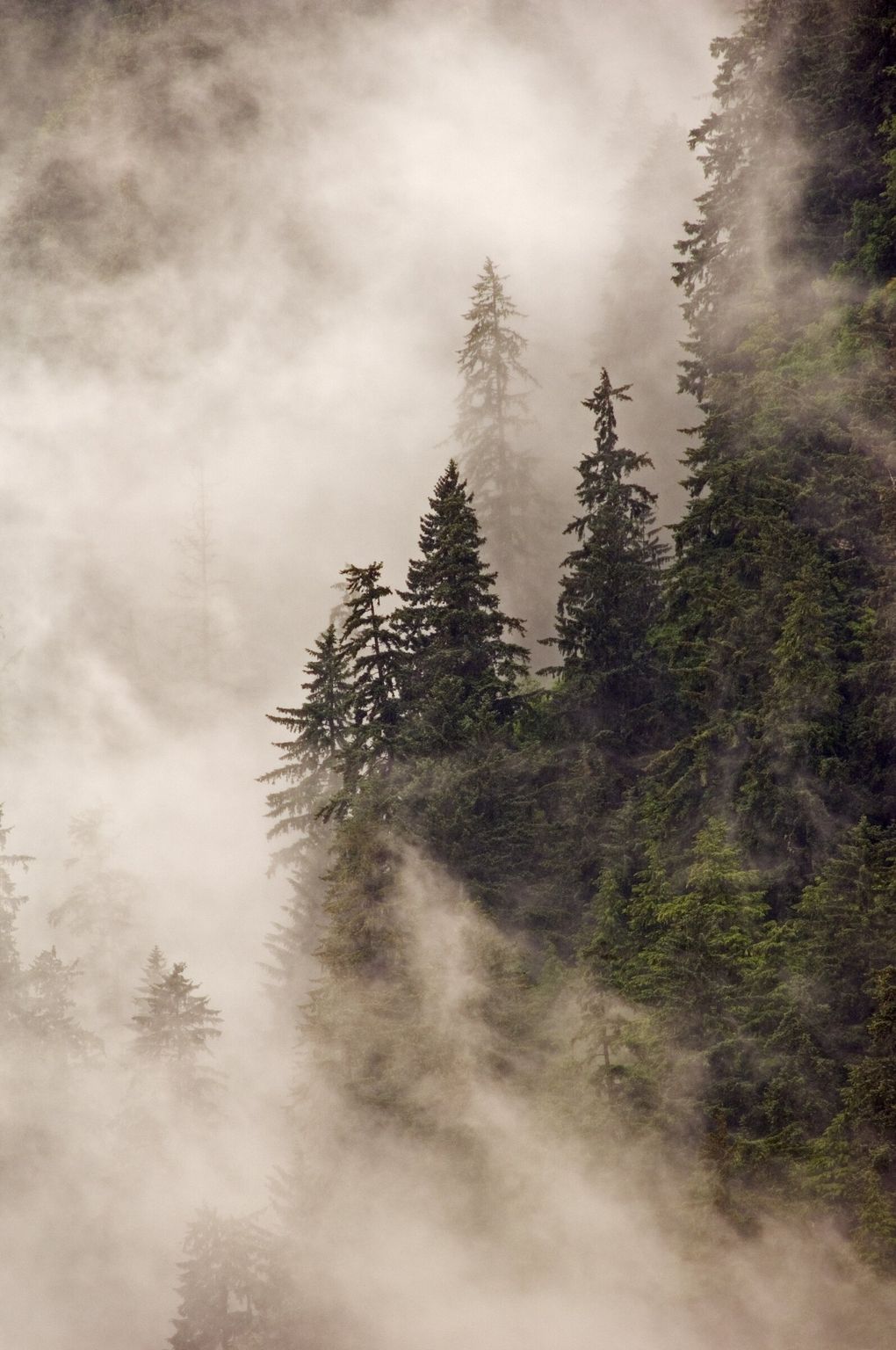
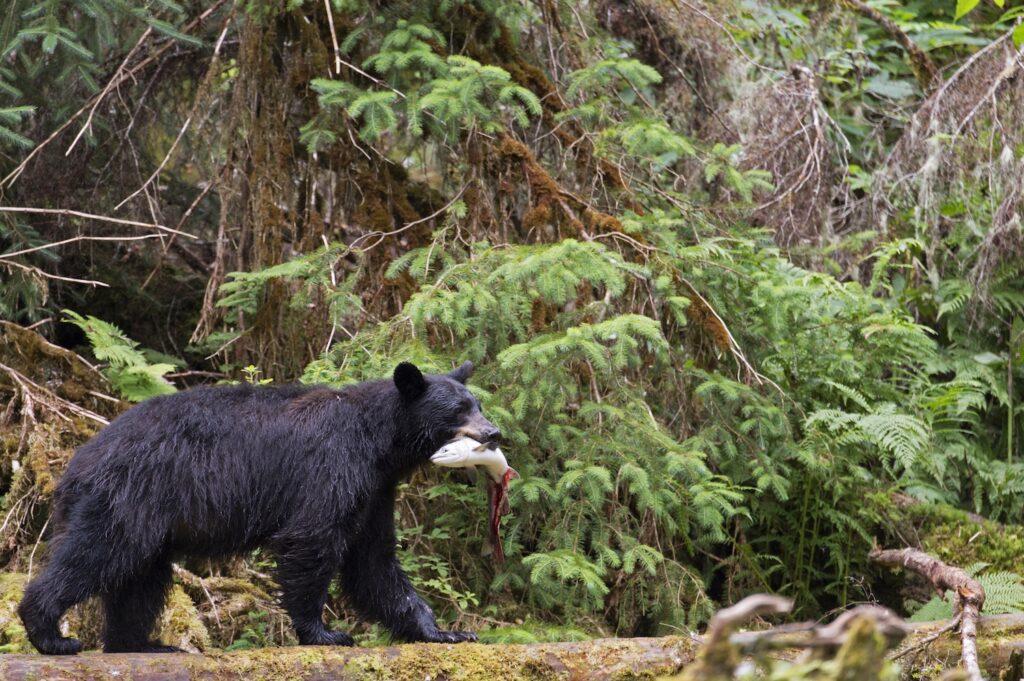
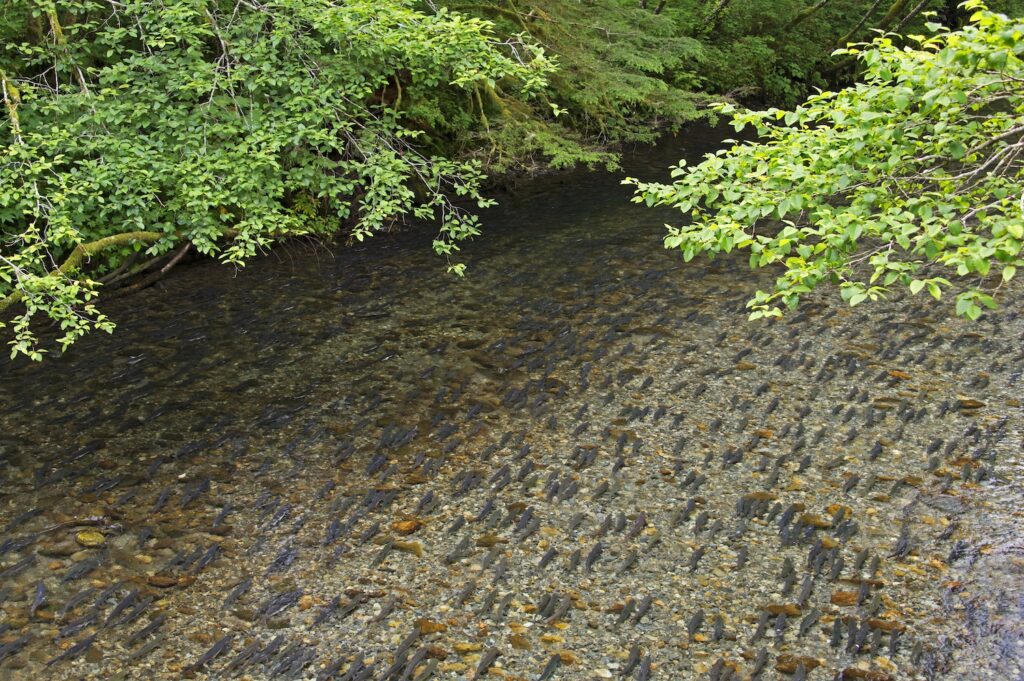
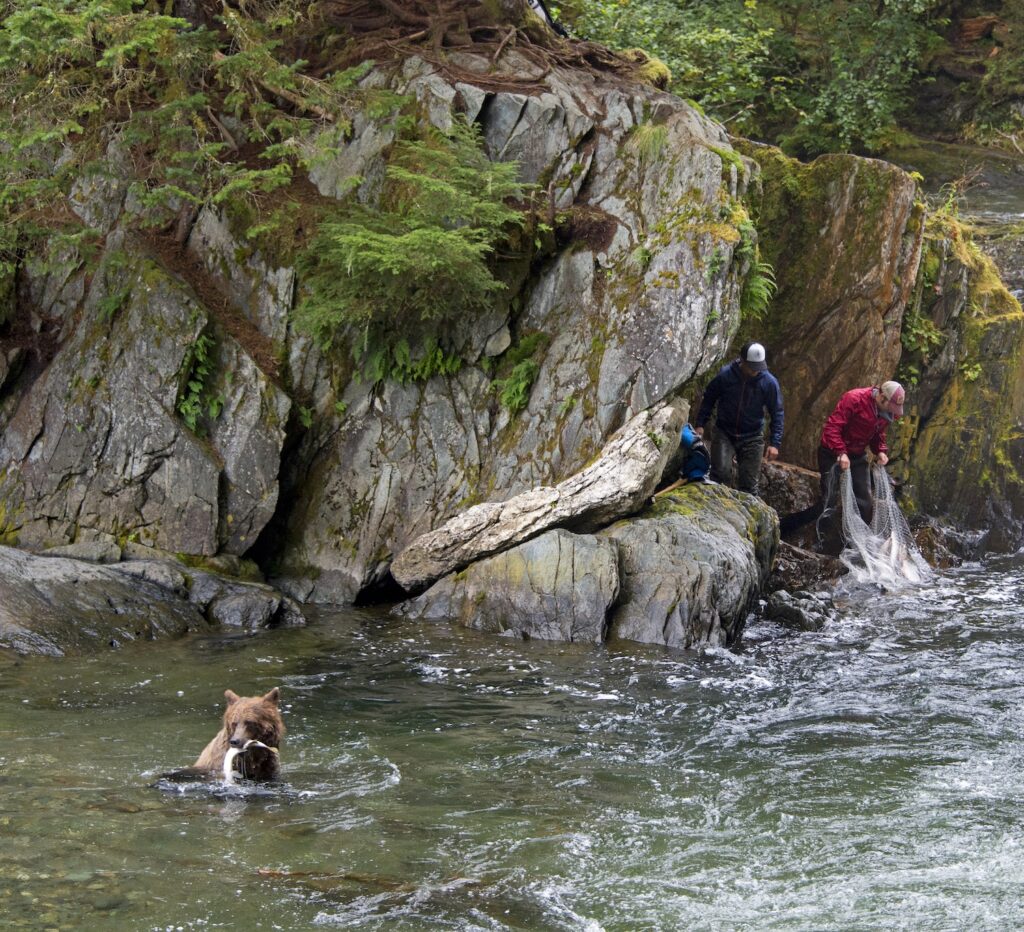
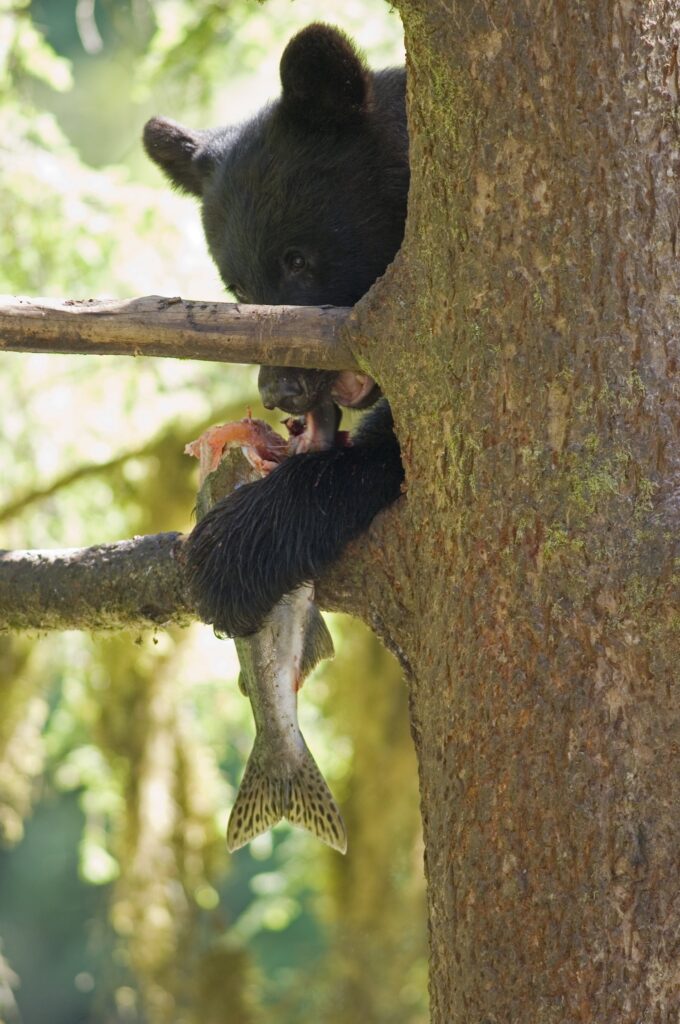
In the forest, looming Sitka spruce, western hemlock, and cedars quill a lush understory of salal and huckleberry. Life grows upon life, with hanks of moss and lichen swaddling trunks and branches. Nothing really dies here, it just transforms into new life. Fallen logs are furred with tree seedlings, as a new generation rises. After they spawn, salmon die — and transubstantiate into the bodies of ravens, bears, and wolves they nourish.

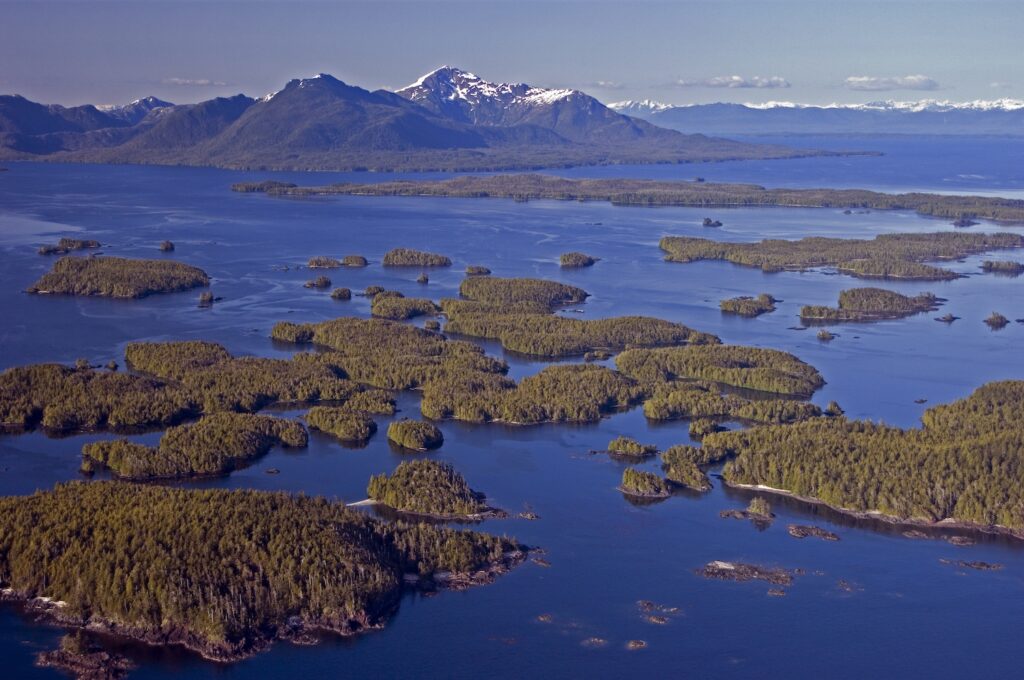
Strewn across thousands of islands, and comprising most of Southeast Alaska, the Tongass was designated a national forest by President Theodore Roosevelt in 1907. The trees here were coveted by the timber industry even before Alaska was a state, and industrial logging began in 1947 with construction of two pulp mills, each with a federally subsidized 50-year contract for public timber.
While the Tongass is big, only about 33% of it is forested in old and second growth, and clear-cuts disproportionately targeted the most productive areas with the biggest trees. In North Prince of Wales Island, notes Kate Glover, senior attorney for EarthJustice in Juneau, more than 77% of the original contiguous old growth was cut.
The logging boom that began in the 1950s is long since bust; the last pulp mill in Alaska shut in 1997. But now, the prospect of greatly increased cutting is once again ramping up.
President Donald Trump wants to revoke a federal rule that could potentially open more than 9 million acres of the Tongass to logging, including about 2.5 million acres of productive old growth. The Roadless Area Conservation Rule, widely known as the Roadless Rule, was adopted by President Bill Clinton in 2001 to protect the wildest public lands in our national forests, after an extensive public process. Trump revoked it during his first term of office. President Joe Biden reinstated it. Now Trump has announced plans to rescind it again.
“Once again, President Trump is removing absurd obstacles to common sense management of our natural resources by rescinding the overly restrictive roadless rule,” said Secretary of Agriculture Brooke Rollins, in a June announcement. “This move opens a new era of consistency and sustainability for our nation’s forests . . . to enjoy and reap the benefits of this great land.”
The Roadless Rule is one of the most important federal policies many people have never heard of, protecting nearly 45 million acres in national forests all over the country from logging, mining, and other industrial development. In Washington state, the rule preserves about 2 million acres of national forest — magnificent redoubts of old growth and wildlife, such as the Dark Divide in the Gifford Pinchot National Forest.
The rule is popular. After Rollins announced the proposed rollback, more than 500,000 people posted comments defending it in just 21 days during an initial public comment period. Another public comment period will open in the spring.
At stake in the Tongass is one of the last, largest coastal temperate rainforests in the world.
Dominick DellaSala is an independent scientist based in Oregon, who has studied the Tongass for three decades. The forest is of national and global importance, helping to blunt the effects of climate warming, DellaSala and his collaborators wrote in a 2022 paper. The Tongass sequesters about 20% of all the carbon stored in the country’s entire national forest system — more than any other national forest.
The Tongass also is home to more productive old-growth trees (older than 150 years) than any other national forest. And the biggest trees store the most carbon.
In a world in which wilderness is rapidly disappearing, “the best is right here,” DellaSala says. “If you punch in roads and log it, you lose it. You flip the system to a degraded state.
“What happens right now is what will make the difference in the Tongass.”
“Who knew this could happen?”
Revoking the Roadless Rule isn’t the only threat to the Tongass. It’s also being clear-cut, chunk by chunk, through land transfers, swaps, and intergovernmental agreements affecting more than 88,000 acres just since 2014.
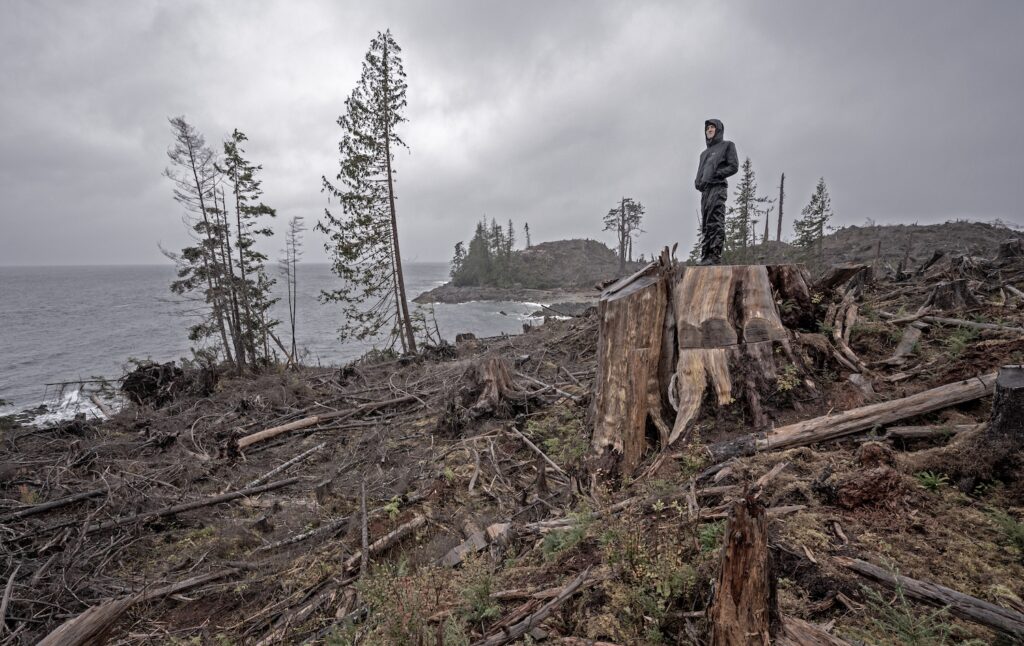
Joshua Wright bends low over a stump, counting its tightly packed rings. Certainly 500, maybe 700, it’s hard to tell in the driving rain. This stump he and DellaSala are standing on is as wide as they are tall. “Who knew this could happen?” says Wright, looking at the clear-cut, with nearly every tree taken, all the way to the beach fringe. So close to the beach, delicate domes of sea urchin shells sit amid the logging slash, as do abalone shells, dropped by seabirds, their shimmering opalescent colors so out of place in a bleak ruin of stumps.
“What happens right now is what
will make the difference in the Tongass.”
This is representative of the type of logging that can happen when lands are removed from the national forest system, says Wright, who leads the Southeast Alaska program for the Legacy Forest Defense Coalition, based in Tacoma. More such cuts could be coming. Legislation proposed last summer would privatize more than 115,000 acres of the Tongass.
The legislation is part of a yearslong effort since 1985 to wrest more of the Tongass from federal control to private, for-profit Native corporations. In 1971, a federal land claims settlement act transferred 44 million acres of federal land to regional and village corporations owned by Alaska Native shareholders.
Five communities that were not included in that 1971 settlement would receive land under the so-called landless legislation, though none of them met the original criteria for eligibility. Native people in these communities were made at-large/landless shareholders, with payments to them managed by Sealaska Corporation, which owns and manages a range of for-profit businesses and investments throughout Southeast Alaska.
First Foods
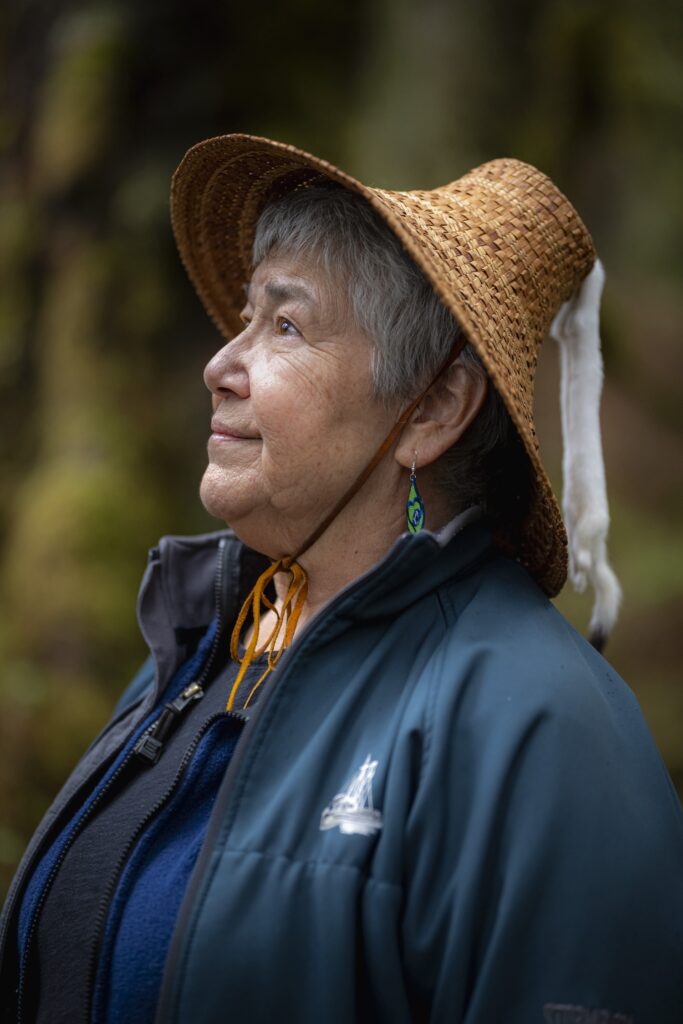
Wanda Culp, 77, says her Indian name is “Pissed Off Brown Bear Grandmother.” She is only half joking: she despises clear-cuts, which she says have “nothing to do with the science of forestry.
“It hurts. It’s painful when you walk through the forests then you see how it’s been decimated, it has a huge impact, emotionally. I understand the need for wood and timber, but do it in a way that isn’t invasive.”
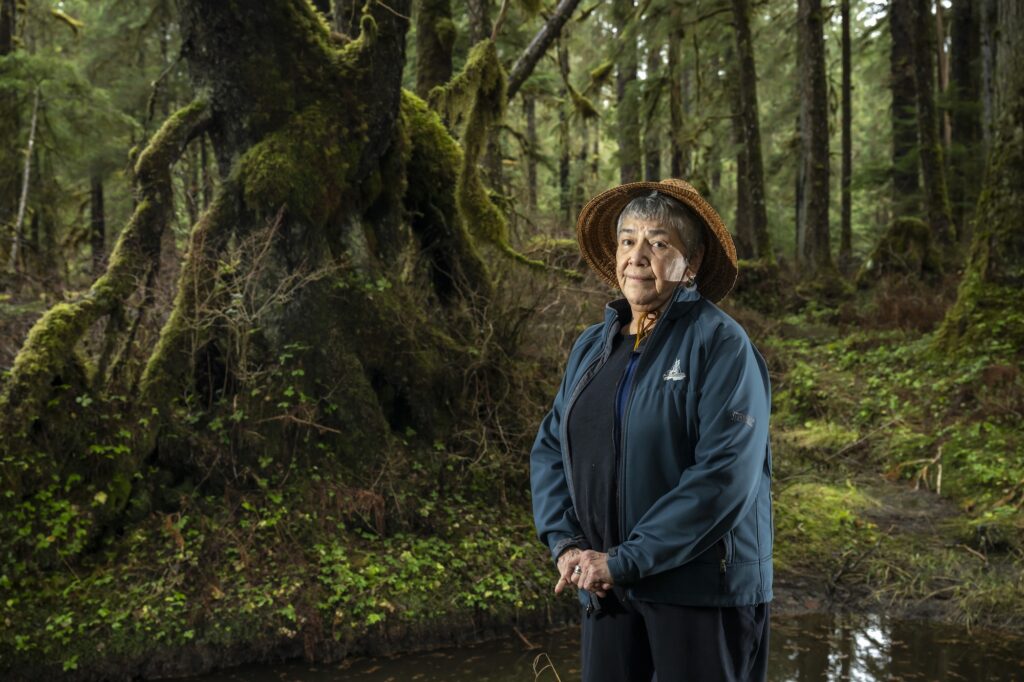
In her trailer home at the base of Thunder Mountain in Juneau, she shows off her prize: gleaming jars of First Foods. There are chunks of harbor seal; rosy hunks of salmon, both smoked and fresh pack. Dried salmon and halibut. Jars of seal oil.
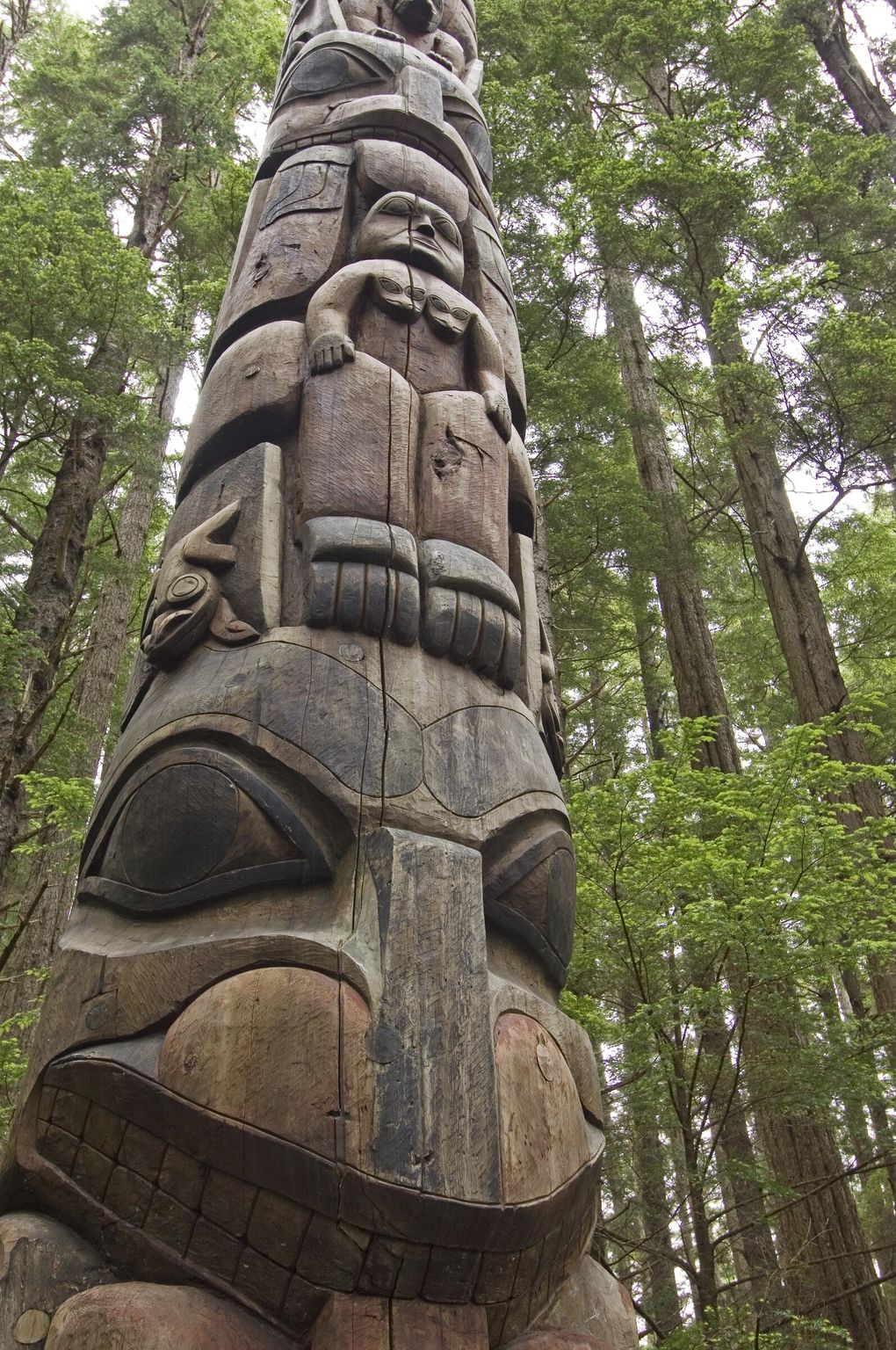
“This is the kind of wealth we want, and the joy of knowing how to put it up,” says Culp, who for nearly three decades practiced a traditional subsistence way of life on a waterfront homestead. The Tongass forest, and the salmon streams it protects, to her mean security. “The forest provides for us. It is all connected, and we have to take care of it,” Culp says. “Don’t take more than you need, that is a Tlingit rule.”

A Tlingit elder and Sealaska shareholder, Culp derides the system of for-profit, private corporations set up when aboriginal land claims were extinguished. The policy resulted in extensive clear-cutting — some of the most devastating in Alaska — as cash-poor Native corporations, with mandates to make a profit for their shareholders, liquidated their only assets: forests in land claims often far from their communities. The Sealaska corporation is diversifying its economy, and has stepped away from old-growth logging — after extensive clear-cutting of its lands — and in 2018 enrolled 165,000 acres of forest — roughly half its land — in a carbon credit program, preserving it for the next 100 years.
But re-racking the original land claim deal now could open the door to more logging, and to more asks for more land claims and more transfers of public land. To some, carving yet more land out of the Tongass is a deeply personal threat.
As Culp warned in an editorial in the local paper, under the so-called landless legislation reintroduced in Congress last summer, lands selected for transfer to the new corporations include 80,000 acres of old growth. Of those acres, 60,000 are currently protected by the Roadless Rule — and would be opened to possible logging and other extraction.
She urges others to speak out on behalf of what is everyone’s public land — and opposing the landless bill without fear of seeming anti-Native. “These are public laws that affect every one of us in the U.S., everyone should say something about it, don’t feel delicate about it, because you are a landowner and have every reason to speak out.”
She also defends the Roadless Rule, which she says offers the best defense for the forest, and Native cultures that depend on it.
“These are public laws that affect every one of us in the U.S., everyone should say something about it, don’t feel delicate about it.”
Some have watched the Roadless Rule flip back and forth so many times, depending on who is in the White House, they say they are tired of hearing about it.
“What we’ve been trying to focus on, is, how do people in this place exist in a good way, given the system we’ve inherited,” says Alana Peterson, vice chair of the tribal council for the Sitka Tribe of Alaska. “The more recent system is extractive and damaging and not what’s good for us or for our future generations or the planet. And so trying to really change that system is what we’re focused on.”
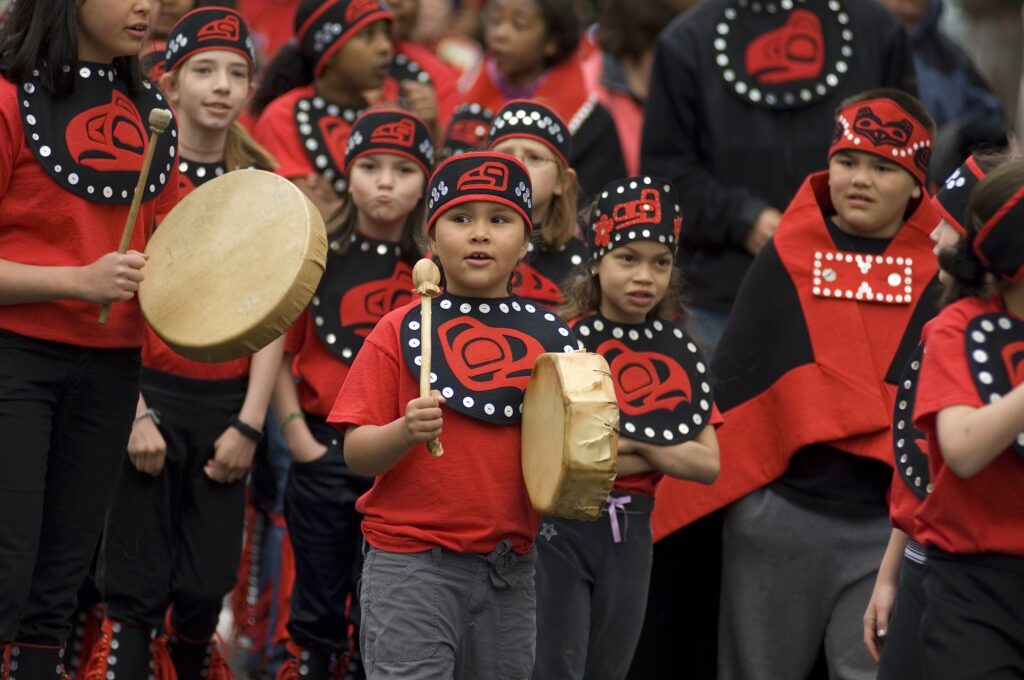
Cultural revitalization has to be part of building healthy communities, Peterson says. “You have generations of people who live with a lot of shame because they were told they’re not allowed to speak your language. You shouldn’t. It’s dirty, it’s bad . . . And so we’re just trying to figure out, how do we reconnect with this knowledge?”
That work is healing a lot of past traumas, Peterson says, and reinvigorating traditional ecological knowledge, because it’s embedded in the language, and the stories, and the songs and the dance.
Industrial scale clear-cut logging in the Tongass, in addition to its environmental destruction, has never made economic sense. U.S. taxpayers heavily subsidize the cutting, in part through the construction and maintenance of Forest Service roads to access the forest. A recent study done by the independent, nonpartisan group Taxpayers for Common Sense found that the Forest Service lost $16.1 million on Tongass timber sales in fiscal year 2019, and $1.7 billion over the past four decades. Most of Alaska’s timber harvest is exported as raw logs to Asian markets.
Now timber sales proposed during the first Trump Administration, the size of which haven’t been seen since the pulp mill days, are coming back to life, says Maggie Rabb, executive director of the Southeast Alaska Conservation Council.
“That’s not what we want for the Tongass,” Rabb says. “We need to protect a vision for the future that is not just round log exports.”
Only about 240 people work in the logging business in Alaska today, most of them at two sawmills. The industry, states the Alaska Forest Association, an industry group, will collapse unless it is fed more old growth from public lands. The AFA made the claim in a lawsuit, joined with other plaintiffs, against the Forest Service, demanding release of more old-growth forest from the Tongass for cutting.
Booming business
But while the timber industry is fighting for a lifeline, more than 8,263 people work locally in a thriving tourism business built on wild and scenic Alaska. In 2023, tourism became the largest economic sector in Southeast, according to a 2024 report by Southeast Conference, the regional economic development organization.
Mary Catharine Martin, spokesperson for SalmonState, a nonprofit based in Juneau, notes that the Mendenhall Glacier Visitor Center at the Tongass National Forest is visited by about 700,000 people annually from all over the world. “This is what people come to see,” says Martin, regarding the glacier, its ice glowing blue as a husky’s eye. “They come to see this amazing place, and to be out in it.”
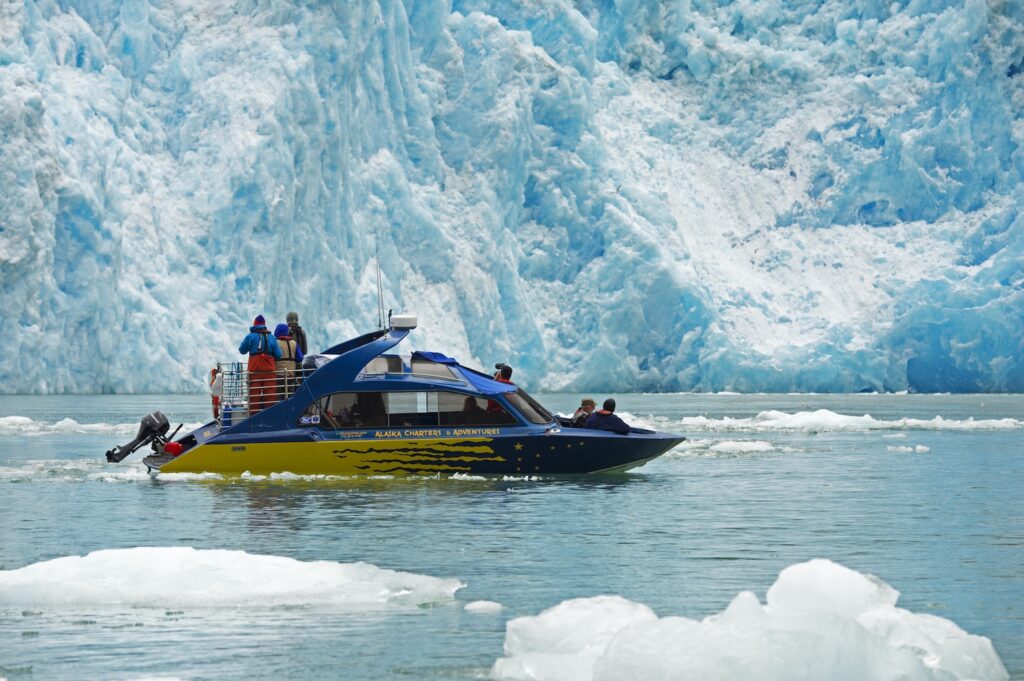

Nearby, an eagle atop a hemlock surveys its home with regal regard, and late-run chum salmon lumber up a creek. Twilight pinks the lake at the glacier’s toe, and the jagged mountain tree line reflects in the mirror-calm water.
Local Southeast Alaska businesses, like Uncruise Adventures, a small boat tour company with offices in Seattle and Juneau, have built their livelihood on the wild beauty of the Tongass.
“Our entire focus is on the outdoors, it is not about the ship,” says Dan Blanchard of Juneau, owner and CEO of Uncruise. “The Tongass is critical to our business.” Today, fishing and tourism power an economy that relies on the resurgent salmon runs and whales and intact ancient forest that have thrived with federal protection, Blanchard says.
“This is what people come to see,” says Martin, regarding the glacier, its ice glowing blue as a husky’s eye. “They come to see this amazing place, and to be out in it.”
“They come to see these things they can’t see at home anymore,” he says of the 7,000 to 10,000 visitors he brings to the Tongass on a fleet of seven small boats each summer.
“They don’t come here to see clear-cuts.”