
If you ask anyone involved in the cleanup of Seattle’s Duwamish River—the only river running through the city—what distinguishes it from other Superfund sites in the country, you’ll get several variations of the same answer.
It’s not that the damage to the river is more dire than any other rivers, though one could certainly make that argument after looking at the data. It’s not that the cleanup is more complex either, though the scope of restoration is far-reaching enough to require intervention on every level, from community to federal.
Instead, it’s the people living along the Duwamish River who care for it the most, many of whose ancestors relied on the river’s bounty.
“The community involvement here is remarkable,” said Elly Hale, the Environmental Protection Agency (EPA)’s Remedial Project Manager on the Lower Duwamish Waterway, “because it’s not fun or easy to understand a river cleanup.”
In Seattle’s South Park neighborhood, along the banks of one of the country’s most contaminated areas, the Duwamish River People’s Park opened in 2022. The 14-acre park sits on a site called Terminal 117, acquired by the Port of Seattle in 1999 after asphalt manufacturing, a major contributor to the toxic waste, was halted several years prior.
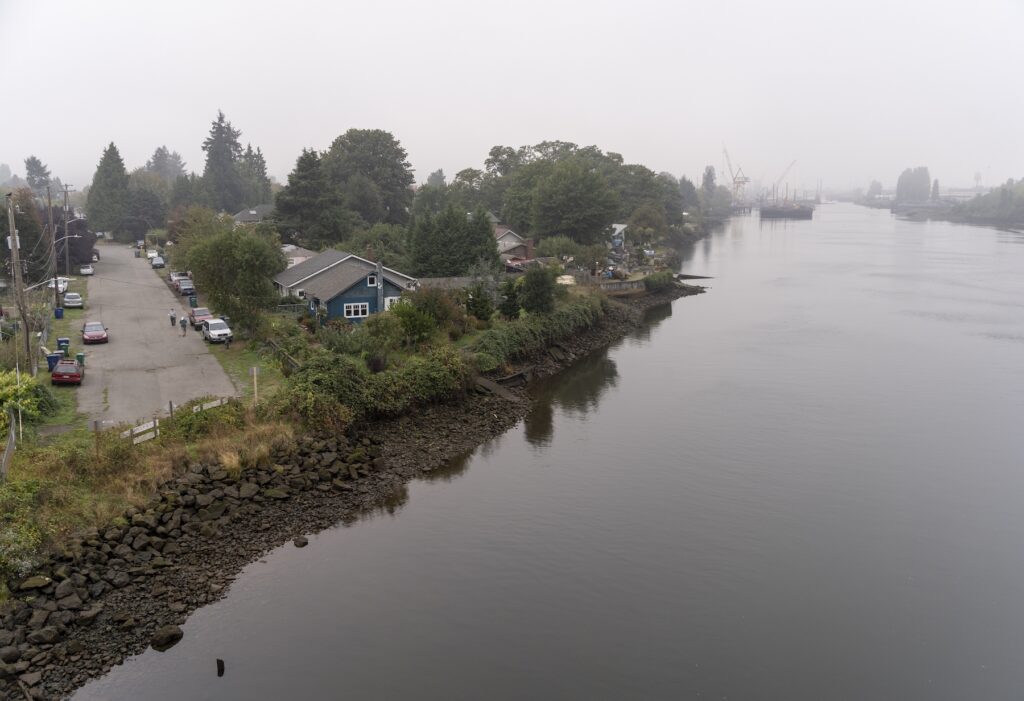
Today, there is no hint of disaster here. Informational plaques peek out from Nootka rose and snowberry, dotting their way down the pier, which ends in a sign over young marshland that announces in multiple languages, including in native Lushootseed, Water Is Life.
Students from the University of Washington wade up to their waists in the river. They are checking on baby Chinook salmon whose reintroduction into the rehabilitated environment will support tribal fishing rights for the Muckleshoot and Suquamish Tribes. The Duwamish Valley Youth Corps have planted trees nearby to help spread roots and restore the soil.
“Before the Port bought Terminal 117, it was going to be turned into a parking lot,” said Paulina López, executive director of the Duwamish River Community Coalition (DRCC). The DRCC was founded in 2001 by James Rasmussen, a member of the Duwamish Tribal Council. The coalition works with community, local, and federal governments to center environmental justice and youth involvement in the cleanup. López took over as DRCC’s executive director when Rasmussen retired. Though López didn’t mention it, the DRCC is part of why Terminal 117 is home to salmon instead of SUVs.
“Indigenous leaders have always been at the center of this. Part of environmental justice is knowing that what benefits our environment helps us.”
Back in 2007, during a midday Port of Seattle commissioners’ meeting, residents of South Park and the DRCC filled the room. The EPA only had enough designated funds for a basic cleanup of the site, so the coalition showed up to call for stronger action, to make the area a thriving part of the larger ecosystem once more.
The commissioners unanimously agreed to extend the scope of the cleanup, and in 2013, the Port installed an office in South Park to continue gathering neighborhood input. “Indigenous leaders have always been at the center of this,” said López. “Part of environmental justice is knowing that what benefits our environment helps us.”
Bullied Straight
In July 1976, Cecile Hansen, great-great-grandniece of “Chief Seattle,” or Si’ahl, and tribal chairwoman of the federally unrecognized Duwamish Tribe, stood above the banks of the river and watched bulldozers crush the remains of her ancestors’ village on the last remaining meander. She had been observing archaeological work there done by University of Washington students since the project had begun, learning about how their findings might impact both the river and her tribe.
In 1976, Hansen’s view of the river was unrecognizable from when her ancestors first arrived. Since 1913, meanders and oxbows had been dredged and straightened to make a deeply cut waterway more friendly to maritime trade through Elliott Bay. The Duwamish River was bullied straight, its mudflats filled in for factories. The watershed became the beating heart of an industrial city growing up around it.
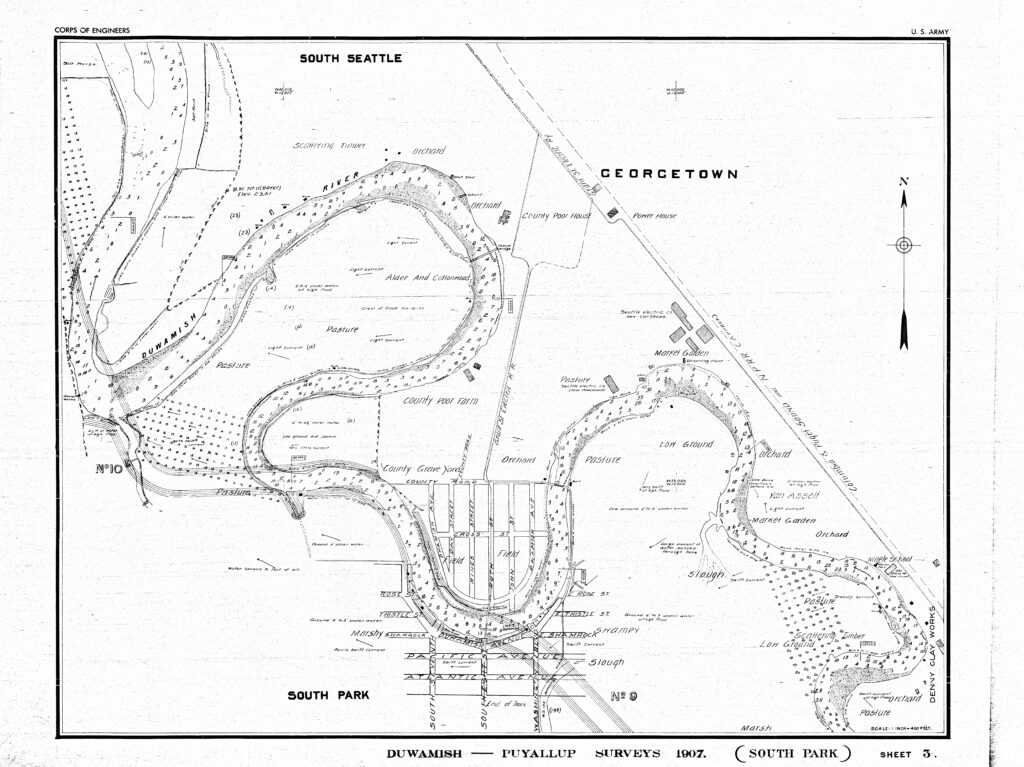
By the 1940s, less than 2 percent of the river’s original habitat remained, while wartime manufacturing brought a huge boom in production along the river. Untreated municipal sewer overflow, metalworks, and asphalt production at Terminal 117 churned enormous amounts of waste into the river. Pollutants—polychlorinated biphenyls (PCBs), arsenic, polycyclic aromatic hydrocarbons (cPAHs), dioxins, and furans—were deposited to mingle with the salmon, otters, and fishermen that used the river daily.
In 1916, Boeing set up shop along the river, where the aeronautics giant would become one of the worst polluters, so much so that the Port of Seattle sued them in 2022, in a now dropped lawsuit to hold the corporation, worth nearly $200 billion, financially accountable.
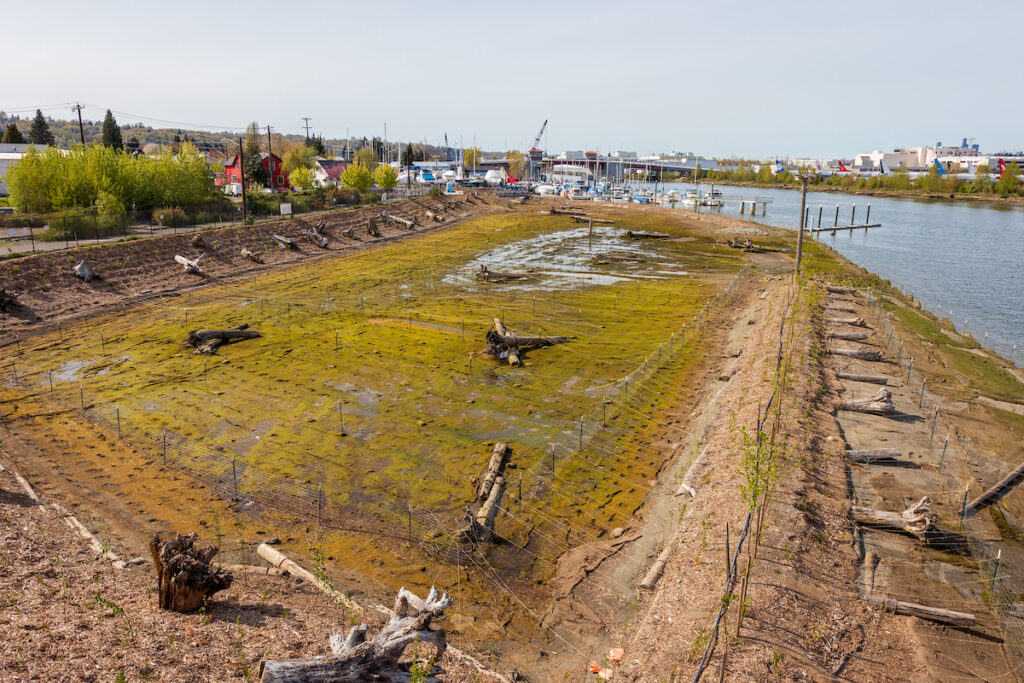
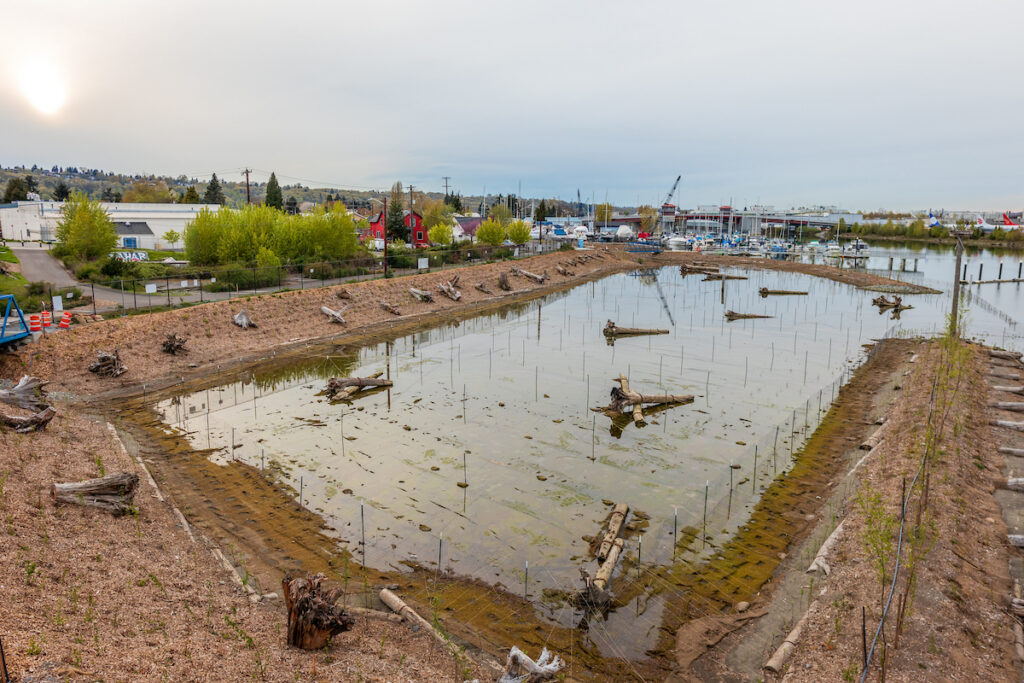
Marshes being built along the Duwamish River. Photo Courtesy: Port of Seattle.
Back in 1976, though, Hansen wasn’t the only one who had been trying to save the last meander. Local tribes had already been fighting for years as the river was increasingly used as a dumping ground, as madronas and marshes were abandoned for eroding banks of poisonous silt.
The Port had applied to fill the last meander the year before, and David Munsell, the Army Corps’ district archaeologist, recommended that the area be left alone. Just weeks later, the bulldozers started their work, and by the time Hansen was able to reach anyone, more than 80 percent of the original site had been destroyed. A study completed by the Corps the following year found at least two and a half additional acres of artifacts in the area, some dating back 1,400 years-plus. (Anthropologists have now dated the earliest human occupation in the watershed to around 12,000 years ago.)
Public outrage over the loss grew. The wider public, including the mayor of Seattle, called for preservation. Backed by the Corps’ findings, the last meander of the Duwamish River was added to the National Register of Historic Places in 1977 and officially protected.
In 1991, King County and Seattle settled with the federal government for damages from the combined sewer overflows, which kicked off an initial cleanup, exposing high levels of contamination. In 2000, a group of the largest polluters called Lower Duwamish Waterway Group signed an agreement with the EPA to fund an investigation and restoration. And finally, after decades of citizen-led advocacy, on September 14, 2001, a five-mile stretch of the Duwamish River was officially announced as an EPA Superfund site.
The announcement would begin decades of active cleanup, costing hundreds of millions of dollars. The designation happened to fall 150 years to the day since the first white settlers, the Luther Collins party, arrived at the mouth of the Duwamish River.
When Superfund Meets Citizen Pressure
“Early Action Areas,” determined by the initial remedial study to be the most toxic, were cleaned up first to protect the rest of the river. According to the EPA, these early efforts reduced surface water pollutant measurements by at least half.
During that time a larger study was underway, one that took more than a decade with multiple investigations and an 800-page report, to bring forward a proposed plan for public comment in 2013. Community members, local agencies, tribes, and organizations, issued at least 1,300 comments, which formed the basis of an action plan for the next thirty years of cleanup. Tribes were incorporated into the larger process as ongoing trustees, and community organizations began to spring up around the efforts.
“In the Duwamish Valley, there are more than thirty organizations working towards the health of our communities.”
“It is highly unusual that a Record of Decision contains a requirement to regularly check in with a community,” Hale said. This refers to the Lower Duwamish Waterway Roundtable (LDWR), a formal periodic check-in created to “[act] as an inclusive, neutral, and transparent forum for input from all stakeholders—tribes, residents, businesses, industries, labor groups, neighborhood groups, government agencies, waterway users, fishers, and others.”
The reduction in waterborne toxins was welcome news, of course, but community groups knew that restoration of an ecosystem went beyond those readings. “One of the biggest strides in the past twenty-five years is that we can finally acknowledge classism as part of the cumulative impacts of environmental destruction,” López said. “We didn’t want to ignore the impacts beyond the river itself—things like gentrification, displacement, and economic inequality.”
The Superfund’s zip code, 98108, ranks highest in the Seattle area for contaminated waste sites and air pollution. This zip code also happens to house one of the most diverse populations in the state. If you zoom in even closer into the neighborhoods of South Park and Georgetown, the communities most directly tied to the river, life expectancy is 73.3—eight years shorter than the rest of King County and thirteen years shorter than Seattle’s wealthiest communities.
A Unique Opportunity
With so many stakeholders involved in the cleanup, the Duwamish restoration has never been simple. Government agencies have numbers they’re trying to reach, endangered species to protect, and salmon runs to monitor. To coordinate all the moving parts requires discrete milestones for which to aim. Achievable goals. Multilayered timelines. But communities around the Duwamish aren’t hampered by the complexity of it all—they are galvanized by it.
John Beal, a local resident and Vietnam war veteran, once took it upon himself to “daylight” Hamm Creek, one of two known salmon spawning creeks in Seattle. He became a leading advocate for the Duwamish from the first day he pulled trash out of Hamm, which flows into the river, until his death in 2006.
López says, “When we started the DRCC, we were one of very few organizations here. Now, in the Duwamish Valley, there are more than thirty organizations working towards the health of our communities.”
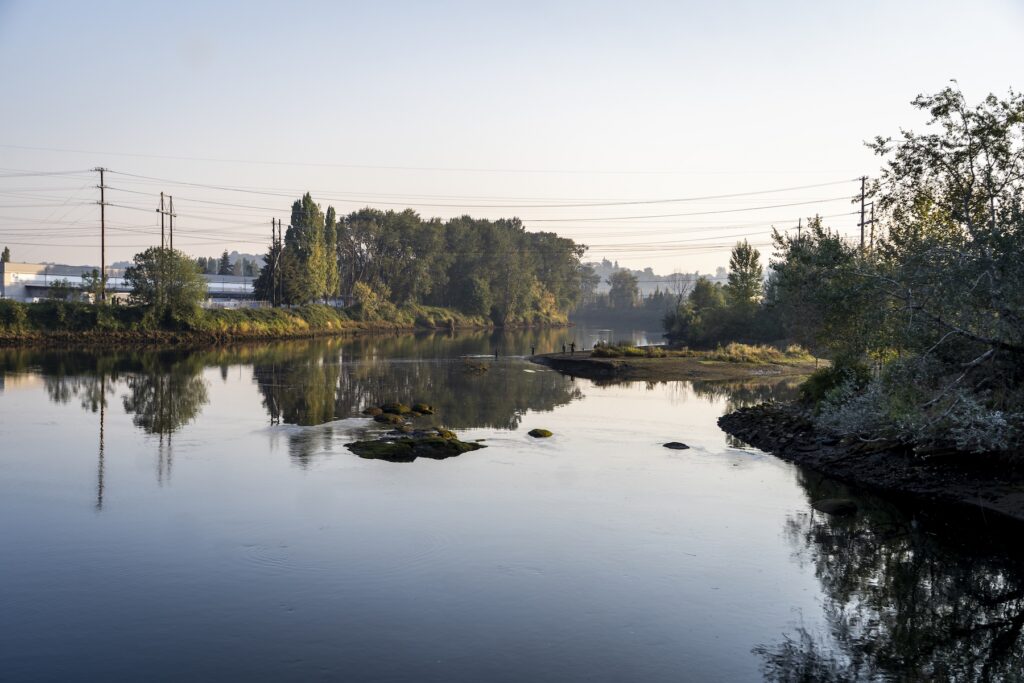
These days, if you walk to the edge of the Duwamish River People’s Park from October through mid-February—the period when sediment cleaning can safely be done without disturbing endangered species—you might see the whole picture: A barge sits with its bright lights shining on the water while an industrial crane fitted with a clamshell grab reaches over a gunwale into a square demarcated by buoys, drops into the night-black water, and comes up with a mouthful of sediment to deposit on the deck before it is dewatered, treated, and moved to a “confined disposal facility.”
“We didn’t want to ignore the impacts beyond the river itself — things like gentrification, displacement, and economic inequality.”
Last year, more than three thousand baby salmon were observed right here, growing among the mudflats and tidal marshes near the park. Just across the water is the original site of St. George Parish School, one of many schools where Coast Salish children were forced to unlearn their heritage and assimilate into settler colonial culture. Everywhere you look, a moving, enduring picture exists of damage that can’t be fully undone, but you’ll also see persistent dedication, people seeking justice, and communal joy.
“We’re always advocating for more green spaces here for communities, because we know it helps human health,” said López. “Now we have the Duwamish River People’s Park. You can see the trees planted by our youth. You can see the native plants. You can see tribal members fishing their ancestral waters. You can see the mark of our community.”
Take Action:
- Join an event with the Duwamish River Community Coalition.
- Learn about polluted rivers and how to join a future cleanup event.
- Donate to the Duwamish Alive! Coalition.