
In the spring of 1968, a group of 30 leading intellectuals and thinkers from 10 countries congregated in Rome, Italy, to discuss a very light topic – the present and future predicament of life on Earth.
This initial meeting would eventually give rise to “The Club of Rome,” a nonprofit think tank dedicated to leading systems-thinkers and industry-leading problem-solvers, incorporating economics, ecology, political, and social inputs.
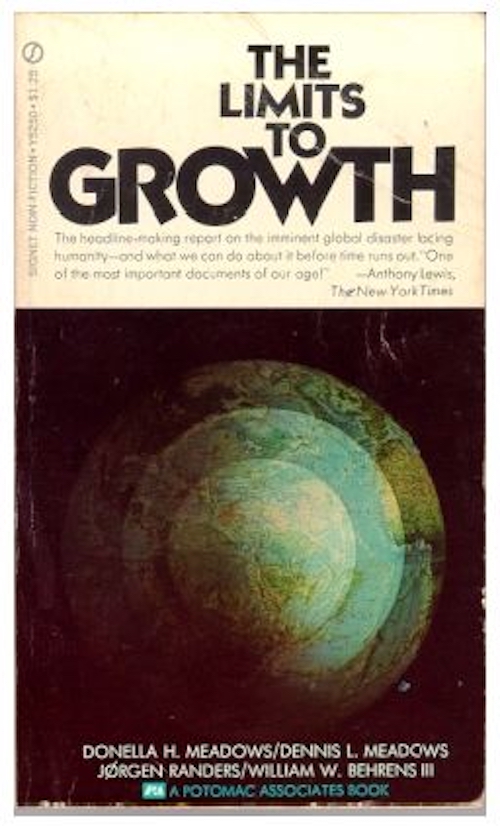
Several members spent the following years breaking ground on a larger study of these overlapping variables, and, on March 2, 1972, along with a research team at MIT, published, The Limits of Growth.
From the Club of Rome website:
“In the summer of 1970, an international team of researchers at the Massachusetts Institute of Technology (MIT) began a study of the implications of continued worldwide growth. They examined the five basic factors that determine and, in their interactions, ultimately limit growth on this planet-population increase, agricultural production, nonrenewable resource depletion, industrial output, and pollution generation. The MIT team fed data on these five factors into a global computer model and then tested the behaviour of the model under several sets of assumptions to determine alternative patterns for humankind’s future. The Limits to Growth is the nontechnical report of their findings. The book contains a message of hope as well. The authors state that: ‘The challenge of overshoot from decision delay is real, but easily solvable if human society decided to act,’ meaning that forward looking policy could prevent humanity from overshooting the aforementioned planetary limits.”
The book sold over 30 million copies and helped to launch the modern environmental movement.
In 2023, five decades after The Limits of Growth was published, Katy Shields and Vegard Beyer put together a three-part podcast, The Tipping Point, which explores the question:
How was this book and these findings, all of which are becoming a reality, essentially ignored?
Based on the late author Donella Meadows’s unpublished memoirs and featuring rare original audio recordings, this podcast accompanies Donella and Dennis Meadows and their team of scientists on a mission to educate the world about ecological crises and their solutions.
Part One: The Problematique
Kicking off in Harvard in the late 1960s, Part One explores how young scientists found themselves thrust into one of the most controversial – but also prescient – scientific projects of all time.
Part Two: Maybe We Did Want to Save the World
Part Two dives into the serendipitous and somewhat chaotic circumstances that thrust the book, initially not intended as a book or for a large audience, into the global spotlight, and recounts the intense PR struggle that would ensue.
Part Three: Where Are We Going, Really?
Part Three takes a deep dive into how the researchers navigated the aftermath of their seminal publication, including their second attempt to warn the world in the 1990s, and track the post-2000 resurgence of interest in their work against the backdrop of escalating environmental crises.