

This articles run in a section of The Tyee called “What Works: The Business of a Healthy Bioregion,” where you’ll find profiles of people creating the low-carbon, regenerative economy we need from Alaska to central California. What Works is funded by Magic Canoe.
Felix Böck didn’t plan on becoming the chopstick guy. When the 36-year-old German engineer first arrived in Vancouver a decade ago, it was as part of a joint project among three universities trying to figure out how to use structural bamboo in construction.
But Böck — who loves takeout sushi and wanted to test out a circular economy model — instead found himself starting a new company, ChopValue, that takes discarded chopsticks out of the trash and turns them into tables, coasters, and cutting boards, among other items.
“I had a pretty exciting career, a very fulfilling career,” Böck said, standing in ChopValue’s flagship Vancouver factory beside a long table made out of pressed chopsticks. “When I moved to Vancouver, I became the chopstick guy.”
But, he added, “I was totally OK with it, because I knew the reason why we commercialized the ChopValue product was because we wanted to test one market, with one product, with one resource stream.”
Böck founded the company in 2016, initially paying rent and employees’ salary out of his University of British Columbia teaching assistant salary.
Today, ChopValue is a global company. The first franchise location opened in Calgary in 2020, and the company has since expanded to include 13 other “microfactories” around the world.
How it Works
Although chopsticks are mostly made out of aspen, fir, or cedar in Asia, in North America they are primarily manufactured from bamboo. In Vancouver, an estimated 100,000 chopsticks are thrown out every day — roughly one chopstick for every seven residents — creating a veritable treasure trove of underutilized material.
That made waste chopsticks a perfect fit for Böck, who began his career as a woodworker and eventually earned his doctorate in creating composite bamboo materials at UBC.
Böck had two goals: remove chopsticks from the landfill stream, and prove that waste could be a resource.
Each ChopValue microfactory is essentially a small woodworking shop — except instead of using wood, they source used chopsticks from local restaurants, malls, and other institutions.
Vancouver’s ChopValue site has collection boxes at restaurants such as Urban Fare, Noodlebox, Earls, and Pho Hoa, as well as long-standing partnerships with the Vancouver International Airport and Simon Fraser University.
Those places have been quick to come on board.
“Chopsticks, just by taking them out of the general waste stream to upcycling, it actually, operationally, is a win for many other flows in the system,” said SFU’s associate director of food and campus services, Simon Tse.
The university started collecting chopsticks in 2019, and the program took off two years later.
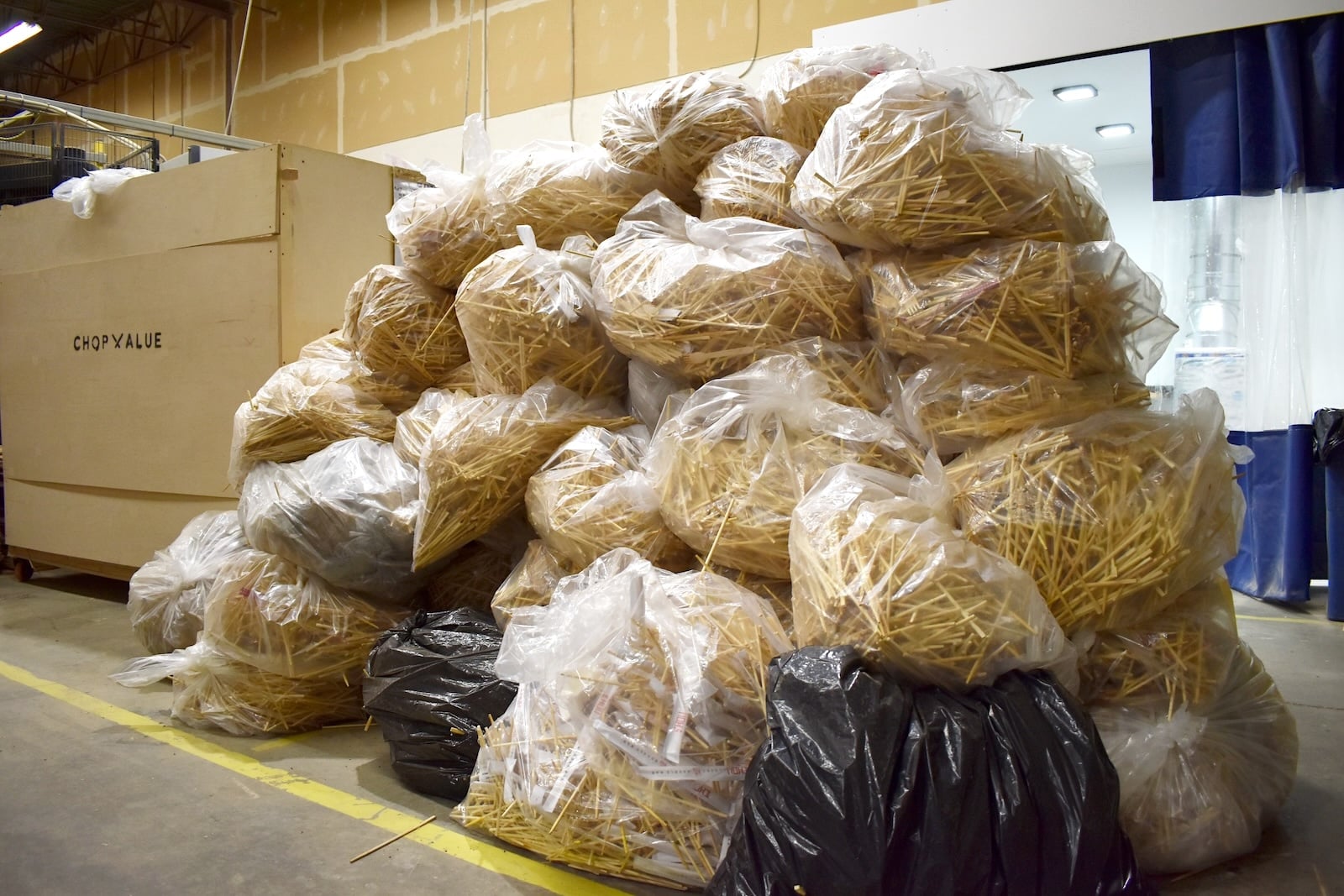
All in all, ChopValue’s Vancouver location brings in roughly 350,000 chopsticks each week.
“Just by taking [chopsticks] out of the general waste stream to upcycling, it actually, operationally, is a win for many other flows in the system.”
ChopValue provides cardboard containers to each of its partners, so hungry sushi lovers have a place to put their used chopsticks. (Some places, like SFU, have opted to build their own, more permanent collection bins.) ChopValue employees come on a schedule to pick up the chopsticks and deliver them to the nearest microfactory.
Each delivery bag contains hundreds of chopsticks — and often some undesirable debris like wooden forks or paper packaging. The bags are emptied onto a shaking table, which helps separate the debris and shake food residue off of sticks. Then, it’s into a water-based resin bath for a soak.
The resin is food-safe, according to ChopValue director of sustainability Sabrina Kon.
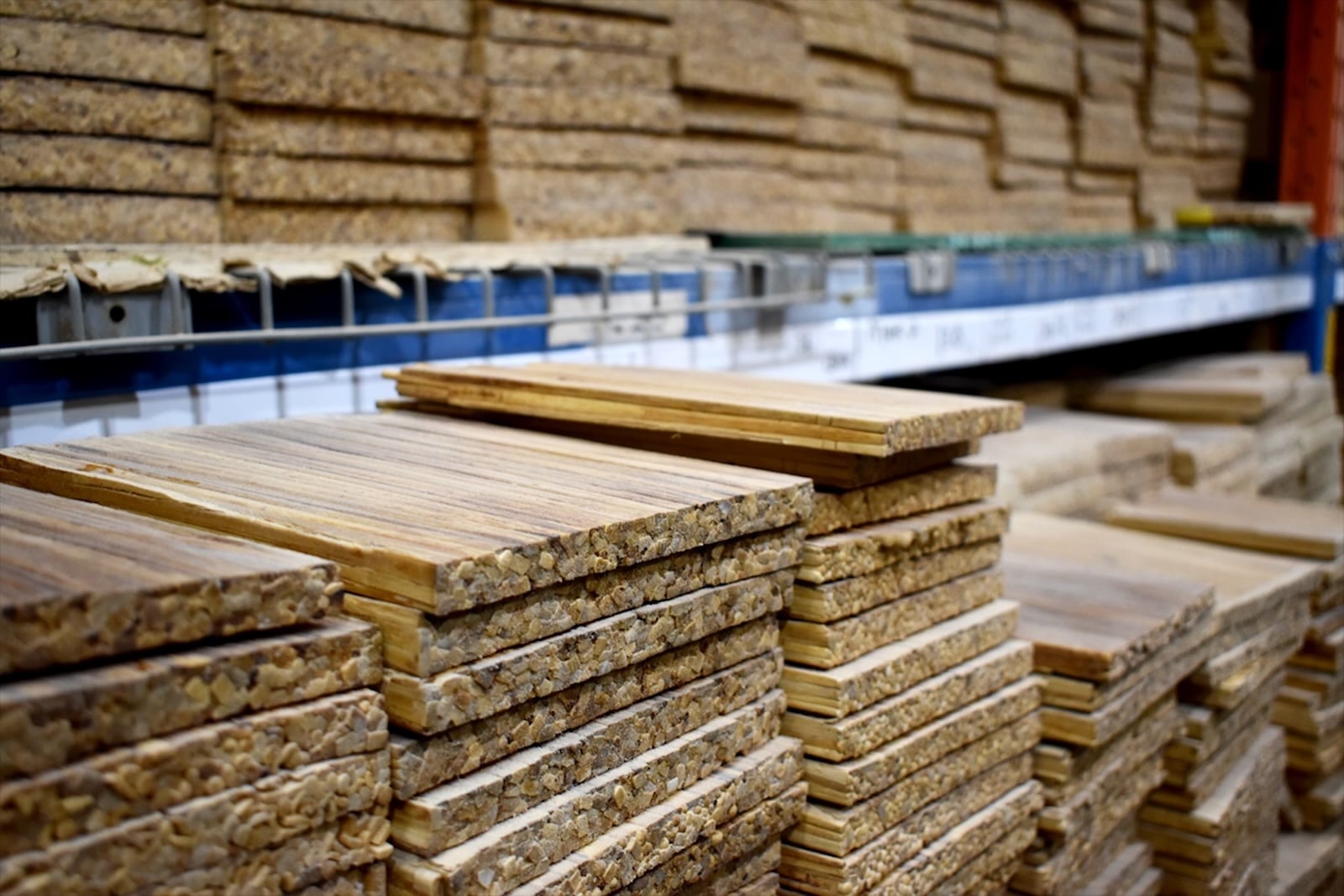
After the bath, it’s into the oven for a high-heat bake. The long drying time and the high temperatures kill bacteria on the chopsticks and also dry out the bamboo. Depending on the sugar content in the bamboo, the process can also create caramelization.
That caramelization adds interest and color to the finished product: a tile-like block of pressed chopsticks held together by additional resin.
Each square is roughly the length of one chopstick and is created using a proprietary hydraulic press.
The press squeezes the chopsticks into a finished block in a matter of minutes, using significantly less binding material than other reclaimed wood products, Kon said. ChopValue’s finished blocks are typically six per cent to 10 per cent resin, while other companies may have resin ratios as high as 80 per cent.
(This high ratio can be a problem in products that use formaldehyde-based adhesives. The formaldehyde gas leaks from the material and can potentially cause cancer at high levels. ChopValue does not use formaldehyde-based adhesives.)
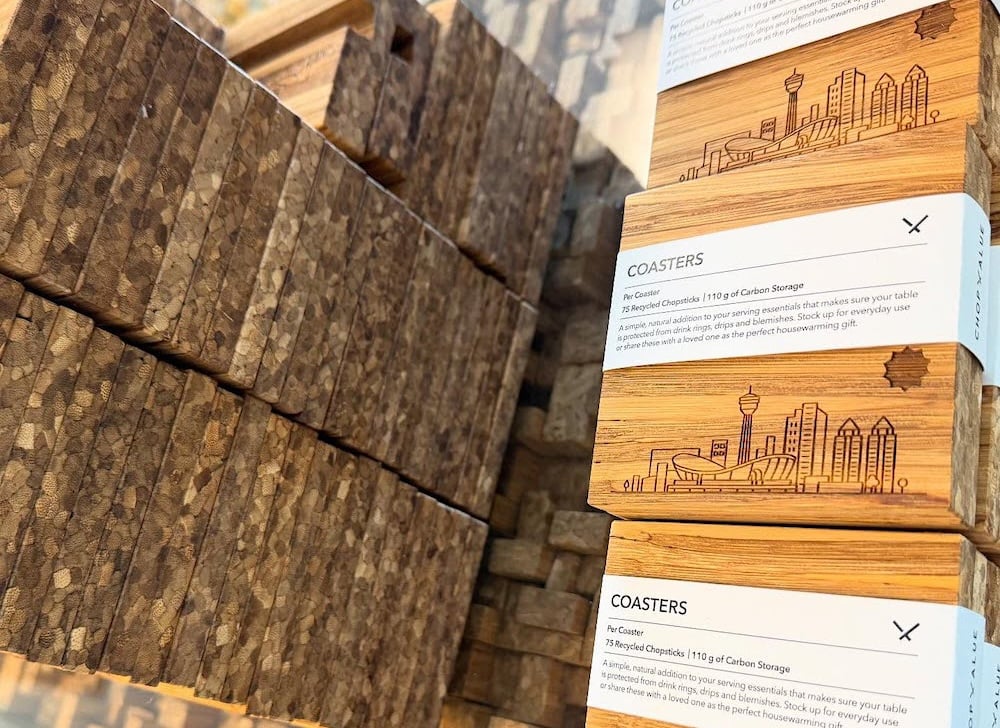
Once the tiles are complete, the rest of the process proceeds just like those seen in an average wood shop. Cutting, gluing, sanding, and finishing all takes place on a few work tables, with folks like woodworker Ben Robert spending their shifts creating tables for restaurants, charcuterie boards for hostesses, and signs and backdrops for businesses.
The process itself isn’t particularly groundbreaking — other sustainable not-quite-wood products are made in a similar fashion. But Böck wasn’t trying to reinvent the wheel with ChopValue; he just wanted to prove that garbage could be worth something.
Where it Goes
When SFU began collecting chopsticks for ChopValue, Tse said it was “the right thing to do” for the university. The program took off in 2021, and Tse said it’s been a success for the flow of their entire food service department.
“Chopsticks get jammed in the dishwasher, if they are reusable. They also put holes through garbage bags . . . and then you put a trail of food service waste from the restaurant all the way to the back,” he explained.
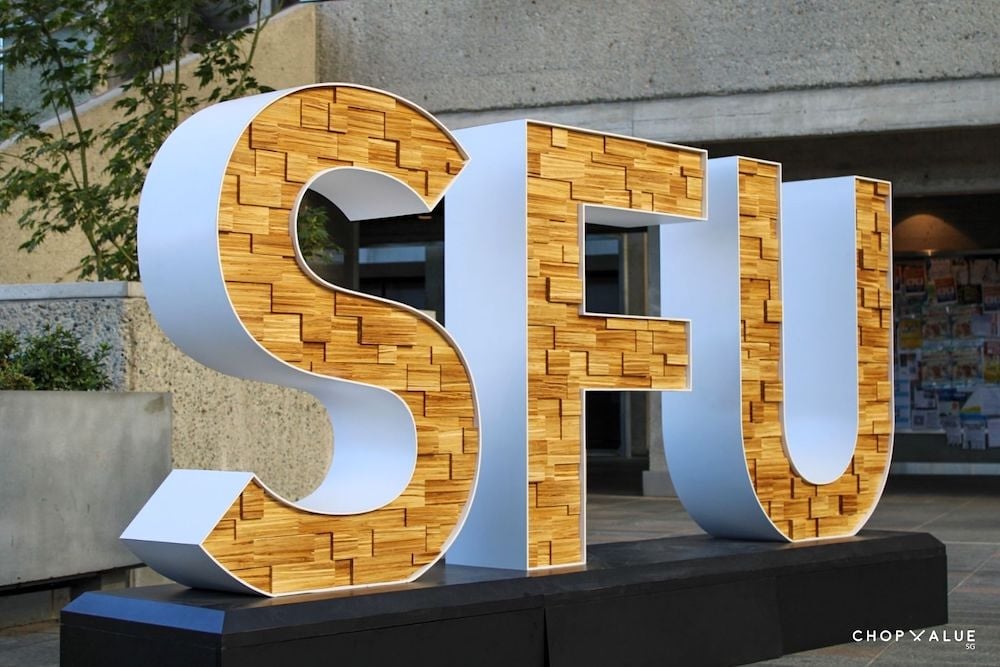
SFU installed new, permanent chopstick collection bins in 2021, making it harder for distracted university students to contaminate the collection with other garbage. The university has roughly 10 bins across its five campus buildings; those are collected every two weeks, and the chopsticks are brought to ChopValue’s Vancouver site. And recently, more than 114,000 chopsticks made their way back to SFU in the form of a giant welcome display.
The four-foot-tall SFU letters were installed in 2022, and Tse said the university wanted them as a backdrop for events on campus. “Everyone loves something that’s photo-worthy, but also sends a message,” he said. The university has also purchased cutting boards from ChopValue to use as awards for culinary events.
Restaurants such as A&W have also contracted ChopValue to make family-style tables for their renovated buildings. Calgary ChopValue franchise owner Joanne Dafoe said the A&W contract is a big part of her business, although her small team also produces a lot of custom tables for homes as well. Recently, the Calgary equestrian facility Spruce Meadows asked ChopValue to provide tables for its new clubhouse.
“I’m a born-and-raised Calgarian,” Dafoe said. “I’m of an age where I remember Spruce Meadows opening.”
“To actually have our furniture in that facility is very rewarding from a local perspective,” she said.
What Comes Next
That perspective is key to ChopValue’s mandate: stepping away from the centralized manufacturing that dominates much of the industry, and stepping towards hyperlocal production.
“From day one, it was not so much about the chopstick but about the microfactory itself,” Böck explained. “Can the microfactory be a viable business model to scale circularity around the world?”
Chopsticks were the tool, he said, the easily accessible waste product that could show that small manufacturing facilities with only a handful of employees can produce high-quality goods. The Vancouver microfactory has around six employees working in the shop; Calgary has around five.
“I really didn’t think I would change the world with 100,000 chopsticks a day in Vancouver,” Böck said. “But I knew if I could create a viable business model with just these 100,000 chopsticks a day in Vancouver, and I could replicate that in other cities around the world — so I could prove that no matter what culture, no matter if recycling is popular or not, I could replicate it — then I could prove that this is a path forward.”
“Can the microfactory be a viable business model to scale circularity around the world?”
So far, ChopValue has 15 microfactories, and it says in its annual report that nearly 70 others are set to come on board soon.
Startup costs for a complete microfactory run to over $300,000, not including property costs, although ChopValue also has cheaper options for people who just want to customize products, rather than make them.
ChopValue plans to expand to over 400 microfactories by 2034. The goal is not as outlandish as it may sound. There are currently billions of disposable chopsticks used worldwide, and the demand for them is only expected to increase.
ChopValue plans to focus its growth in China and Japan, aiming to open 200 microfactories in those countries. ChopValue was present at the 2025 World Expo in Osaka and said in a blog post that it “saw clear signs that Japan is ready to scale” in the circular economy. ChopValue currently has one microfactory in Kawasaki, and none in China.
Dafoe in Calgary noted there have been some bumps in the franchising road, especially on the production side. Her franchise location faces challenges related to Canada’s cold winters, which could affect tiles and inventory. Other locations in places like Indonesia are affected by high humidity and heat.
Dafoe told The Tyee ChopValue’s teams have been conducting a lot of tests, and franchise owners are able to learn from both each other and Böck on the best path forward.
So, step by step, ChopValue’s manufacturing processes are becoming smoother. But beyond chopsticks, Böck’s circular-economy-focused microfactory business model hasn’t been as successful as he’d initially hoped.
So Böck is taking matters into his own hands.
In April of last year, he became CEO of another company — Microfactory Venture Platform, which aims to create “waste to resource” streams similar to ChopValue. Its website showcases ChopValue as the commercialized pilot project for the company.
The Microfactory Venture Platform website suggests it has looked at coffee grounds, disposable packaging, textile fibers, and wood construction waste. All have possibilities. But for Böck, changing industry norms is where the real challenge lies — especially among the companies that make the waste in the first place.
“They’re not doing this for the sustainability story; they’re doing this because there’s actually economical value in their waste streams,” he said.
“Without the broader commitment from the industry . . . I don’t think we have the scale of the resources,” he added. “And that’s what we’re working on. That takes time.”