
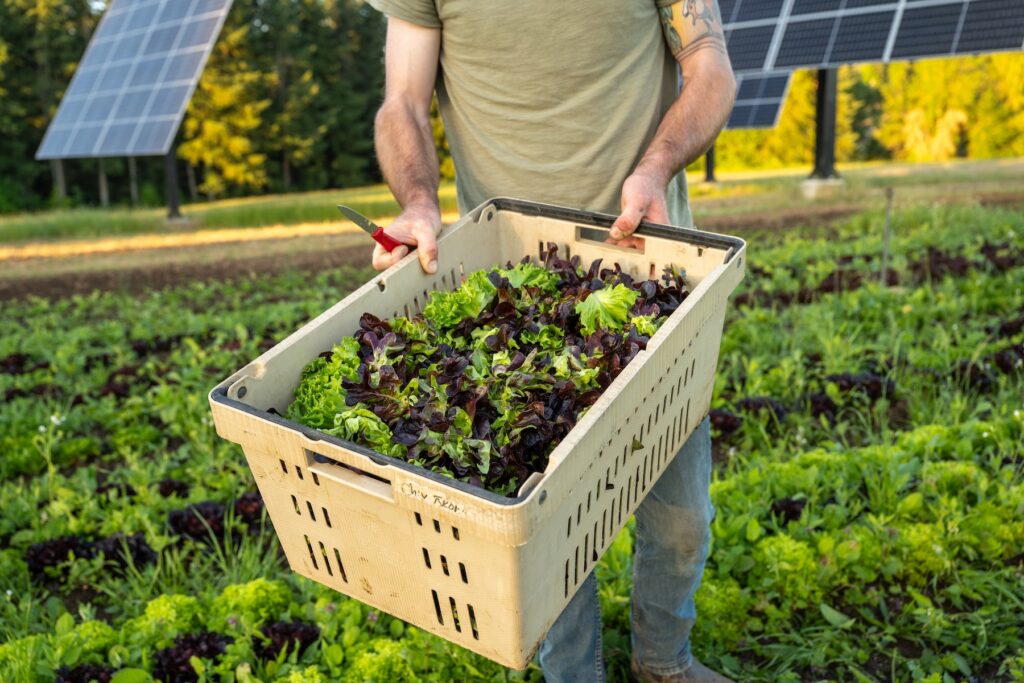
The Pacific Northwest, especially west of the Cascade Mountains, is known for its mild, damp climate, historically ideal for growing leafy greens. But as climate change raises the mercury, those harvests have become harder to reap.
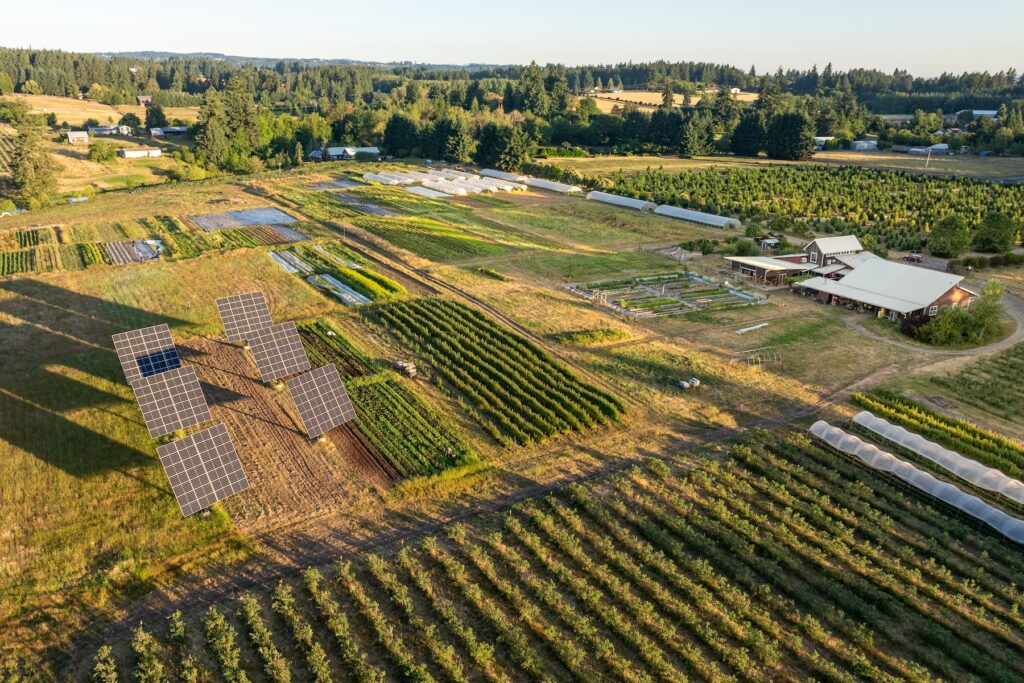
At Our Table Cooperative, a fifty-eight-acre farm fifteen minutes south of Portland, Oregon, the cofounder, Narendra Varma, has seen the elevated warmth cut his harvests in half. And that hits harder because the vegetables that are most vulnerable during summer, which is precisely when customers hunger most for a cool, refreshing salad.
Varma and his team began to seek ways to protect the heat-sensitive plants they sow. “The obvious thing was to provide shade of some sort,” he said. But the standard approach—stringing up a semitransparent cloth—is imperfect. Shade sails only let a fixed amount of light through, and once they’re up, they’re up. “You can’t say, I want shade for two hours of the day and not the other seven.”
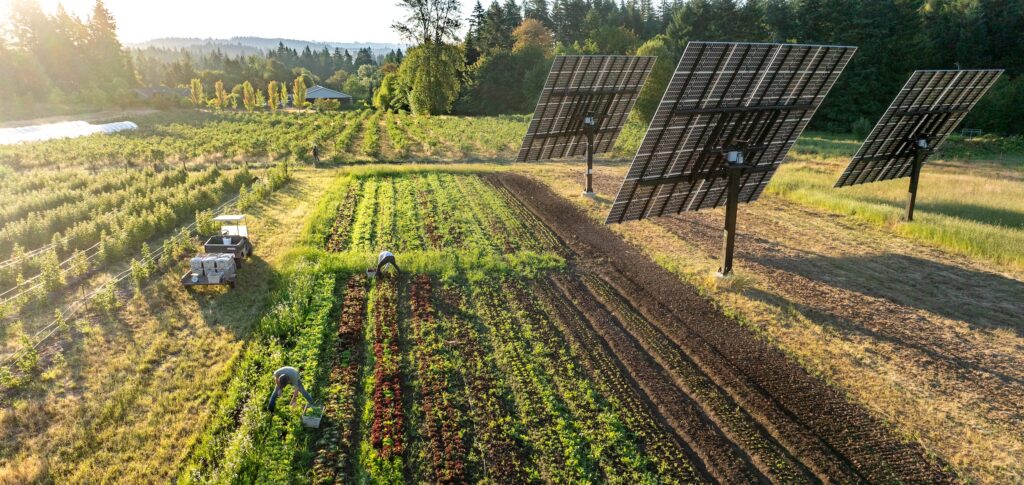
He wanted something he could control. Solar panels seemed the solution, with the advantage of extra energy. As the 2024 growing season ended, Our Table debuted the Lettuce Shine microgrid, which innovates on a well-established technology—agrivoltaics—to give the farm the controllable shade it seeks.
Making the Most of the Sun
Agrivoltaics—solar arrays above productive farmland—has existed for decades. Two German researchers proposed the concept back in 1981, and a Japanese engineer built the first prototype in 2004. Back then, it was called “solar sharing,” with a focus on efficiency.
Neither plants nor panels absorb all the sunlight they receive. Chlorophyll can, at best, convert just 6 percent of solar energy into sugar, and even the most efficient photovoltaic cells currently available capture just under 50 percent of the sunlight striking them. However, most photovoltaic cells on the market are only 20 percent efficient, so sharing light between panels and plants can get the most out of what sunrays offer.
In 2010, a team of French scientists built the first agrivoltaic setup, designed for experimentation. The layout looked similar to a typical solar farm: long rows of panels presenting flat faces in one direction like a well-ordered infantry. While most arrays have a few feet of ground clearance, these panels stood more than 13 feet off the ground. The gap between each row was also widened to allow extra light to reach the undergrowth.
The practice spread around the world, with abundant data to show its advantages, and for two decades following this first prototype, only one additional innovation was made. In 2014, the French team upgraded their array to allow the solar panels to perform a kind of slow-motion backflip over the course of a day in following the sun.
When Chad Higgins, an Oregon State University professor focused on farm sustainability, walked by a new solar array on OSU’s campus more than a decade ago, it was obvious to him that the panels had changed the microclimate beneath them. “The grass was literally greener under the solar array,” he told me.
Higgins and a PhD student began what he called “experiments of opportunity” to study how temperature, humidity, soil moisture, wind speed, grass growth, and other conditions in the solar field’s shadow compared to those of a sun-exposed patch nearby.
Their research has grown, too; since then, he’s become an internationally recognized expert in the field. Higgins even has an experimental agrivoltaics array of his own called Solar Harvest at OSU’s research extension center in Aurora, Oregon, about twenty miles south of Portland.
A New Era in Agrivoltaics
Despite all the early success of agrivoltaics, Varma at Our Table still felt the standard approach was limited compared to what he wanted. “You get a checkerboard pattern of shade and sunlight underneath,” he said. “It’s about 50 percent shade, and it moves throughout the day. But none of them could vary the shade amounts.”
Varma partnered with the Oregon Clean Power Cooperative, who helped build Solar Harvest, to devise a way to get adjustable shade. The clean power co-op pointed Our Table toward a new player in the state’s renewable energy industry, Stracker Solar, which built a product Varma described as a giant, controllable shade umbrella.
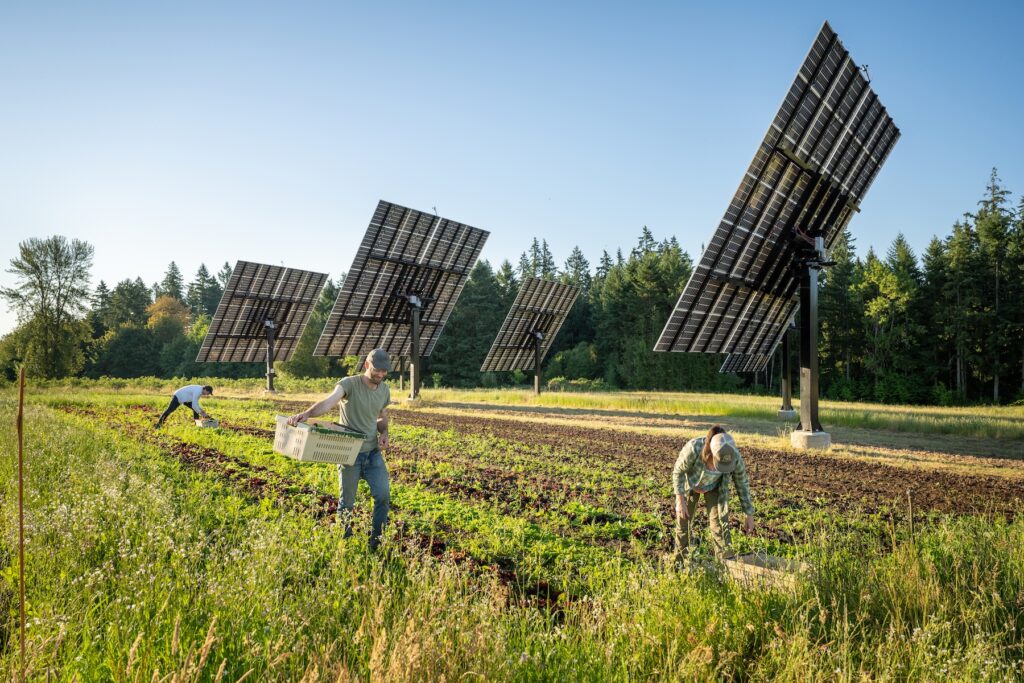
Most sun-tracking solar setups, including Solar Harvest, spin around a single axis. Each “Stracker,” by contrast, mounts a rectangular array of twenty-eight solar panels high off the ground on a steel column with a single pivot atop that allows the system to behave like a giant sunflower, twisting and swiveling on two axes to forever face sunward.
While a Stracker typically just micro-rotates toward the sun every few minutes, the company’s chair of global expansion, Freddy Sennhauser, said that they’ll soon allow Varma and others to take more custom ownership over the exact orientation of the panels. Now, Our Table’s six Strackers produce seventy-five kilowatts of power and shade a third of an acre while taking up just thirty square feet of total ground area.
A Break in the Shade
Adjusting shade fall matters for more than just managing heat—it supports agricultural efficiency. Even full-sun crops like corn, beans, squash, and tomatoes can only soak up around six hours of direct light “before its muscles get tired,” Higgins said.
“More than that, they basically just get stressed out,” Varma added. “They use more water. The flavors change. They don’t produce as much.”
In open fields, growers can’t do much but cope with rising temperatures. But devices like Strackers change that, and they could represent a major advance in how farmers manage their fields. “You’ve got an irrigation system for managing your water resource. You’ve got a tillage plan and a fertilizer plan for managing your soil resource,” Higgins said. “So you should probably also have equipment and a plan to manage your sun resource.”
As far as Varma and Sennhauser knew, when their Lettuce Shine system was installed in October 2024, nothing else like it existed in the world. To investigate how to make the most of this new approach to agrivoltaics, Varma planned to partner with Higgins’s lab. The researchers intended to install sensors across the farm and sample the plants to collect data that could help Our Table optimize its strategy. Unfortunately, the research funding was among many budget lines erased when the Trump administration took over the federal ledger.
“You’ve got an irrigation system for managing your water resource. You’ve got a tillage plan and a fertilizer plan for managing your soil resource. So you should probably also have equipment and a plan to manage your sun resource.”
Chad Higgins
Even without that data, Varma felt their first year with the Strackers was a success. “Our water usage under the panels is about half of what it is anywhere else,” he said.
These new panels weren’t without controversy, however. When people shopped the farm’s on-site grocery after the Strackers were first erected, Varma said that some found them ugly. Others looked out the windows and saw the future: worker-owners harvesting greens as huge, black-faced sunflowers swiveled above, following the heat.
The cooperative’s member-owners who were originally skeptical were easily swayed by the savings the microgrid provided on energy bills. Still, where some people might see solar itself as a cash crop, Varma believes that “the dollar value is more in the crop than it is in the energy.” Sure, the electricity itself is worth at most $30,000 a year to Our Table, “but if I can improve the yields of my lettuce in July and August,” Varma said, “I can generate $50,000 or $60,000 worth of extra lettuce.”
A Problem of Priorities
In too many cases, “agriculture takes second fiddle” to solar, Varma said. This results in sterile fields of photovoltaics that swallow fertile farmlands nationwide.
Many farming communities are, therefore, skeptical of solar, said Carrie Seay-Fleming, an environmental sociologist at the University of Arizona. In places like Pinal County, Arizona, where Seay-Fleming has talked with many farmers, thousands of acres have been lost to industrial solar. “There’s already a lot of animosity,” she said. Pinal County residents tend to pucker at agrivoltaics too. Meanwhile, in nearby Tucson, younger, small-scale farmers are eager to experiment with the approach in the hopes of making their farms’ finances easier to manage.
Higgins has seen a similar divide in rural Oregon, especially when agrivoltaics are planned on lands zoned for “exclusive farm use.” Coming from a rural area, Higgins knows what these communities can offer, and also what they’re burdened with. “I want to do everything I can to support them,” Higgins said. He sees agrivoltaics as a way to do that. But if a community doesn’t want it, “that’s their prerogative,” he added, and it should be honored.
That hasn’t stopped big solar developers from placing agrivoltaics experts into regional planning councils, to downplay community criticisms, Seay-Fleming said. Such a possibility worries Higgins. “It’s my biggest fear that my research is used to justify a project and circumvent the desires of a community,” he said.
The way Higgins and Seay-Fleming see it, if a proposed agrivoltaics project garners community support without stacked testimonies, then not only must the promise of dual use be kept, but developers should also provide tangible benefits for the surrounding community. Guaranteeing that will require legislation that establishes clear rules for agrivoltaics that support locally led projects.
“One farmer . . . talked about agrivoltaics as a ripe peach waiting to be plucked,” Seay-Fleming said, but questions about financing and technical hurdles have kept them from pulling it off the branch.
This is why the support of the Oregon Clean Power Cooperative was so important for Our Table’s success. Varma was already knowledgeable about solar, but the co-op’s support helped his team navigate the nuances and get the project’s $460,000 price tag paid through a $324,000 grant from Portland General Electric, with federal tax credits covering the rest.
If more farmers can navigate the hurdles of installing solar on their farms, the potential is considerable. It will help save water, improve yields, and reduce energy costs, all at a time when farming is proving harder than ever and retiring farmers struggle to find successors. As Higgins’s research has shown, converting just one percent of croplands worldwide to agrivoltaics could offset global energy demands and bring international climate goals within reach—proving once more that what’s good for land workers is good for the planet.