

This article runs in a section of The Tyee called “What Works: The Business of a Healthy Bioregion,” where you’ll find profiles of people creating the low-carbon, regenerative economy we need from Alaska to central California. This section is sponsored by Magic Canoe and the Salmon Nation Trust.
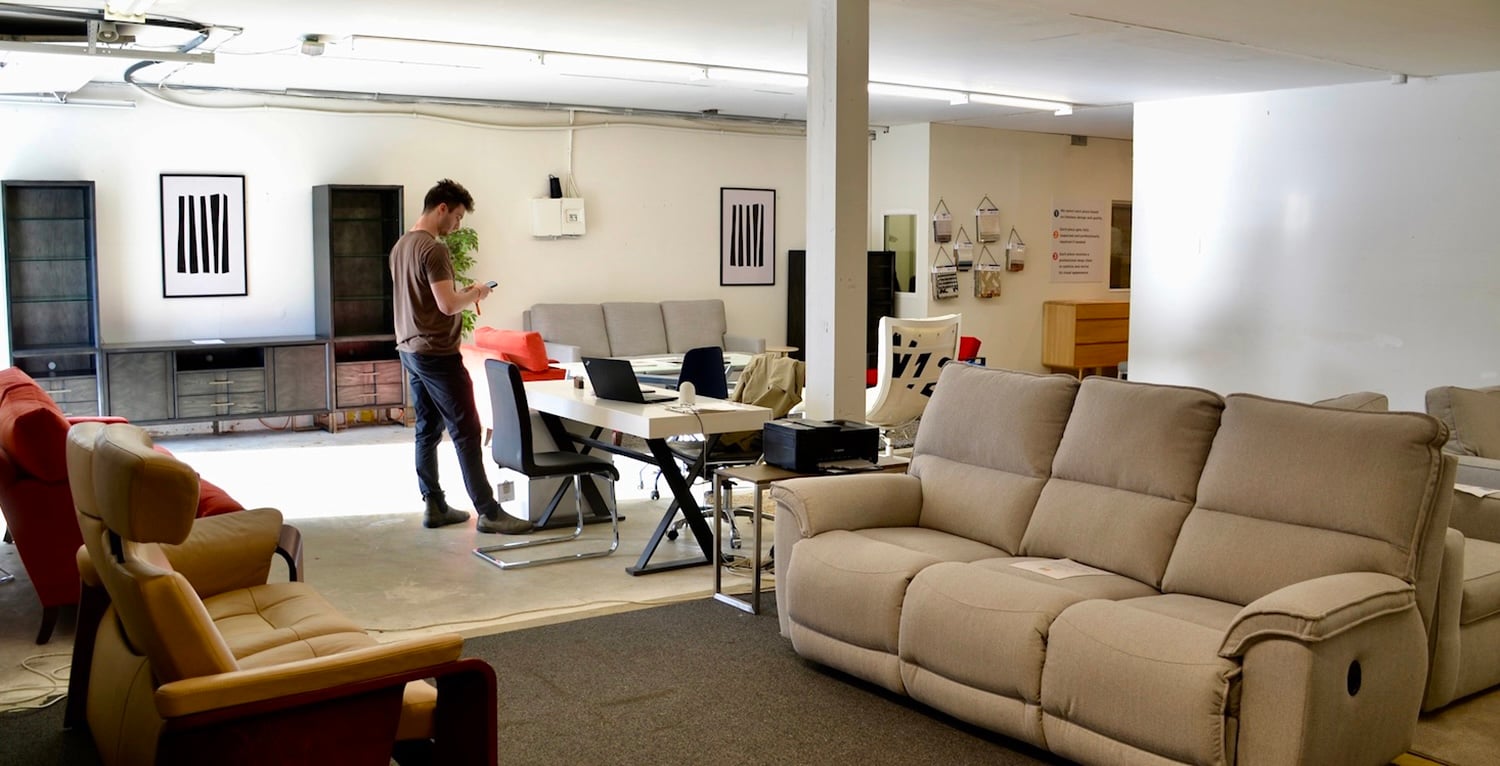
In the basement of a building outside downtown Victoria, Elwyn Thom gently places his hand on the refinished leather of a beige couch.
It came from a man who was moving and didn’t want to rent a bigger U-Haul, he explains. A few steps away, there’s a recliner from a couple in their mid-80s who didn’t know what to do with it.
A couch in the corner has a similar story. It was brought in by a landlord who recently sold his apartment and needed to get rid of the piece by moving day.
For more than three years, Thom has collected furniture destined for the dump, fixing it up and reselling the pieces at a discounted price.
“I can tell you where every piece in this store comes from,” Thom said.
Beginning in grade school, Thom was curious about how he could become “financially secure.” In his childhood years, he watched his parents find ways to save a buck: getting discounted items at the grocery store, not buying expensive toys, working within a budget.
After he graduated from college, Thom found inspiration from an unlikely source: YouTube. He stumbled upon a couple of videos from a motivational speaker and a man who sold used sofas from storage lockers.
That’s when the light bulb went off.
Thom, who previously ran a student painting business, saw a market for used furniture. A business like that, he thought, could provide some financial security and simultaneously help the planet.
Today Thom employs two people and calculates his company’s yearly revenue at over $420,000.
Thom estimates his business, Recertified Furniture, has saved over 45,000 kilograms of waste, including more than 700 couches, from the landfill since 2022.
That’s a significant number for a region that, as recently as 2019, estimated it spent six figures on removing large furniture from the dump every year.
Finding a Place to Sit
About 672,000 tonnes of furniture are thrown out in Canada per year, according to a 2021 report from the National Zero Waste Council. That’s equivalent to over 286,500 brand new Toyota Tacomas.
The numbers are even worse south of the border, where an estimated 12 million U.S. tons, or about 10 million metric tonnes, of furniture are discarded every year.
All that waste can strain landfills, especially considering some components of furniture break down slowly or are not biodegradable at all.
“Landfill is not a good option,” said Akash Gondaliya, who co-authored a 2023 study that found reusing furniture could significantly reduce the University of British Columbia’s furniture emissions.
Furniture is made up of wood, metal and plastic. The latter may take anywhere from hundreds to thousands of years to break down, while metal won’t decompose. Even wood, arguably the most biodegradable part of furniture, will produce methane gas as it degrades over time, Gondaliya said.
“The best way to conserve any resource is to reuse,” he said. “That should be the first action if you want a sustainable future.”
The furniture spotlight has been centered on Victoria in recent years.
In 2019, CBC reported that a local furniture company was throwing away “what appeared to be quality, lightly used couches,” saying that it was hard to donate or get rid of furniture in the region.
Thom said he’s addressing that problem.
While other companies tackle a piece of the consigning, transporting, cleaning, repairing, and selling puzzle, Recertified Furniture is a one-stop shop.
The goal is to rehome furniture that donation centers or other businesses can’t address because “they don’t have the equipment or they don’t have the means to sell high-end stuff for high-end prices that need investment work,” Thom said. (Thom’s furniture retails anywhere from a couple of hundred dollars to well into the thousands.)
The model works like this: Thom gets an inquiry about a piece, or pieces, of furniture. He’ll then review what, if anything, needs to be fixed and suggest a sale price with the seller. If all goes well, Thom and his team clean it and hire a contractor to fix issues such as stitching or wood scrapes, and the piece gets sold.
When people are moving and need to get rid of furniture, Thom and his team will pick up the items and transport them to his storefront.
The model is a win-win for buyers and sellers, Thom said. Sellers make more money consigning with him than paying the transportation and landfill fees to get rid of the item. The seller gets 50 per cent of the sale, minus a fee for repairs.
And buyers get to purchase refurbished furniture at a discount.
Moving Couches Between Businesses
The model may be helpful for other businesses too.
Recently Thom received a couch with a broken leg from a direct-to-consumer company, which may not have been able to resell or donate to charity. (Some charities are not able to repair donated pieces.)
The couch was repaired and listed on the market.
“That’s something that would have gotten tossed and now it has lots of life ahead of it,” Thom said.
It turns out there may be many other unwanted pieces of furniture in a similar spot.
Although some major businesses like Walmart, Ikea, and Amazon have programs that sell refurbished items, the retail industry reported an estimated $890 billion worth of returned goods in 2024.
Not all that is furniture. But oftentimes companies don’t want to deal with returned items. A 2022 article reported that some companies contemplated giving customers their money back to hang on to the clothing or furniture they wanted to return.
Thom considers developing more business-to-business relationships with furniture and mattress companies important for the growth of his company — and for avoiding future waste.
A Seat for Everyone at the Table
Of course, Thom can’t buy or sell every piece of furniture that comes his way.
If it’s not sellable, he’ll take it to another local business, such as Habitat for Humanity Victoria, Charmaine’s Past and Present, or Local Liquidations. If none of those places can do anything with it, well, then it’s off to the dump.
Thom said he dumps just a small amount of all the items that come his way.
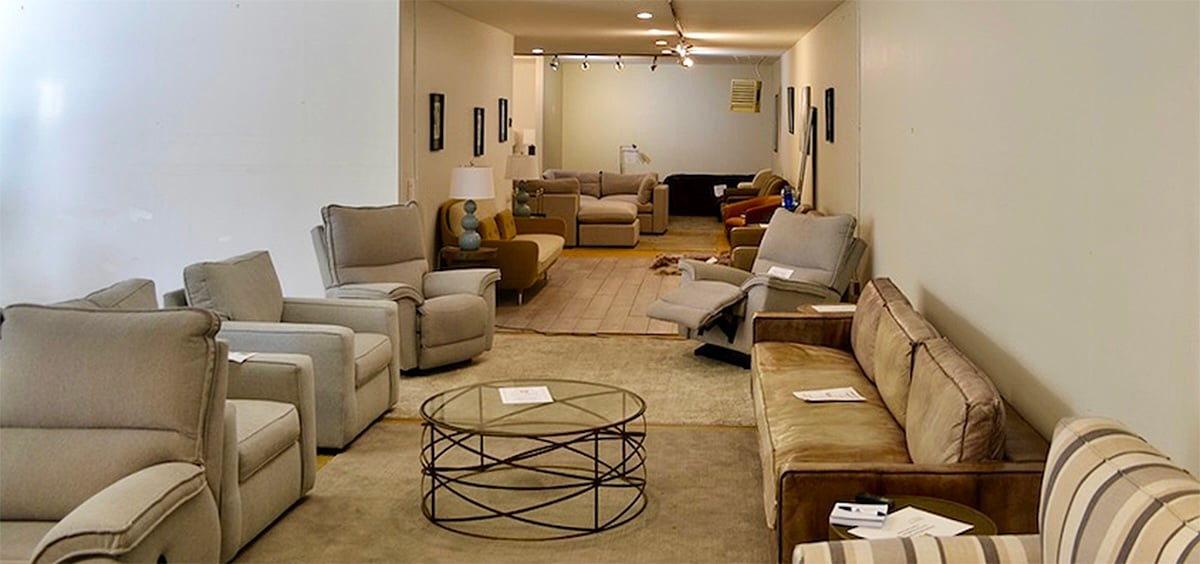
Ultimately Thom is filling a gap in the region’s furniture puzzle, said Carmen Rempel, chief executive officer of Habitat for Humanity Victoria. The charity has two locations in Greater Victoria where residents can donate and buy goods such as furniture. As part of their registered charity status, they can’t “add value to the items that come in,” meaning they can’t fix or refurbish anything, Rempel said.
“We need organizations like Elwyn’s,” Rempel said, adding that businesses like his can serve as a keystone of sorts, preventing waste and supporting the upholstery sector, an industry that has reportedly struggled to grow in recent years.
“Our planet cannot sustain this culture of waste that we have created for ourselves,” Rempel said.
Rory Perron, owner of Local Liquidations, said he’s gotten “three or four loads” of stuff from Thom in the past. Perron, who also has a store in Calgary and worked in Vancouver and Surrey, believes there’s space for both businesses to grow in Victoria, a region that has an appetite for reusing furniture and diverting it from the landfill.
“Victoria, more than anywhere else, is keen on getting used furniture, reusing old stuff and repurposing,” Perron told The Tyee.