

This article runs in a section of The Tyee called “What Works: The Business of a Healthy Bioregion,” where you’ll find profiles of people creating the low-carbon, regenerative economy we need from Alaska to central California. This section is sponsored by Magic Canoe and the Salmon Nation Trust.
Minto Roy looks out the window and takes his measure of a tree.
The oak towers about 60 feet over a golf course not far from his Pitt Meadows home, swaying with every gust of wind. Dozens of golfers walk by without a second glance. But Roy can’t stop looking at it.
This tree, if turned into paper, would make about four boxes, each box holding 5,000 sheets, Roy estimates. Which means the dense fiber of this large oak hold bigger-than-usual paper potential. Typically, one tree produces anywhere from 5,000 to 10,000 sheets of paper.
The impacts stack up.
More than a third of all wood that is traded globally is used to make paper products, according to the World Wildlife Fund. Even though more than half of U.S. paper and cardboard waste ends up in landfills every year, the sector was worth an estimated $482 billion in 2023.
Across the Pacific Northwest, pulp and paper mills have caused air and water pollution in B.C., Washington, and Oregon.
All of this preoccupies Roy. Which is why, when he eyes a mighty oak, he may also imagine vast, rippling fields of sugar cane.
In the early 2010s, a handful of businesses started manufacturing tree-free paper, products that are made without wood fiber but with alternatives like wheat, cotton, or hemp. The movement even reached Hollywood, where actor Woody Harrelson pushed for a non-wood paper mill.
Roy joined the trend in 2011, co-founding Social Print Paper, a New Westminster-based company that uses sugar cane to make printing and copy paper.
“It’s indiscernible from tree fiber paper,” Roy said. “It looks the same, feels the same, performs the same.”
Major retailers and consumers seem to agree. Social Print Paper currently sells more than 350 million “sugar sheets” across Canada per year, with goals of expanding to the United States and increasing that number over the next two years.
Yesterday’s Paper
Social Print Paper is taking a page from the ancient past.
Historically, paper was not sourced from trees. The first papers made in AD 5 used textile waste, old rags, and fishnets, which included hemp, according to a University of Toronto researcher. It wasn’t until the early 1800s that wood became the dominant source of paper in Europe, due to the then-seemingly vast supply of trees on the continent, shifting the papermaking process globally.
Both wood and tree-free paper cause emissions, said Jim Bowyer, a professor emeritus in bioproducts and biosystems engineering from the University of Minnesota who has studied the pros and cons of tree-free paper for more than a decade.
But paper made from crop residue—the norm in China, India, Mexico, and many other countries—has the potential to be better for the environment, he said. Think of it like a recycling win-win. If a piece of land is clear cut and used for growing corn or wheat, using the byproduct to make paper gives the plot two useful purposes instead of one.
“The impact that is allocated to that co-product is remarkably less than if that were the sole product on the land,” Bowyer said.

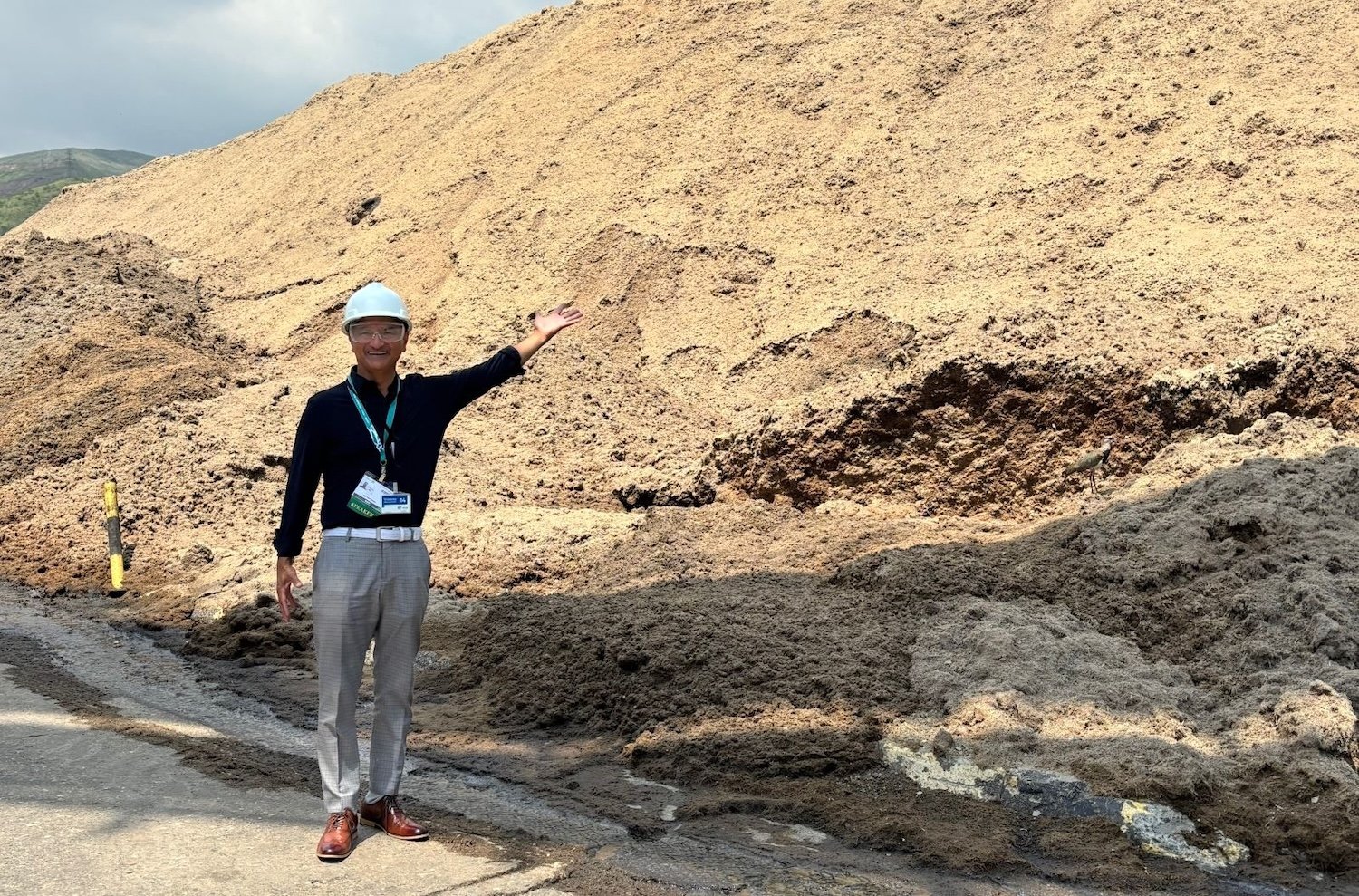
Social Print Paper makes its paper in Colombia from bagasse—a dry, pulpy material produced when sugar cane is crushed to make sugar, juices, or alcohol. Social Print then ships the paper to one of its four Canadian distribution centers in Vancouver, Toronto, Montreal, and Calgary, and the products are sold by outlets including London Drugs, Staples, and Amazon.
Other places have made the switch too, including the technology organization BCNET and the Provincial Health Services Authority, which has seen an 80 per cent reduction in carbon emissions from paper usage since last year, according to the Canadian Collaboration for Sustainable Procurement.
Another Crown corporation, BC Assessment Authority, adopted Social Print’s sugar sheets at its Victoria office several months ago and recently rolled it out at all 12 offices across the province. It was a “sweet choice that reflects our commitment to sustainability and supporting our local economy,” said Bryan Murao, BC Assessment spokesperson and assessor, in an email.
It’s a product that also has the potential to be scaled quickly. Colombian sugar cane can be harvested up to four times per year, much quicker than the 20 to 30 years it may take for a tree to grow and be chopped down to make paper, according to Roy.
“There’s an abundance of sugar cane fiber,” Roy said.
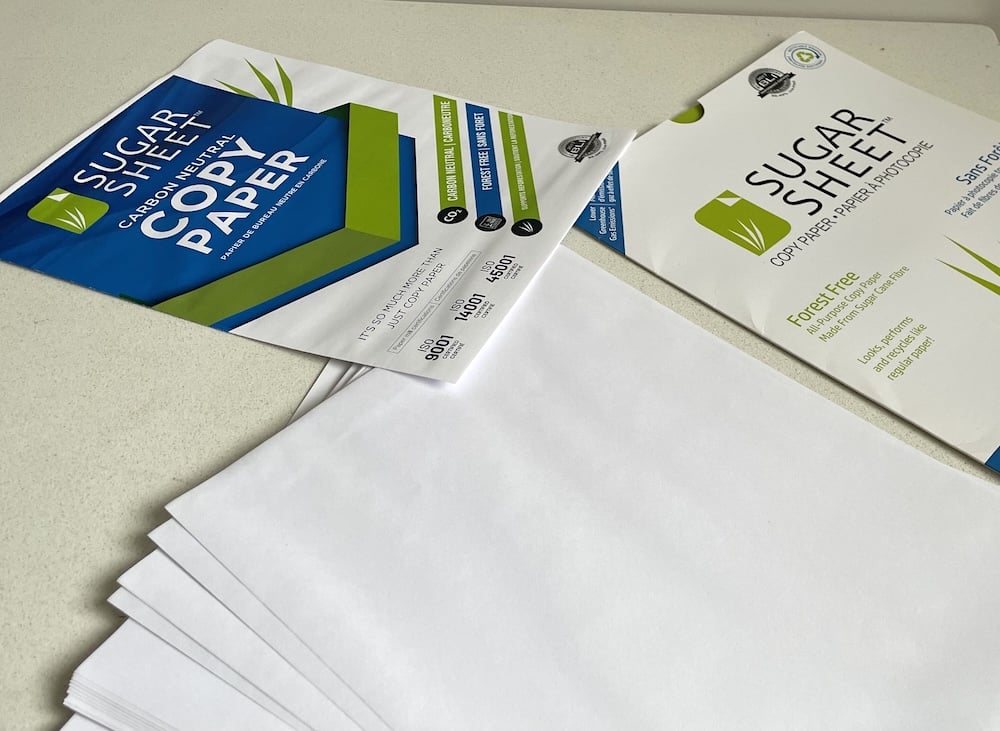
Customers for Social Print’s treeless paper products include BC Crown corporations and a school district. Photo for The Tyee by Josh Kozelj.However, sugar cane isn’t something that’s grown in North America’s northwest coastal bioregion. Roy notes that shipping his paper from Colombia to Canada by sea has a lower carbon footprint compared with air and rail travel, and Social Print has hired a third-party company to analyze its carbon footprint.
Trying to Sweeten a Shrinking Market
If it’s so easy to harvest and make paper out of nearly any kind of fiber, why have some companies aiming to make tree-free paper fallen short?
One firm in eastern Washington closed most of its operations in 2022, five years after it pledged to use straw for paper.
Another sustainable paper business in Victoria called Ecosource has closed as well.
Part of the challenge may be that the world is using less paper. Even though the sector produces millions of tons of paper per year, the production rate has been steadily falling since the 1990s. For that reason, Bowyer thinks it may be hard for tree-free papers to make much headway.
“It’s a major decline, and because of that, producers are hungry for markets,” said Bowyer. He also noted that to be competitive, any tree-free paper product must match the tear strength of wood-based paper, and some don’t in his view. “What society looks for is high-quality paper at a competitive cost.”
Dan Sullivan, owner of a sustainable paper company based in Los Angeles, California Green Press, said that many businesses come to him looking for environmentally friendly paper.
“Anyone who has any sort of sensibility knows that we live in an ecosystem with limited resources,” Sullivan said. “What we try to do is limit and be as conscious as possible about how we produce printing [paper].” Most of his business comes from post-consumer waste, products made from recycled paper like newspapers, office paper and cardboard. But 10 per cent is made up of tree-free products like wheat, sugar cane, and bamboo.
The tree-free reach is global too. Founded in 2015, a Dutch company, Paper on the Rocks, has found a market for notebooks made from stone and agricultural waste. Karst Stone Paper, an Australian company, also recently sold stone-based notebooks to over 80 countries and clients like Facebook, WeWork, and TED.
Social Print has found customers in nearby public schools.
The North Vancouver School District started using paper made by Roy’s company at the beginning of this year, sending “a number of truckloads” to its 40 school and administration buildings, said Chris Carter, the district’s manager of purchasing and contracts.
The switch came amid tariff talk from U.S. President Donald Trump in the early days of his second term. The district previously used paper from a “traditional” U.S.-based company and has not noticed a difference in quality.
“I couldn’t tell you the difference between regular paper; it looks identical, the tearability feels exactly the same,” Carter said.
That’s the message Roy’s looking to hear more of moving forward. He’s hopeful that others are curious to give tree-free products a try.
“Here’s an eco-friendly paper that looks, feels, and performs the same as a traditional paper,” Roy said.