
After coral reefs, kelp forests are the marine ecosystem most threatened by climate change. Like coral, kelp can experience a type of “bleaching” from heat stress caused by prolonged periods of above-average temperatures. Unlike coral, which loses the microscopic algae responsible for much of its color, kelp loses its golden green-brown pigment as heat stress disrupts photosynthesis at the cellular level.
The reason we don’t see imagery of vast, bleached kelp forests online the way we do with coral reefs is that this kind of severe heat stress also causes kelp tissue to deteriorate, leaving behind no obvious remains.
Entire forests vanish.
Tristin McHugh, kelp project director for The Nature Conservancy, describes what it was like to experience the staggering kelp forest loss along the northern coast of California brought on by the 2014–2016 marine heat wave known as the Blob.
“I remember being in the field and the ocean was hot,” she said. “I was doing [bull] kelp counts, and I moved my hand to go touch a kelp. It literally disintegrated, just completely fell apart because its body could not exist in that temperature of water.”
McHugh grew up loving the ocean. Her grandmother was a diver and would go abalone diving, something the area was well known for before the kelp forest loss. McHugh was in her last year of undergrad when the Blob started forming in the Gulf of Alaska.
By fall 2014, the Blob had reached Northern California, where its affects coincided with the 2015–2016 El Niño event. Sea surface temperatures rose approximately 4°F to 7°F (2° to 4°C) above average. The warmest nearshore waters along parts of the Sonoma and Mendocino coast reaching around 66° to 68°F (19° to 20°C). Bull kelp’s optimal temperature range is between 46° and 57°F (8° and 14°C). Sustained temperatures of 64°F (18°C) or higher cause a high risk of mortality and reproductive failure.
As a marine biology and ecology researcher, McHugh was diving all the time when the marine heat wave hit. Looking back, she now sees how that timing launched the trajectory of her career. But while it was happening, no one knew just how devastating the effects would be.
Sonoma and Mendocino Counties ended up losing 96 percent of their bull kelp canopy. To put that into terrestrial perspective, it would be like watching 30,000 acres of forest reduced to a few spread-out clusters of trees.
Elsewhere along the California coast, various levels of natural recovery occurred. Bull kelp is an annual, growing rapidly through spring and summer months to reach the light at the ocean’s surface, forming a forest canopy. With the right conditions, bull kelp can grow up to a foot a day. When observed from the surface, whole forests can seemingly spring up overnight.
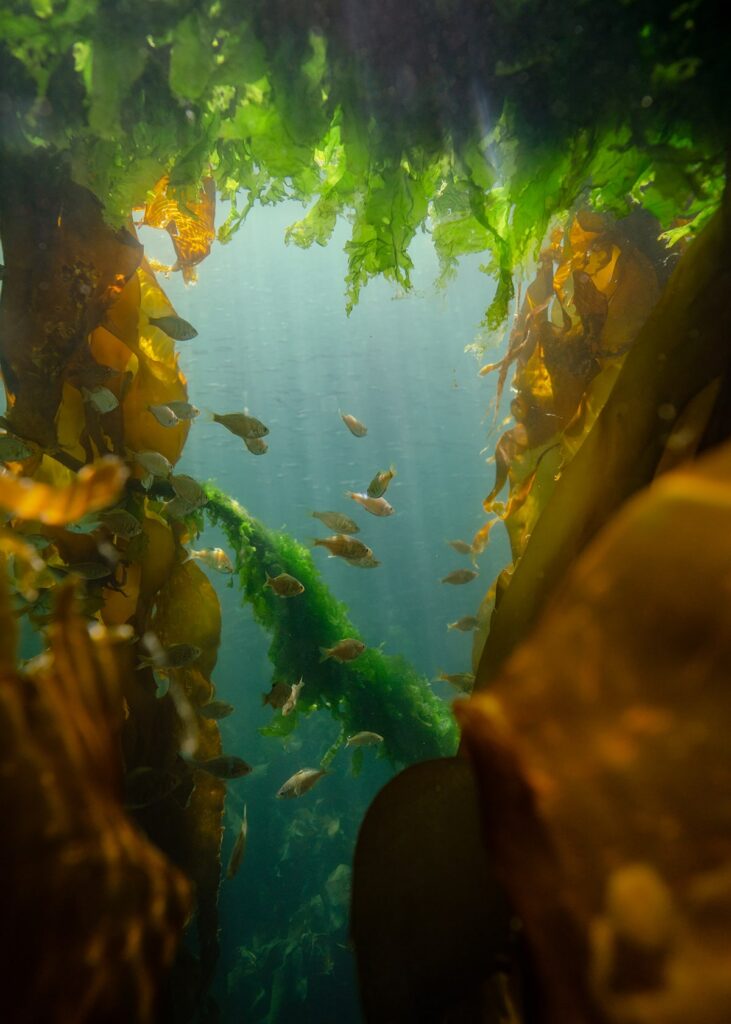
Anchored to the seafloor by a root-looking holdfast, bull kelp’s long, skinny stipe ends in a round gas bladder called a pneumatocyst. Four short branching structures sprout from the pneumatocyst, growing a crown of up to a hundred blades that splay out in the current and provide surface area for photosynthesis and nutrient absorption.
From the start to the end of growing season, a bull kelp forest will provide three-dimensional habitat for hundreds of species, from tiny invertebrates to large marine mammals. Understory seaweeds, including winged and stalked kelp, sway beneath the canopy, while juvenile herring schools among the blades seek shelter and food. Harbor seals swim gracefully through the stipes, and sea slugs like the hooded nudibranch lay long, intricate ribbons of eggs along the wide bull kelp blades.
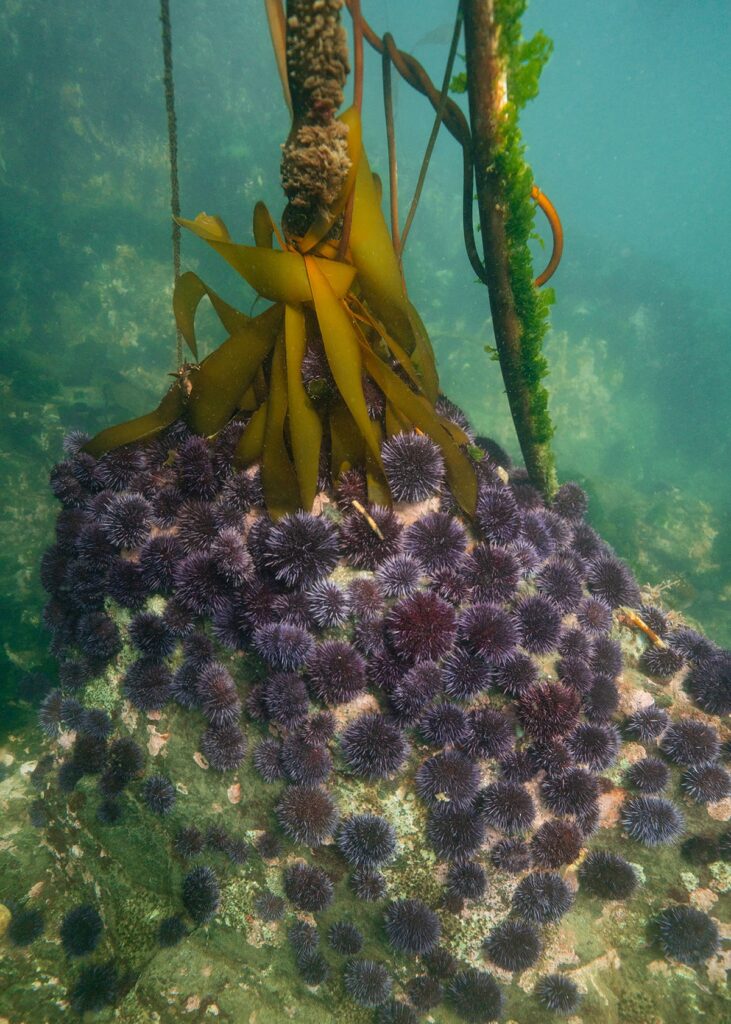
Near the end of the summer, some of these blades will form thick, dark reproductive patches called sori. These patches detach from the blades and sink to the seafloor to release spores as the whole kelp forest begins to die off in the seasonal change to fall. In this microscopic life stage, it can persist on the seafloor for a few years, waiting for favorable conditions, but after the years-long marine heat wave and related stressors, a new threat to young kelp appeared: herds of hungry purple urchins.
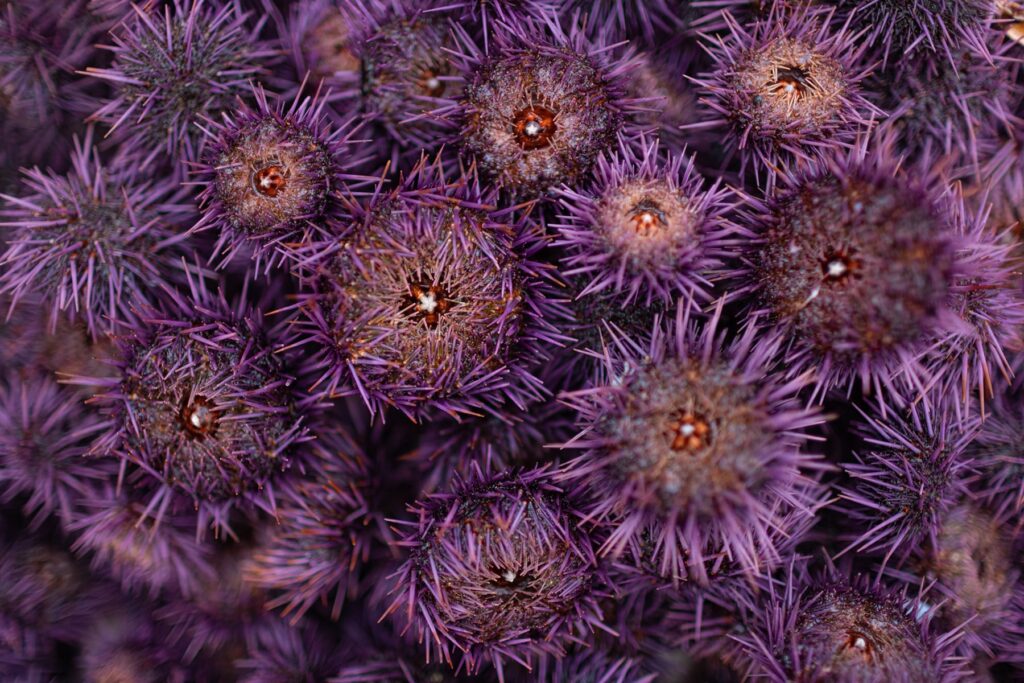
Purple urchins—sometimes referred to as “the cockroaches of the sea,” though far cuter—are incredibly resilient. They can go for years without eating, existing in a zombielike state. Unlike other local urchin species, purple urchins can form dense groups numbering in the hundreds, even thousands, mowing down kelp to create what are known as urchin barrens. Divers describe the seascape left behind as “moon rock” for how devoid of life it is.
Though purple urchins aren’t new to the area, their skyrocketing numbers are.
An outbreak of Vibrio pectenicida, the genus of bacteria that causes sea star wasting disease (SSWD), coincided with the Blob and led to the death of billions of sea stars from Alaska to Baja in only two years, 2013 to 2015. This die-off left local kelp forests vulnerable after the decimation of sunflower sea stars, who love to eat purple urchins.
“I remember being in the field and the ocean was hot. I was doing [bull] kelp counts, and I moved my hand to go touch a kelp. It literally disintegrated, just completely fell apart because its body could not exist in that temperature of water.”
Tristin McHugh
Reuven Bank, executive director of the Sunflower Star Laboratory (SSL) and collaborator with The Nature Conservancy, explains that warmer conditions likely made the outbreak worse. “The research has shown that Vibrio pectenicida appears to impact [sea] stars more quickly under warmer water conditions,” said Bank. “Warming oceans didn’t necessarily cause the particular outbreak, but most likely exacerbated it and allowed it to spread faster and become worse.”
Sunflower sea stars are the world’s largest sea star. Some grow more than three feet wide, weigh thirteen pounds, and have up to twenty-four legs. As a keystone predator in kelp forest ecosystems, they are also one of the most susceptible sea stars to SSWD.
Bank describes the sea stars as the “Roombas of the seafloor,” eating urchins in large quantities. At the Sunflower Star Lab, their largest star, appropriately named “Titan,” ate forty-four purple urchins in one day. He didn’t stop because he was full; the lab ran out of urchins.
Bank has found that sunflower stars don’t discriminate between starved and healthy urchins, saying, “They can potentially transform, through direct consumption, the ecology of an urchin barren.”
Their impact goes even beyond consumption. Sunflower stars can also change urchin behavior, causing them to hide more and graze less. Bank’s team is now conducting temporary, controlled outplanting experiments in Monterey Bay, two hours south of San Francisco, to understand how the ecosystem dynamics change around them, and to start answering questions about how to successfully reintroduce these stars to protect kelp.
There’s still a lot to learn, from when the best life stage for outplanting is, to how many stars an ecosystem might need. For Bank, that uncertainty makes collaboration even more important.
“Sunflower star recovery is an awesome example of collaborative conservation in action,” he said. “It’s taking the efforts of many institutions working on both sunflower star recovery as well as other factors of kelp restoration coming together and coordinating to bring back these ecosystems that are so important to all of us. No one institution can go it alone.”
A lot of these institutions or organizations have come together under the Pacific Coast Ocean Restoration Initiative. Led by The Nature Conservancy, it includes Reef Check, Sonoma State University, Mendocino College, and Greater Farallones Association, among others.
Bringing kelp forests back isn’t as simple as putting more kelp in the ocean; the conditions also need to support its survival and recovery. Sea otters, another major urchin predator, were extirpated from Northern California following intensive hunting during the colonial commercial maritime fur trade that occurred roughly from the 1730s to 1840s.
More recently, humans’ role as urchin predators was diminished, too, when the local urchin fishery collapsed alongside the kelp forest. Without those three major urchin predators, newly outplanted kelp remain vulnerable to grazing. So while the Sunflower Star Lab works toward the eventual reintroduction of one native predator, McHugh and her partners have been figuring out how to keep kelp out of reach of urchins.
Juvenile kelp for outplanting is grown in a nursery at Moss Landing Marine Laboratories. Early efforts involved growing kelp on small cobbles that divers could place on the seafloor, but between hungry grazers and the North Coast’s heavy swell, survivorship was low. Then came a series of accidental successes.
At one restoration site, navigation lines had been left in the water over winter. The following year, the team at Moss Landing noticed kelp growing along the lines, while little kelp were growing on the reef below. As the kelp grew, their buoyancy lifted the lines above the seafloor, keeping them out of reach of urchins and other grazers.
That observation helped lead to the development of Arrays to Recover Kelp Ecosystem Vegetation (ARKEVs), which McHugh proudly named after her son, Arev. Here, PVC pipes form a rectangular platform from which rope is strung across for young kelp to be spliced onto by their holdfasts. Another rope connects the platform to a forty-five-pound dumbbell, thus anchoring the kelp’s natural buoyancy and helping it withstand heavy waves.
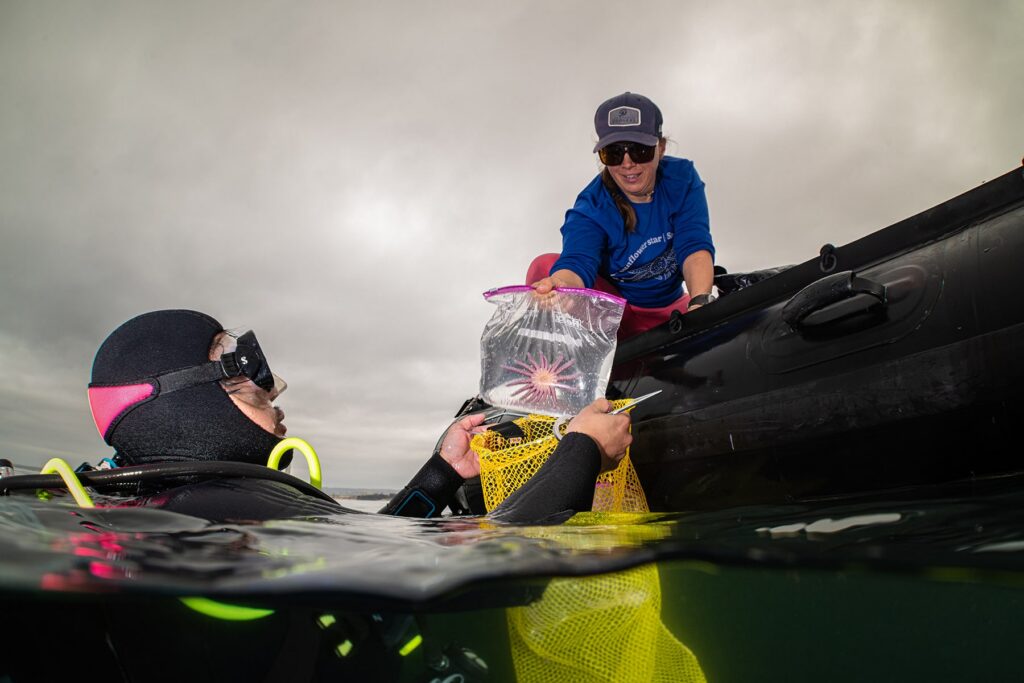
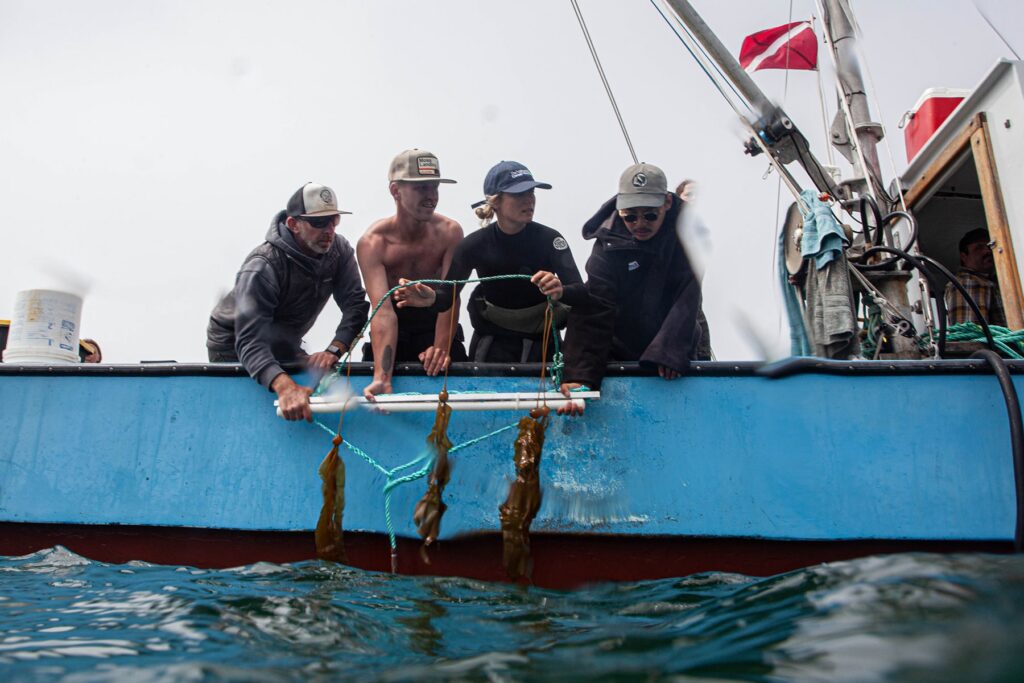
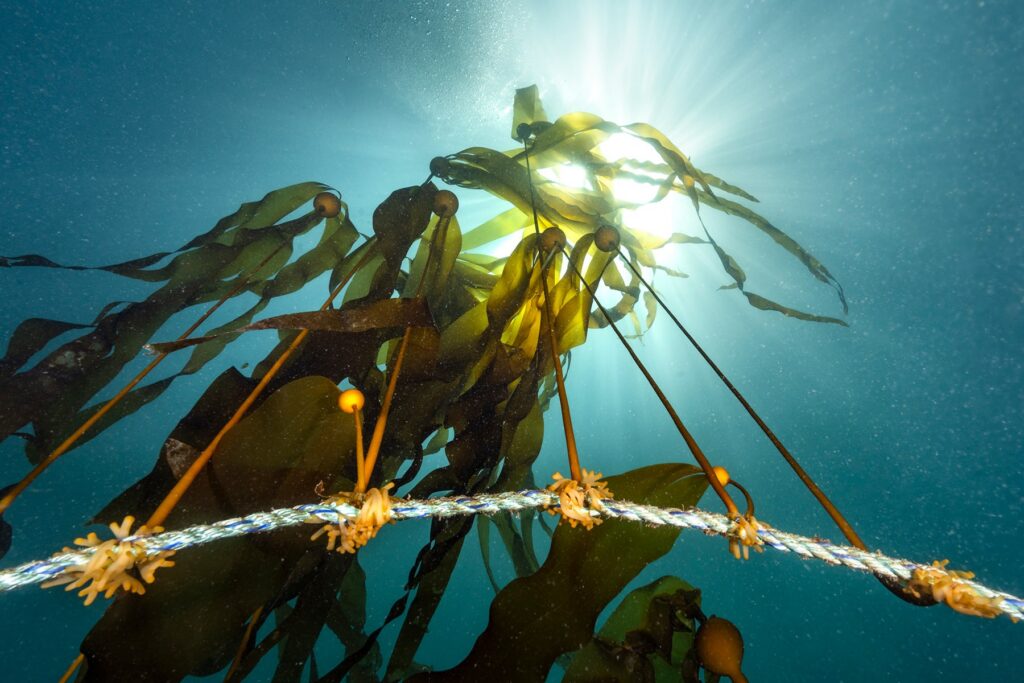
But getting that equipment in and out of the water along Northern California’s rugged coastline is no small feat. This is where second-generation urchin diver Grant Downie comes in.
When more urchin divers were forced to hang up their fins after the region’s fishery collapsed, Downie turned to restoring what was lost. His knowledge of the coastline, experience handling heavy gear at sea, and familiarity with the restoration sites positioned him to support the operational side of outplanting.
For Downie, kelp restoration and the future of the urchin fishery are closely linked. With so many urchins threatening kelp forests, it might seem that commercial harvesting would offer a solution. But there’s a catch: Urchins surviving in a near-starvation state can have very little commercially valuable roe because of their limited food intake, leaving little financial incentive to harvest them. One of the biggest challenges he faces is getting people to understand how bad conditions have become. Successfully re-establishing healthy kelp forests could help one day create the conditions needed for the urchin fishery to return. If it does, he would like to see stewardship built into how it is managed.
Downie said that the broader community didn’t realize the scale of what had been lost until recreational abalone fishing closed and dive tourism declined. It raises a common challenge in ocean conservation:
How do you get people to care about an ecosystem most will never see for themselves?
For artist, author, and Above/Below cofounder Josie Iselin, part of the answer is storytelling. She is one of the creators of The Mysterious World of Bull Kelp, an online project that uses art, photography, detailed science, and character-driven stories to transport visitors underwater and to introduce bull kelp ecology along with the restoration work along the coast, from Alaska to Central California. Launched in 2023, the website was designed as a resource for scientists and restoration groups to share developments in their projects with people of all age levels in their own communities.
But Iselin said online storytelling can only go so far. Some people need to experience the magic of kelp and the work, in person. That thinking helped led to North Coast KelpFest!, created by Above/Below and local partners. The Fort Bragg festival brings together scientists, fishers, artists, and community members for restoration demonstrations, talks, art, food, and even a kelp-themed parade. For McHugh, these various entry points are critical to community engagement. “To some, kelp is food. To some, kelp is a livelihood. To others, kelp is an aesthetic appeal,” she said.
Ultimately, it’s about finding a way to link kelp back to the communities however possible. At last year’s festival, held on bluffs overlooking the coast, visitors could see kelp beds that had visibly improved from the year before.
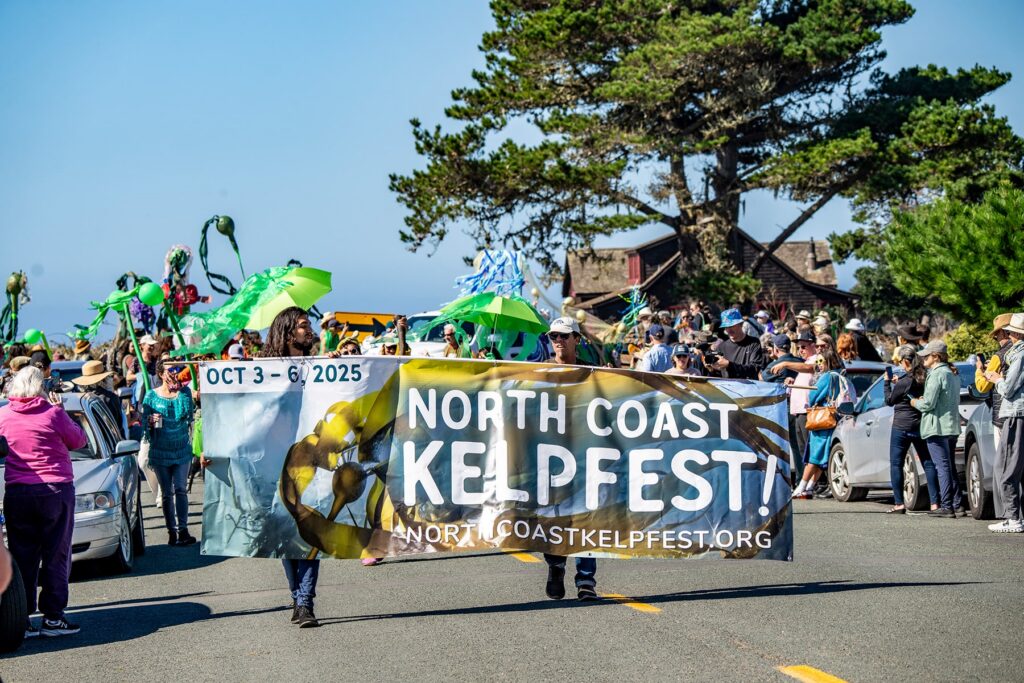
This community connection is becoming increasingly important as federal funding, initially helping organizations across the region collaborate on kelp recovery, approaches its end in 2027.
The KelpFest! is also beginning its own transition, with local leaders taking over the organization. Long-term restoration will likely require more of that local capacity, partnership, and stewardship.
Shared responsibility is part of a larger reality for kelp restoration. Success, McHugh said, will require whole communities—with “many different flavors from many different folks and many different perspectives”—understanding their relationship to these places. No single intervention is capable of restoring an entire ecosystem.
As a testament to McHugh’s tenacity, after first witnessing sunflower stars melt from SSWD and bull kelp disintegrate, she remains hopeful more than a decade later. “There’s no silver bullet, but there are a lot of successful ways to do this.”
Take Action:
- Enroll in Reef Check’s Kelp Forest Monitoring Program. Trained volunteer divers help scientists track changes in kelp forests along the California and Oregon coasts.
- (Sea)stargaze. Help researchers track their recovery by reporting sightings through the Sunflower Sea Star Recovery project on iNaturalist.
- Dive into the Mysterious World of Bull Kelp to learn more about this fascinating ecosystem and the restoration efforts happening throughout Salmon Nation.