
In February 2017, Oxford economist Kate Raworth published her first book, Doughnut Economics: Seven Ways to Think Like a 21st-Century Economist, which promptly launched her into the stratosphere. The book became an international bestseller, translated into 18 languages, and sold more than 100,000 copies in the UK alone.
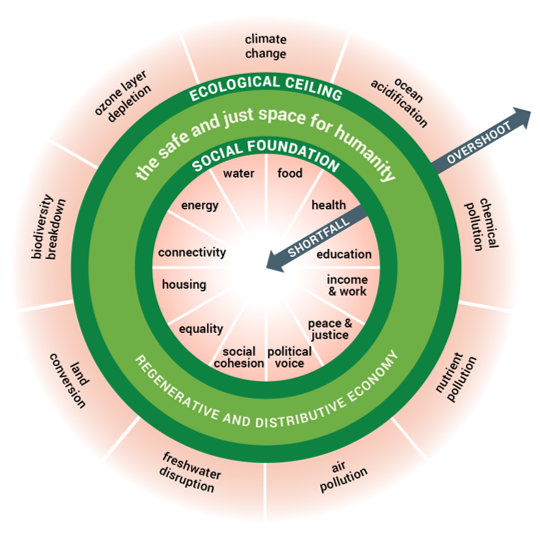
Its power came not only from the writing, but also from the simplicity of its visual—a Doughnut, a model of understanding an economic system by its balance of social demands and ecological limits at the scale of a city, country, or planet. Raworth leveraged the transformational power of the image, realizing how data visualization can have an outsize effect on cultural transformation.
“Our brains are wired for visuals,” she wrote. “When it comes to new economic thinking, draw the change you want to see in the world.” To think differently, we need to see differently. And that requires better models.

“She points out how we can break our addiction to growth; redesign money, finance, and business to be in service to people . . . and create economies that are regenerative and distributive by design,” said the book’s publisher, Chelsea Green.
This reflects what Raworth said last year in a New York Times interview, that economic systems aren’t simply ideas and words—they’re designed. Therefore, taking a design mind-set is critical when imagining an alternative. “There’s a lot of creativity in a regenerative economy,” said Raworth. “We must create economies that are distributive, that share value and opportunity with everybody who cocreates it. That’s about changing the design of businesses, of who has the power to generate energy, who owns the land and housing, so everybody has access to an equitable share.”
The Doughnut model is—you guessed it—circular. Social well-being lies at its core, with a certain number of categories—housing, equity, income, work, and so on—while its outermost layer represents the ecological ceiling—climate change, ocean acidification, land use change, etc. Fall short of social demands and you fall into the middle hole of inequity and unrest. Overshoot ecological indicators and you end up unsustainably beyond the outer edge. The key? To stay within the Goldilocks middle zone where social demands are met, but not at the expense of ecological overreach, and vice versa.
In the past several years, the visual diagnostic has been championed by millions, ranging from readers like Pope Francis, to executives at the United Nations, to organizers for Occupy Wall Street. The book arrived at a time when many were hungry for an alternative approach to economic systems with limits.
Here’s the publisher again: “[Raworth] handpicked the best emergent ideas—from ecological, behavioral, feminist, and institutional economics to complexity thinking and Earth-systems science—to address this question: How can we turn economies that need to grow, whether or not they make us thrive, into economies that make us thrive, whether or not they grow?”
Kneading Doughnuts into Action
Since its publication almost a decade ago, the question remains: How has the Doughnut framework been set into motion on the ground?
In July 2019, Raworth and partners started the Doughnut Economics Action Lab (DEAL), to put the Doughnut in action at country and city levels. The most active groups initially emerged in western Europe and Australia, while Amsterdam is perhaps the world’s leading example—the city officially embraced the model in April 2020. More than fifty cities and municipalities around the world have now incorporated the Doughnut model into their planning.
To be clear, no single country is currently operating within the Doughnut’s “safe and just space,” where basic social needs are being satisfied without exceeding planetary boundaries. But this shouldn’t surprise anyone, as that’s not what makes the Doughnut attractive. Its greatest utility appears less in confirming social underperformance or ecological overreach, and more as a systems-based tool for how best to prioritize local action and political investment. It’s giving countries and cities a comprehensive, data-driven dashboard to triage action, track results, and engage with citizens and officials from the bottom up.
In the United States, Philadelphia, Pennsylvania, and Portland, Oregon, were two of the earliest adopters of the Doughnut, and California has recently been leading the charge at applying the Doughnut statewide to understand where ecological and social priorities should be set. The California Doughnut Economics Coalition (CalDEC) is composed of volunteers with backgrounds in public policy, economics, and political organizing.
After more than two years of work, last month CalDEC released an updated snapshot and in-depth report on California’s current status using the Doughnut. They settled on twelve social categories and nine ecological categories. It’s a thorough and impressive report, and the findings were “sobering yet hopeful,” wrote Franziska Raedeker, a CalDEC member and independent sustainability consultant.

Based on the group’s research, 100 percent of the social indicators in California were reported as falling short of meeting basic needs, while 89 percent of the ecological indicators were being overshot. This is based on indicators and thresholds selected for their specific relevance to California, taking into account both production- and consumption-based footprints.
Though the results appear alarming, the coalition found great possibility. To get a better sense of the results, the process, and the Doughnut’s application now, I connected with Raedeker and CalDEC’s outreach and communications officer, Nouhaila Oudija.
Six Questions for the California Doughnut Economics Coalition
How is Doughnut Economics positioned right now?
Nouhaila Oudija: Doughnut Economics is a framework. It instantly clicked because it was such a succinct visualization. We first heard about how they’re doing it in Amsterdam and other places around Europe. Now, we’re moving from the theoretical and academic to actually implementing it. In California, we’ll support local Doughnut implementations, whether it’s statewide, at a municipal policy level, or in local communities, where they’ll apply these regenerative and distributive concepts of circular, intertwined of ecological ceilings and social foundations.
Franziska Raedeker: The premise with which Kate Raworth started was that the traditional economics being taught at universities and schools—the one that’s ingrained in so many decision-makers’ minds—is flawed and often limited to the neoclassical, neoliberal economics that got us into all this mess. Doughnut Economics debunks those myths and brings it all together in a very holistic perspective. It says that the economy should be in service to the well-being of people and the planet. It’s both a compass and a unifying concept.
Globally, we’re already overshooting seven of the nine boundaries, which is horrific, but a lot of people worldwide have asked: What does it mean for our location? Raworth started the Doughnut Economics Action Lab because she got so many pings from around the world asking: What do we do about this? It’s exciting.
“Doughnut Economics debunks those myths and brings it all together in a very holistic perspective. It says that the economy should be in service of the well-being of people and the planet. It’s both a compass and a unifying concept.“
Why California?
FR: California is the fourth largest economy on the planet, if it were a country. So how are we really doing here? Ideally, we would have wanted to do it on a bioregional basis, but it’s hard to come up with data by watershed. So we said, let’s look at California.
We want to know where we are overshooting and where we are falling short. How will that then help influence policy? Where exactly should California state lawmakers focus? How are the indicators all interrelated? A lot of today’s polycrisis is amenable to multi-solving. In other words, if you can find solutions for some things, it will elevate others.

Where do Indigenous communities and leadership play a role in the work you’re doing?
FR: A great example of an Indigenous-driven local Doughnut adaptation is New Zealand’s Doughnut, which reflects the Māori worldview by flipping the typical visual inside out. While CalDEC has had a variety of backgrounds in its team, research sources, and reviewers, our in-depth report was also reviewed and co-edited by Native leaders at Redbud Resource Group.
We’re bringing in the Indigenous perspective much more now. Through the justice lens we bring into all of those dimensions, we want to make sure that’s being reflected. For example, in the San Francisco East Bay, the Sogorea Te’ Land Trust is doing important rematriation of the land, and they are affiliated with the local Ohlone tribe. Once we get more Doughnuts active here, these would definitely be key players. That’s just one example.
How might Doughnut Economics help us to think more bioregionally?
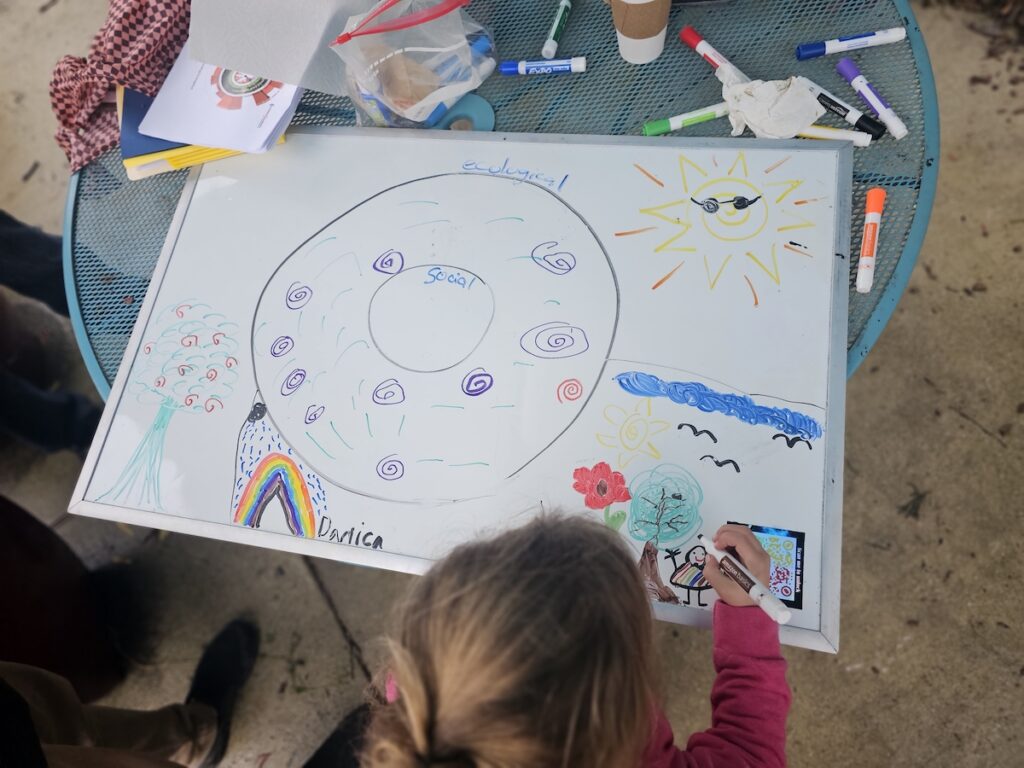
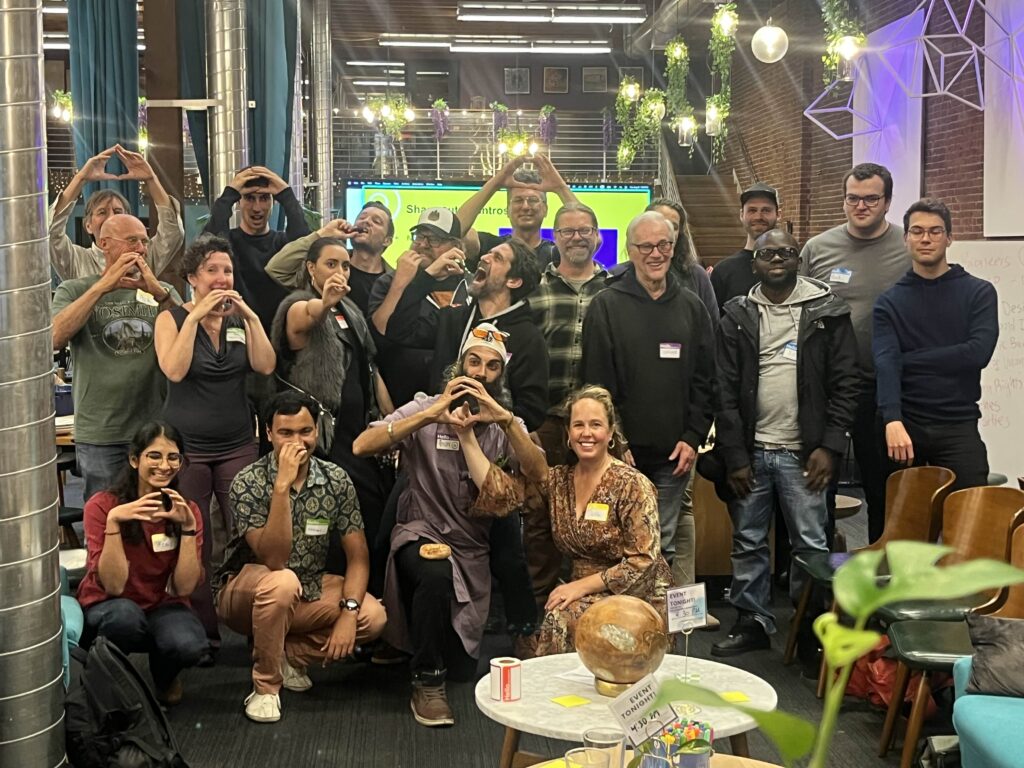
FR: The model centers these questions: What do we want to focus on? What can we change? Where should we have the conversations? The pathway depends on what local groups are involved in. For example, in San Jose, interest in the Doughnut came from a concerned parent who is a part of several environmental activist groups. The San Francisco group, on the other hand, meets in a coworking space and includes people from tech, start-up incubators, and local nonprofits—all coming together to think about how they can improve both the social and the ecological factors in their city.
In San Diego, there’s a bit more presence of pharma, biotech, and the military, which is interesting, so we’ll see where that leads. We’ve had conversations with Regenerative California, based in Monterey. They’re focused on food and agriculture, ocean fisheries, and attainable housing. This is the beauty of Doughnut Economics: it’s flexible and can be, by design, adapted to a lot of bioregional contexts.
Moving into 2026, what are three main focus areas for your CalDEC team?
FR: We did publish a first California snapshot at the end of last year. This year we’re back to volunteer involvement. We’ve just developed an in-depth report that, for each of the dimensions, really shows how we got those numbers, why we selected those indicators, what it means for policy, what it means for justice and equality, and some further resources. We will be sharing these findings in presentations and workshops with different audiences.
“This is the beauty of Doughnut Economics: it’s flexible and can be, by design, adapted to a lot of bioregional contexts.”
We’re also supporting local applications because there’s been a lot of good response to what we’ve been doing and people have been excited about. As mentioned, we have a San Jose Doughnut that we are supporting in the South Bay, and also one in San Francisco. We had an EcoFest in San Jose and a couple other events, too. Basically, we’re helping people come together. We’re intentionally a coalition. “Don’t be the movement; join the movement.” We’re going where the energy is and we’re amplifying that.
The third prong iseducation, outreach, and communication, especially at universities and other places of higher education. We’ve had around twenty events so far this year, and have a few more lined up. We’ve been at UC Berkeley, both at the business school and the School of Public Policy, and virtually at Middlebury, Vermont, and several others. Doughnut Economics and CalDEC were also part of a PBS series called Climate California.
What’s the main takeaway you’d want people to know about Doughnut Economics?
FR: Doughnut Economics tries to say: Let’s not just rearrange the deck chairs on the Titanic and do a few smaller changes while improving a little bit here and there. Instead, let’s think about the actual goal of the economy. Changing the goal of the system is so important. Doughnut Economics offers a hopeful vision for changing the goals of the system in order to shift to something that’s a lot more in support of the well-being of the human and nonhuman world, locally and globally, socially and ecologically.
NO: My dream was always to have a go-to resource that’s like, if you are into this or that, here are all the different options on how you can best plug in. With Doughnut Economics, you can get involved with climate stuff, social justice stuff, racial justice stuff. You really see how it’s all connected. It’s important to push people to reflect on where they can plug in to the revolution, and that looks differently for different people. I feel like folks often don’t ask that question intentionally, and that’s exactly what the Doughnut can offer.
Go Deeper:
- Read CalDEC’s November 2025 snapshot and full report.
- Order a copy of Doughnut Economics.
- Explore Doughnut Economics Action Groups near you.
- Learn more about the Doughnut 3.0 (October 2025).
- Connect with the California Doughnut Economics Coalition.