

Wave after wave rattled the fishing boat as it fought its way across Chatham Strait, a deep, narrow passage in southeast Alaska’s Alexander Archipelago.
“It looked like the whole ocean was moving,” recalls Lance McMullan, who was aboard that day.
On that voyage, he was a marine biology student at Alaska Pacific University. But after experiencing the unbridled force of the ocean current, McMullan charted a new direction. He transferred to the University of Hawaii, switched his major to mechanical engineering and set about learning how to tap tidal power.
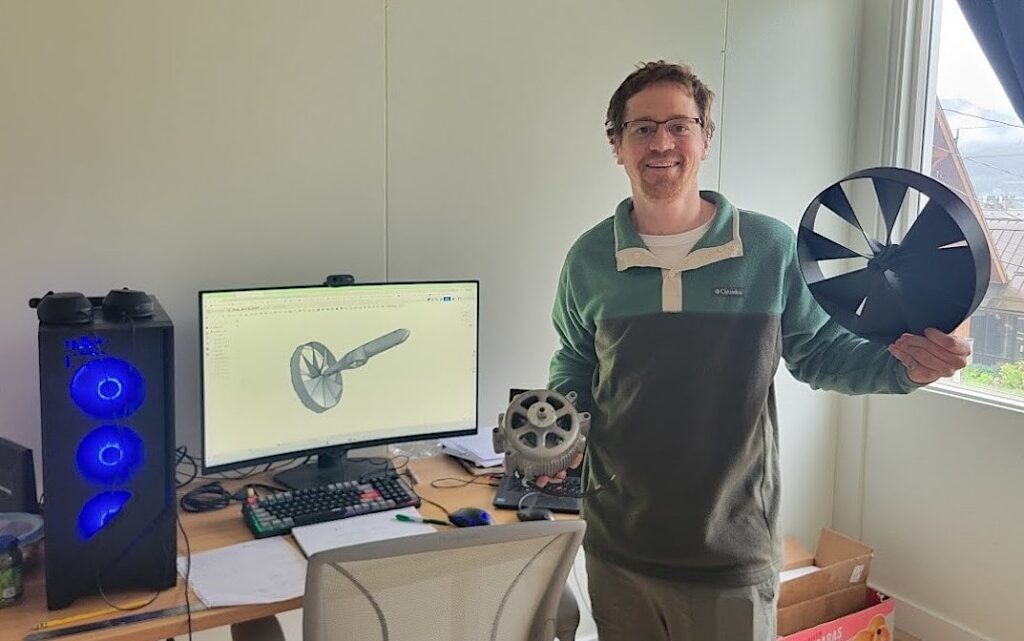
After graduation and a stint with an energy company, McMullan founded Sitkana, a Juneau-based startup developing turbines that convert tidal energy into electricity.
In coastal Alaska, where challenging topography and long, dark winters make large-scale wind and solar mostly impractical, tides offer the promise of dependable energy.
Tides follow the cycle of the moon and sun, making it easier for operators of such projects to predict when (and how much) power will be produced.
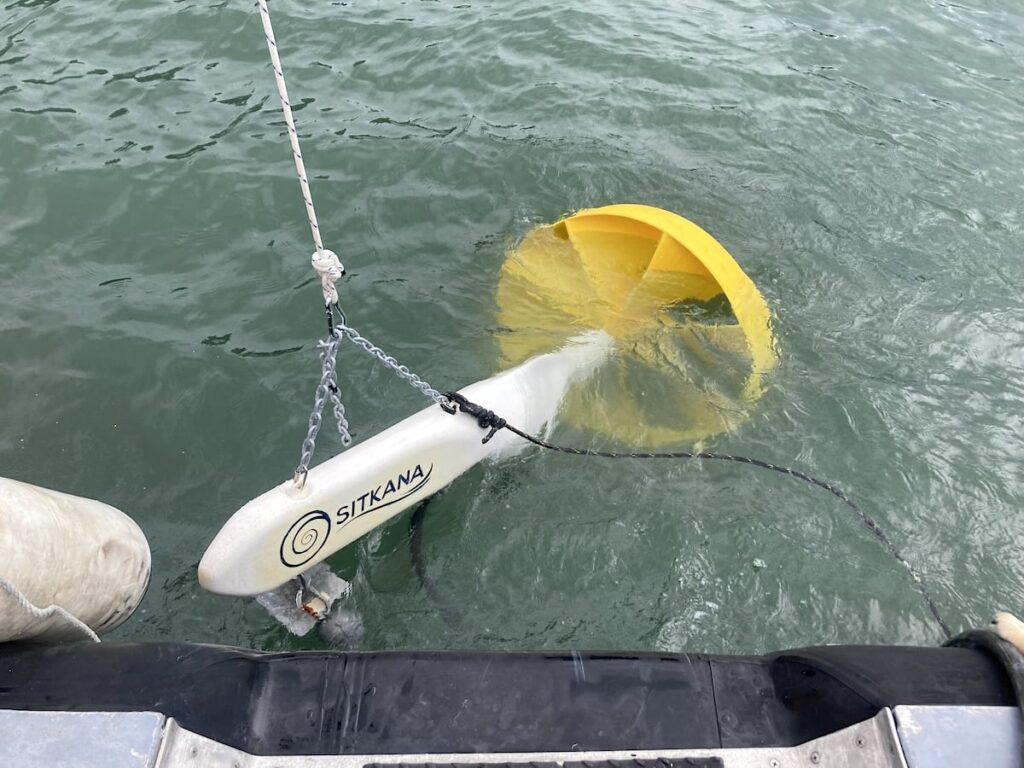
Sitkana has made multiple tidal turbines, and its newest model, the Chinook 4.0, has already drawn interest from potential buyers, including Shikat Bay Oysters on Alaska’s Prince of Wales Island.
The meter-wide turbine is also being trialed off the coast of Massachusetts to gauge its impact on wildlife.
“Often, when people think of tidal energy, they picture turbines rotating rapidly in the ocean,” said John Miller, executive director of the Marine Renewable Energy Collaborative, or MRECo, which operates a tidal generator testing facility at Cape Cod. “But in fact, their top speed is usually about thirty to forty miles per hour, similar to a swimming white shark.”
Small turbines moving at these speeds should be safe for fish and marine mammals. However, McMullan hopes the MRECo test will provide data that confirms this, allowing him to scale his idea even further.
Harnessing the Tides
Unlike wind and solar power, tidal energy is an emerging technology facing barriers to full-scale deployment. For starters, the technology costs are currently high and the policies that will guide these projects are still in the works. Although the renewable can reduce carbon dioxide and other harmful emissions, its impact on the marine environment and neighboring communities is still not fully understood.
Coastal Alaska, however, has massive potential to be a leader in tidal energy. The region, where communities are often reliant on diesel-powered microgrids, has a combination of mountainous landscapes and islands that discourage other renewables but are conducive to tidal power.
Energy can be generated through those kinds of natural features that constrict water flow, said Rob Cavagnaro, a marine energy expert at the Pacific Northwest National Laboratory. “Think bay entrances or narrow passages between islands, where water is squeezed through a gap,” he said.
Research suggests that marine energy in the state could produce 1,000 terawatts per year, which is enough to power 100 million homes, according to a National Renewable Energy Laboratory study.
Those funnels compress the tide into something capable of turning a turbine, providing a much more attractive alternative to burning diesel, which is harmful to both humans and the environment.
Sitkana’s technology acts like an underwater wind turbine that harnesses the fast-flowing water in coastal Alaska, using spinning blades to convert tidal energy into electricity. Each turbine — known as a power-generating ocean device, or POD — is relatively small, but they have the potential to produce a megawatt or more of power once they are strung together in large arrays. The POD consists of a long body with a turning rotor at the back that keeps the unit facing into the current, mimicking a chinook salmon, which is built to swim against currents with minimal resistance.
While an individual POD works like a salmon, arrays suspended from a floating platform and anchored to the sea floor resemble a forest of bull kelp that sits just below the water surface where the current is the strongest.
The name Sitkana even had a role in the device’s construction. It comes from the Latin name of the Sitka periwinkle, Littorina sitkana, derived from a Tlingit word. Sitka periwinkles are tiny marine snails found from Alaska to Puget Sound. The design of Sitkana’s rotor blades is based on the spiraling interior of a snail shell.
“A snail shell uses very little material but withstands the force of ocean waves because of its geometry,” McMullan said. “It’s extremely structurally sound.”
Other Tidal Entrepreneurs
McMullan’s hope is to place arrays of small turbines, about a meter wide, in tidal currents near a coastal community. Each array would hang from a boat or dock, suspended in the water like the fishing lines used on the boat where McMullan once worked.
Attached cables anchored to the sea floor would feed electrons into an onshore microgrid.
To make this vision a reality, Sitkana first needs to build a successful demonstration project, likely to power an oyster farm or a business rather than a whole community.
McMullan isn’t the only entrepreneur testing out the technology. Other tidal entrepreneurs in the Pacific Northwest are bringing similar projects to life.
One, at the Blind Channel Resort on B.C.’s West Thurlow Island, is currently under construction. That project is aiming to show how a single turbine can produce up to twenty-five kilowatts of power and connect to an onshore microgrid.
“The resort is a private enterprise which also serves as a community hub,” said Brad Buckham, a mechanical engineering professor at the University of Victoria, which provides support and technical expertise for the Blind Channel project. “It’s essentially a living lab, a proxy for remote communities that could benefit from this technology.”
Another project, led by the Mowachaht-Muchalaht First Nation on Nootka Island, could soon provide the energy infrastructure that the First Nation needs to return members to their ancestral homeland.
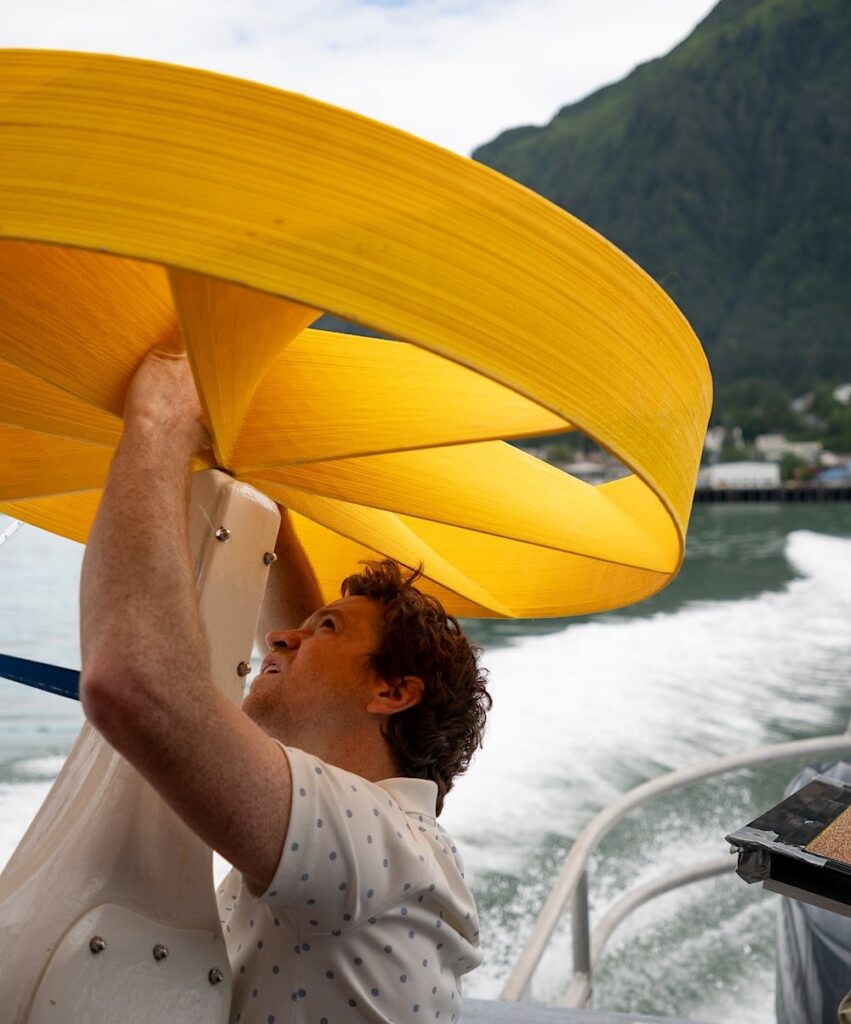
Sitkana has yet to break ground on its own demonstration project, but McMullan is looking to line one up soon. A successful demonstration would pave the way for widespread adoption of Sitkana’s technology. McMullan believes the simplicity of his prototypes sets them apart from many other tidal generators.
For example, the U.K.-based Orbital Marine Power has a design — still in the development phase — featuring massive spinning blades attached via adjustable arms to a floating vessel bigger than a school bus. The company may pull it off, but the many moving pieces are something McMullan wants to avoid.
“A snail shell uses very little material but withstands the force of ocean waves because of its geometry. It’s extremely structurally sound.”
Lance McMullan
“The more parts you have in a system, the more failure points you have,” McMullan said.
Sitkana’s PODs are made from plastic and can be produced using a 3D printer. They are lightweight, have a few parts and are simple to replace. In the inevitable event that a turbine is damaged by pounding waves, it could be easily removed and swapped without affecting other units.
Eventually, McMullan would like to see a factory in Juneau that processes and recycles damaged POD components.
“The goal is to get energy from the water at a scale that matters,” McMullan said. “But to do that, we need to make it tangible. Then we can scale things up.”
First, though, he needs to attract more investment and buyers.
Overcoming Challenges
Like many startups, Sitkana struggled for funding in the beginning. McMullan’s first round of fundraising brought in $45,000, mainly from friends, family, and a couple of large investors. The money was matched by a grant from the 49th State Angel Fund, a program supporting Alaska entrepreneurs.
Since then, McMullan has won local and federal grants that keep him working on Sitkana full time. He now has a team of five interns, but the kind of funding that would help hire a larger staff remains elusive.
“It takes a lot for investors to have faith in a project,” McMullan said. “They want to see us generate sales.”
Originally, McMullan pictured Sitkana operating as a utility, supplying energy directly to communities. But he quickly realized it wasn’t smart to come in as a competitor, considering most small Alaskan towns already have their own utility provider.
Now, McMullan plans to sell turbine arrays to existing utilities that could use them to replace diesel generators. He hopes a pilot project will draw interest from prospective customers and, eventually, investors. He is getting tantalizingly close, having run a July test in waters off Juneau that shows his latest prototype will work in the type of lower-velocity tidal currents located near many coastal communities. Testing proved the Chinook 4.0’s turbines will spin in velocities as low as 0.6 meters per second, typical for currents in the area.
If Sitkana succeeds in deploying its unique turbines on a large scale, they could play a key part in the Pacific Northwest’s energy transition. As a society, McMullan believes, humans should be harnessing this predictable, giant source of energy.
Today, when McMullan watches the tide move back and forth through ocean channels from his home in southeast Alaska, he sees a vast source of clean energy that could soon power homes and businesses all along the coast.
“We have here, essentially, the most powerful river in the world, driven not by rainfall but by the tide,” McMullan said. “Harness that, and it would be huge.”
This article runs in a section of The Tyee called ‘What Works: The Business of a Healthy Bioregion,’ where you’ll find profiles of people creating the low-carbon, regenerative economy we need from Alaska to central California. Find out more about this project and its funders, Magic Canoe and the Salmon Nation Trust.