
This feature is part of a six-month series from Magic Canoe’s Contributing Writers. Four writers were selected to each cover Salmon, New Economies, Environment, or Indigenous Leadership. This is the fourth story for the Salmon Desk. Major support for the Contributing Writers Series is made possible by a gift from Priscilla Bernard Wieden, in loving memory of Dan Wieden.
Our salmon are on the ropes—and have been for decades. In August 1989, winter-run Chinook salmon hailing from California’s Sacramento River earned a spot as the first Pacific salmon population listed under the Endangered Species Act. By 2007, regulators across Salmon Nation—in California, Oregon, Washington, and Idaho—added another twenty-seven salmonid populations as threatened or endangered under the law. The listings signaled the dire condition of the country’s most iconic fish, which have nourished people, cultures, and ecosystems for thousands for years.
In the nearly two decades since, the Endangered Species Act has prevented these populations from careening toward extinction, and many of them have improved. But no salmonid has achieved the “recovered” status that would warrant removal from the list—as have the bald eagle and Oregon chub. But that could soon change.
In Washington’s Hood Canal, summer chum are surging toward a historic recovery. What went right? And could other salmon populations follow their path and swim back to healthy, wild populations?
Falling Numbers
An excavator sits on an elevated strip of earth on the edge of the bay. The operator scoops buckets of dirt from in front of the machine and drops it into a waiting dump truck. Slowly, scoop by scoop, he whittles away the last fifty feet of a railroad grade that used to stretch along the near shore of Discovery Bay on Washington’s Olympic Peninsula, not far from the Salish Sea.
In the early 1900s, workers filled tidal flats along the bay to construct the rail line and mills. Lost in the process were salt marshes, spits, and backwaters that provided habitat for salmon, forage fish, shellfish, waterfowl, and other wildlife. But with the mills gone and the railroad long defunct, work has been underway for more than a decade to erase the industrial scars and the ecological harms they caused across the bay. That has included removing the railroad grade and the creosote railroad trestles and bulkheads that leaked toxic chemicals and disrupted natural tidal flows.
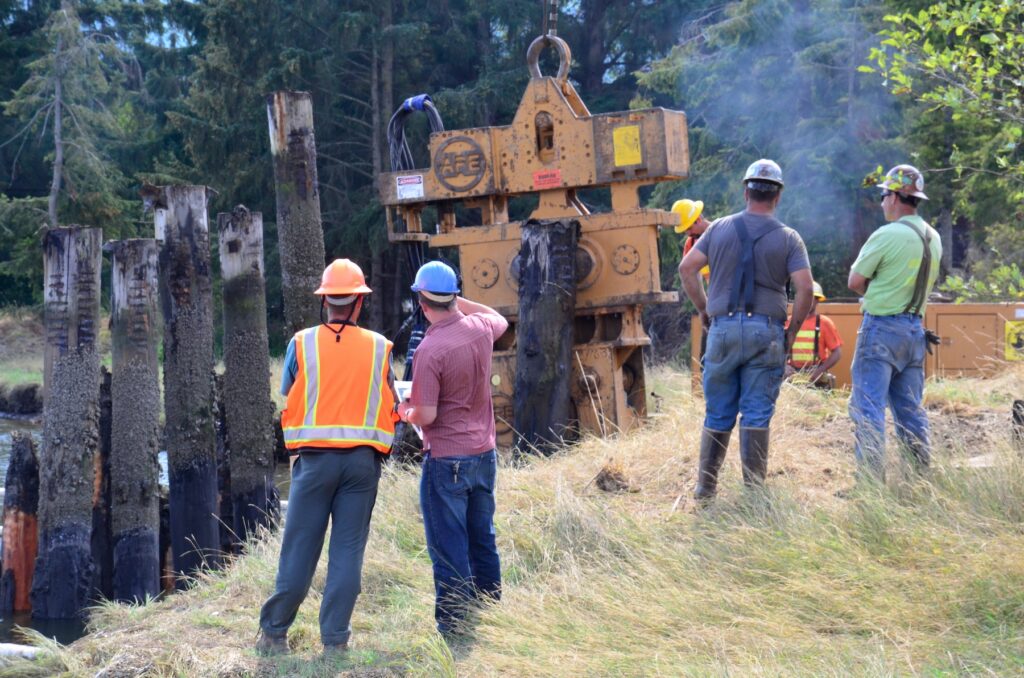
The work is needed in Discovery Bay—and all across the region where marshes, pocket estuaries, and other shoreline habitat have been uprooted, filled, and developed for farms, industry, businesses, and roads. Highway 101 cuts across the head of the bay here and rides its western flank. The highway, and others like it in the Olympic Peninsula and across the region, lure vacationers to scenic shoreline drives, but at the expense of native wildlife, including chum salmon.
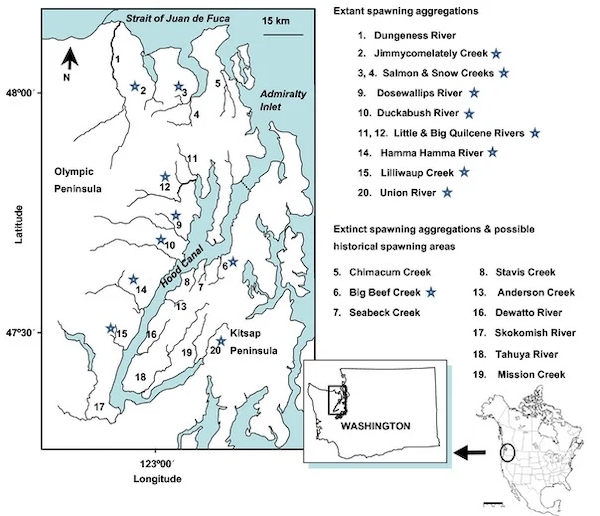
Hood Canal summer chum were listed as threatened under the Endangered Species Act in March 1999. Fish included in the population are chum that return to spawn from late August to late October in tributaries of Hood Canal, a sixty-eight-mile-long fjord in the Puget Sound region that runs between the Olympic and Kitsap Peninsulas, and also those from rivers and streams on the Strait of Juan de Fuca as far west as the Dungeness River near Sequim.
In the early 1990s, fewer than a thousand summer chum spawners were observed in these tributaries—a far cry from historic numbers and down tens of thousands from a few decades prior. Once found in more than twenty streams across Hood Canal and the eastern part of the strait, they’d disappeared from half of them, and numbers in the other half plunged. Experts attributed the perilously low decline to a combination of fishery exploitation, ocean conditions, and habitat loss—like that in Discovery Bay and elsewhere.
Staging a Recovery
Fast-forward about thirty years. Now, summer chum face a brighter future thanks to a carefully implemented recovery plan. This year, as spawners return to tributaries, experts expect their numbers could reach thirty-five thousand.
Since being listed as threatened, a threefold approach to recovery has helped chum rebound. The first action was to curtail fishing for summer chum, which has also meant some restrictions on when and where Chinook and coho can be fished because the timing of their runs overlaps as they all pass through Hood Canal.
For fishers, particularly those from tribes for whom salmon is not only an integral part of their livelihoods but also their culture, the restrictions have been a sacrifice.
“For tribes, recovery has been on their backs—they had to cut back on fishing, and they did,” says Alicia Olivas, the salmon recovery director of the Hood Canal Coordinating Council, a multigovernmental organization that’s the lead entity on implementing the summer chum recovery plan. The organization includes representatives from the Port Gamble S’Klallam and Skokomish Tribes, and Jefferson, Kitsap, and Mason Counties, as well as other regional, state, and federal agencies.
For the second approach, biologists set up hatcheries to boost populations in select locations, including Big Quilcene River, Union River, and Salmon Creek. In a handful of others where summer chum were long gone, biologists revived the population with brood stock from neighboring rivers. Instead of pumping out fish indefinitely, the hatcheries were managed for conservation purposes, and sunsetted when wild runs began to regain a footing—about twelve years.
“Supplementation and reintroduction programs helped reduce the immediate risk of extinction for some of the most vulnerable populations,” says Sarah Doyle, executive director of the North Olympic Salmon Coalition, a regional fisheries enhancement group. “Then communities, local governments, landowners, state and federal agencies, and nonprofit organizations worked collaboratively to protect and restore habitat.”
Chum aren’t intrepid athletes like coho, Chinook, or sockeye that are known to travel dozens, or even hundreds, of miles upriver for spawning. They prefer lower parts of rivers and streams. And they also don’t stick around long when they’re young. After eggs hatch, the young fish leave their freshwater digs but they don’t immediately enter the ocean. Instead, they pause for a month or two in estuaries to acclimate to salt water, find food, and try to stay clear of predators—of which there are many for a tiny salmon.
“It’s very important to have some of those pocket estuaries, those embayments where they can find the prey they need before heading up into the ocean,” says Olivas. The habitat they most need is also the habitat that has been most developed in the region.
That’s what makes projects like the restoration on Discovery Bay so important. Young salmon hug the edges of the bay, finding small channels and backwaters to take refuge. “These areas are really important for juvenile summer chum to come in and feed,” says Doyle. “These shoreline projects are critical because [salmon] need that shallow migratory habitat when they’re really small and easy pickings for predators.”
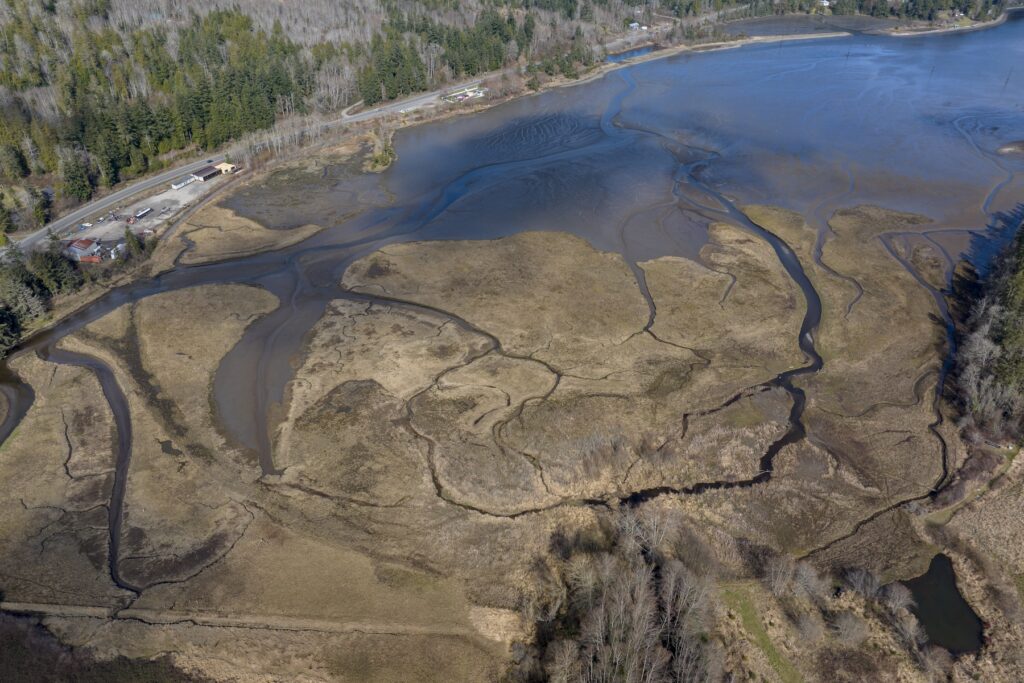
Summer chum that find food and cover in Discovery Bay likely first began their lives in Salmon or Snow Creeks, which both descend from the Olympic Mountains and join the head of Discovery Bay just a half mile apart and in the Salmon-Snow Creek Estuary.
In the early 1990s, only about 120 summer spawners were seen in the creeks. Then the Washington Department of Fish and Wildlife supplemented the population for a short time with hatchery rearing. “There’s no point in boosting them if we don’t have habitat restoration happening side by side with it,” says Doyle.
So restoration efforts began in Salmon Creek to improve spawning habitat but soon included the extensive projects still underway across the estuary to remove the railroad grade and associated infrastructure.
“There’s no point in boosting them if we don’t have habitat restoration happening side by side with it.”
Sarah Doyle, executive director of North Olympic Salmon Coalition
The work has paid off. Salmon and Snow Creeks now support a wild run of about two thousand to three thousand summer chum, making them a key part of recovery efforts across Hood Canal and the Strait of Juan de Fuca.
“It’s a success story of how the collaborative efforts between the Jefferson Land Trust [which owns the property where current work is being done], the Washington Department of Fish and Wildlife, North Olympic Salmon Coalition, and many other partners can actually recover a population of salmon and sustain it,” she says.
And that success has been replicated in other parts of summer chum habitat in the region. About sixty miles south of Discovery Bay at the southern end of Hood Canal, the Skokomish River descends from Olympic National Park to meet the fjord at a thousand-acre estuary. It was once a nursery for young salmon.
But levees and ditches constructed for agriculture in the early 1900s blocked access for numerous fish, including Puget Sound Chinook salmon and steelhead, both of which are also listed as threatened under the Endangered Species Act.
Since the 1990s, the Skokomish Tribe has led a massive restoration effort to bring back the natural marshland by removing roads and dikes in the Skokomish Estuary. Their work was primarily focused on Chinook recovery. “Now we are seeing a resurgence of summer chum there without any added hatchery work or supplementation of any kind,” says Olivas.
In other areas, partners have tackled infrastructure improvements. Just off the northeastern edge of the Olympic Peninsula, a causeway cut between Indian and Marrowstone Islands. The road helped drivers pass between the islands, but its levee-like structure buried tidal channels and salt marshes, disrupting the flow of water and sediment, and the migration of young salmon between Oak Bay and Kilisut Harbor.
North Olympic Salmon Coalition and partners undertook an effort to replace the causeway, which also contained two culverts, with a 440-foot bridge. The new structure now allows tidal waters—and fish—to freely move beneath it. It helped restore nearly thirty acres of salt marsh and marine habitat, while also providing the community with more resilient infrastructure that can better endure earthquakes and storm surges.
Similarly, some thirty miles west on the lower part of Big Quilcene River, the Jamestown S’Klallam Tribe, along with the Hood Canal Salmon Enhancement Group, and Jefferson County, are replacing an eighty-one-foot-long bridge with one stretching 1,140 feet.
The new structure allows the river, which had been straightened and diked, to once again spread out and meander across its natural floodplain. The wider channel, with a longer bridge, reduces local flooding and also improves conditions for salmon. The tribe is also creating thousands of feet of new side channels and more than a hundred logjams to improve salmon spawning and rearing habitat.
These are among dozens of restoration projects across Hood Canal that are driving summer chum recovery. “This work was guided by a shared recovery strategy,” says Doyle. “We weren’t just doing random projects and hoping they added up to recovery. There was a clear understanding of where the problems were, what needed to happen, and which actions would make the biggest difference. Over the last several decades, recovery partners have been steadily ticking away at this prioritized project list.”
Part of the success may also have something to do with summer chum’s life history. Their most vital habitat is often the most developed, but it has also helped managers better target restoration.
“I think summer chum may have had an advantage in that many of their critical habitats are relatively concentrated and identifiable,” she says. “Because they spawn in the lower reaches of rivers and depend heavily on estuaries, we were able to focus restoration and protection efforts in some very important places.”
Doyle also has one other idea on why summer chum are getting back on track: the diligence and commitment of those doing the work, which has included a long list of tribes, local governments, state agencies, and nonprofits.
“I think the longevity of the partnerships has mattered enormously,” she says. “This recovery effort has been going on for decades. Partners have remained at the table and have been committed to recovery goals. I don’t feel that there is much substitute for that kind of sustained commitment.”
A Delisting Ahead?
So, does all this success mean that Hood Canal’s summer chum can be moved from “threatened” to “recovered”?
The Hood Canal Coordinating Council’s website states, “The summer chum salmon story is remarkable and unique among Pacific salmon species. All indications suggest that summer chum are recovered, and can be de-listed.” But that doesn’t mean delisting is imminent quite yet.
Project partners would need to prepare a petition, which would then be sent to NOAA Fisheries to make the final decision. But Olivas says they have not yet begun the petition process. A few more metrics need to be met, and a plan for post-recovery and monitoring established.
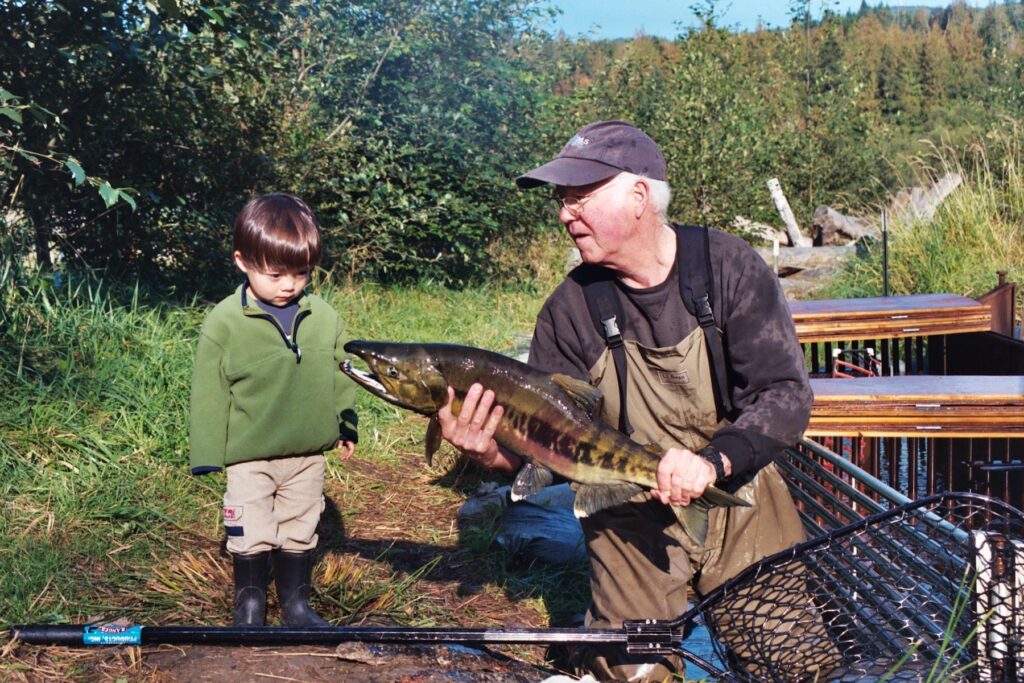
When it comes to overall numbers of summer chum across Hood Canal, things look good. But numbers are only one of the factors that need to be considered to ensure the population’s long-term resilience. Biologists are also checking to make sure that chum are sufficiently robust across their range. They need strong numbers in not just a few tributaries, but most. Those numbers will be helped by a new effort in its early days to reintroduce summer chum to the Dungeness River, where the previous subpopulation had been lost. And there’s more.
“Before delisting, I would like to see us finish the work that is already underway to better understand remaining threats, strengthen geographic distribution, and address climate resilience and long-term genetic and spatial diversity,” says Doyle. “I also think it is critical that we have a strong post-delisting monitoring and sustainability plan in place. Recovery is not a finish line. If we are successful enough to remove summer chum from the Endangered Species List, then we have an obligation to make sure we do not end up back where we started.”
“The summer chum story is one that I tell a lot of people who ask whether salmon recovery is working.”
Sarah Doyle
While Hood Canal summer chum aren’t yet about to be delisted, they are very close. “And that in itself is something worth celebrating,” says Doyle. “I think the summer chum story shows that recovery is possible when we are willing to make investments and address multiple salmonid limiting factors (in-stream habitat, floodplain, estuary, shoreline) at once.”
When summer chum are delisted, it will likely be a historic first among salmonids, and the lessons managers learned here could inspire those working to restore other imperiled salmon runs.
“The summer chum story is one that I tell a lot of people who ask whether salmon recovery is working,” Doyle says. “We have moved these fish from dramatic decline and low abundance to the possibility of full recovery. To me, that is such a powerful reminder that we should not give up on the other populations that are still struggling, even when we sometimes feel that the challenges ahead are insurmountable.”
Take Action:
- Want to see summer chum on the move? Hood Canal Salmon Enhancement Group needs volunteers until October 15 to monitor returning adult chum on Washington’s Union River.
- If you can’t see Hood Canal’s summer chum in person, take a deep dive into their recovery plan to learn what’s needed to bring back healthy, wild populations.
- For more from Magic Canoe Salmon Desk writer Tara Lohan, order her book, Undammed.