

Lumberjacks, the Wright brothers and luthiers all prize the Sitka spruce.
The coastal giant is the skyscraper of the rainforest. One monster on Vancouver Island stretches 96 meters from the Carmanah Valley floor to its swaying top, making it the tallest tree in Canada. Sitka wood is commonly prized for its strength-to-weight ratio and resonance — so much so that its trunks were once used as airplane wings.
Today, the tree remains a favourite for making pianos and guitars.
But few people look at its sharp needles and think, “Yum!”
That’s a shame, says Benjamin Patarin, co-founder of the Port Alberni-based harvesting company Forest for Dinner. Because the Sitka spruce, like many other Vancouver Island plants, is an edible delicacy.
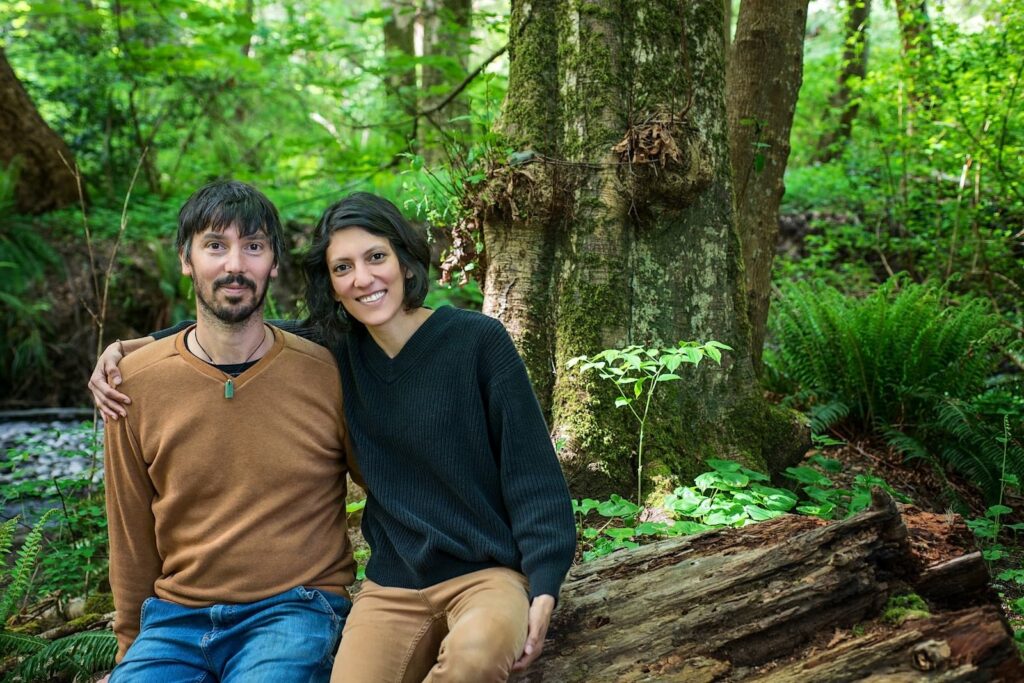
Patarin runs Forest for Dinner with his wife and business partner, Célia Auclair.
Together, they harvest more than 40 wild plants and fungi, processing them into a variety of products: infused salts, jams and jellies, herbal teas, and mushroom powders. They supply about 65 restaurants and retailers across Vancouver Island and the Lower Mainland, and partner with local businesses to create unique spirits, perfumes, and more.
The couple are also mindful of not damaging the surrounding ecosystem while they forage. Careful and sustainable harvesting is important not only for ensuring there are berries, mushrooms, and other edibles to harvest next year, but also for the health of the surrounding ecosystem, upon which fungi and plants rely to thrive, says Patarin. Before harvesting a new species, he develops specific protocols for collecting, as well as the storage and processing steps.
Their work is changing the way people look at forests, bringing locally foraged food to restaurants and homes.
“Our goal is to bring awareness that the forest is able to produce something else besides timber,” Patarin says.
Finding Foraging
Before shifting the Vancouver Island palate, the couple, unknowingly, followed similar paths to foraging.
Both Patarin and Auclair were born and raised in France, where they grew up foraging for mushrooms and berries with their parents, a common practice in Europe. Then, they both went to university in Quebec: Patarin for a master’s in non-timber forest products, and Auclair for marketing and sales. Their parallel paths finally converged 16 years ago in Australia, where they met picking fruit.
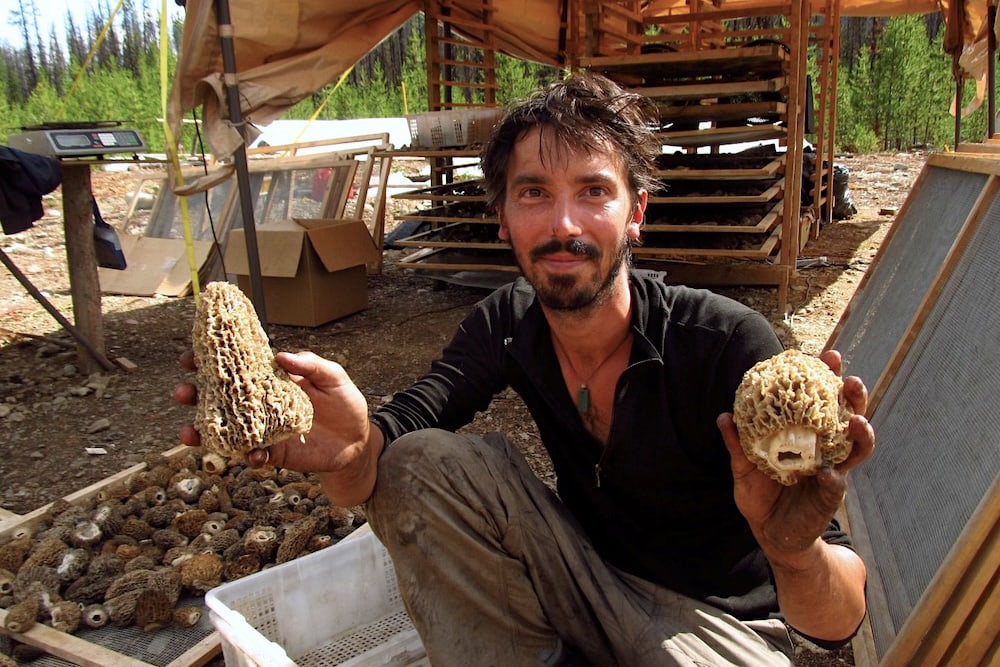
They both had fond memories of their time in Canada, so in 2012 they followed the picking season back to Quebec, where they heard about B.C.’s wildly popular morel mushrooms. The mushroom grows in the ash of a forest fire, and experienced pickers can make more than $500 a day harvesting the mushrooms and selling them to exporters.
That was a lifestyle the couple could get behind.
“We really liked that there was no boss,” says Patarin. “It’s piecemeal work, so you get what you put into it. And there were no pesticides, which was a nice change from the fruit farms.”
Fellow morel pickers told them they should try chanterelles on Vancouver Island, the promised land for foraging in Canada. Following that advice, the couple headed to Ucluelet for the fall picking season. After a couple more fall picking seasons they saw an opportunity to start a full-time foraging business.
They are not alone.
In recent years, the foraging industry has grown significantly across the western United States and Canada. In Quebec, for instance, foraging has changed from a quirky Wild West to an organized industry with dozens of companies processing forest products and employing hundreds of people. (Natural Resources Canada estimates the Quebec non-timber forest product industry is worth more than $300 million a year, though maple syrup makes up a big chunk of that.)
“It was our dream to develop the same kind of industry here on Vancouver Island,” Patarin says.
Room to Grow
In 2015, the couple moved to Ucluelet permanently and started Forest for Dinner, mostly selling what they could harvest and process at farmers markets. Using their combined skills — Patarin’s master’s in the foraging industry and Auclair’s marketing and sales expertise — they grew the business and steadily expanded their product offerings.
Their work has received high praise from local restaurant owners.
“Pickers often have a whimsy to them,” says Warren Barr, the owner of Pluvio, a high-end restaurant in Ucluelet.
Most pickers are a one-person show, he says. They appear at the restaurant door only when they have something to sell. They don’t answer their phone or take orders. They can’t be depended on like other suppliers. But Patarin and Auclair are different.
“I can’t plan a menu around an ingredient unless the supply is predictable,” Barr says. “That’s what’s nice about working with Ben and Célia. They’ve turned foraging into a polished, legitimate business.”
Barr likes to work foraged ingredients into his menu. The wild plants add unique flavours and textures. For diners from Vancouver Island, seeing plants they recognize but have never tasted, such as Sitka spruce or salmonberries, piques their curiosity and keeps them coming back.
When Patarin and Auclair started a family, they moved to Port Alberni and were still running the business out of their home. With no room for more processing, storage or refrigeration, opportunities to grow further plateaued.
That changed in 2020 when the Port Alberni Port Authority converted an old fish processing plant into a commercial kitchen and five adjoining business spaces. With provincial funding and money from Island Coastal Economic Trust, the authority opened Dock+, as it’s known, in 2021. Forest for Dinner moved in on Day 1.
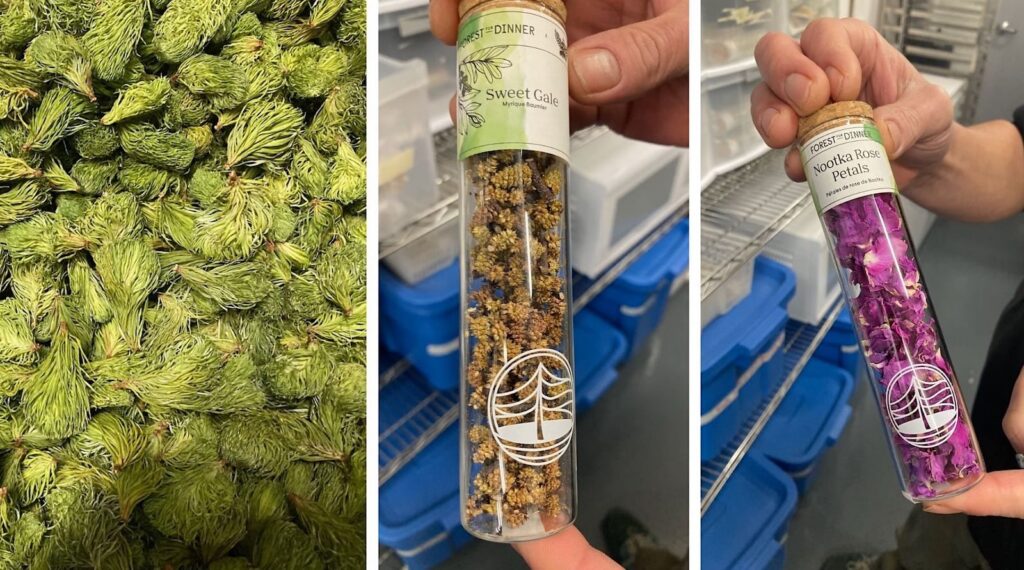
Their dedicated space has a walk-in fridge full of boxes of berries, waiting to be processed. Industrial-sized dehydrators and freeze-dryers hum away, sucking the moisture out of spruce tips, chunks of chaga mushrooms, and trays full of navy blue juniper berries.
A side door leads into the community kitchen, which Patarin leases by the hour when he’s making jams and pickled preserves. And there are more raw ingredients in the food hub’s shared freezer.
The heart of Forest for Dinner is a workstation and storage area. Patarin pulls boxes off the shelves. Each one is filled with dried samples of different edibles, and as he opens each one, it’s like hiking through the seasons: sticky, sweet spring gives way to a perfumy, floral summer, then an earthy and rich autumn.
Meanwhile, an employee, one of five, is weighing dried juniper berries and siphoning them into sleeves that will be sold at 60 retail stores and online.
Can’t Keep Up
Today, the company harvests more than 40 different wild plants and mushrooms, including about 15 berries, mostly on Vancouver Island. (The chaga mushroom and juniper berry are the only products that come from the Lower Mainland.)
Patarin does a lot of harvesting himself, but he also works with five or six professional pickers, depending on the season, one of whom works for them nearly year-round. Auclair manages all the marketing and sales.
“We can’t keep up with demand,” Patarin says. “And we’ve almost outgrown the factory space.”
But it hasn’t been easy. While there is no licensing or tenure required to harvest wild plants, turning the venture into a sustainable business is complex and full of uncertainty.
In a lot of ways it’s not that different from farming, except that they first must figure out where the fields are. And not just where to find chanterelle mushrooms or Nootka rose, but where it grows in quantities that make harvesting financially viable. Then they have to know when it will be in season — and some crops have only a two-week harvest window.
To know where to be and when, Patarin has become a mapping and spreadsheet expert. He uses government forest maps to identify promising areas and spends a day every week scouting. He adds his notes to a database of picking information and combines it with demand forecasts to develop a harvest plan for the whole year.
Patarin figures he works more than 60 hours every week, 52 weeks a year.
Most of the harvesting happens between April and October. The fall is busy with processing and attending Christmas markets. A small amount of harvesting continues through the winter, but it’s mostly a time for more processing and planning.
At the same time, he consults and collaborates with First Nations working to develop their own non-timber forest businesses and with other food and beverage businesses.
Finding new ingredients and flavours is one of his favourite parts of the job. Business owners and chefs often come to him with an idea for a product or flavour, and he comes back with some wild possibilities.
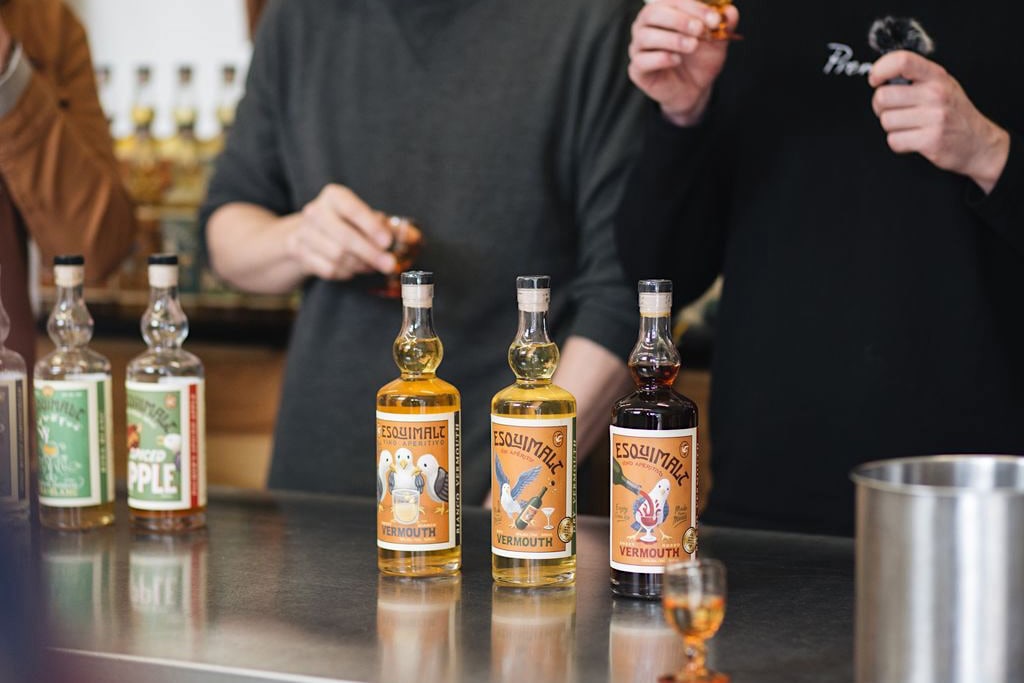
For instance, Nanaimo-based Esquimalt Vermouth & Apéritifs came to Patarin to help develop a native botanical spirit. The result, Apéritif Cascadia, includes Douglas fir tips, pine needles, fireweed flowers, licorice root, and trailing blackberry leaves, all harvested on Vancouver Island.
“Having a source for foraged ingredients allows us to be really creative with the products we want to make and gives us a unique opportunity to showcase native species and the abundance found here.”
Michela Palmer, one of Esquimalt Vermouth & Apéritifs’ owners
Pluvio’s Warren Barr says he never leaves a visit with Patarin without a new ingredient to try. Together they developed a herbal tea made entirely from native plants. Barr is now working on adding Forest for Dinner’s salmonberry jam to his menu.
‘People are Fascinated to Learn’
Patarin loves the hunt. He spends a lot of time reading scientific papers and researching historical uses of plants. His interest goes beyond curiosity to changing the way people look at the forest. He’d like to see the foraging industry grow in B.C. to the point the provincial government considers the forest’s potential to produce food when it makes logging plans.
“My goal is to bring awareness that we can do something more with the forest than just timber,” he says. “After you cut down a tree you have to wait 50 years to harvest again, while I can go into that same forest and sustainably harvest every year. A lot of the time the log is going to generate more money, but it depends what I harvest and how I add value to it.”
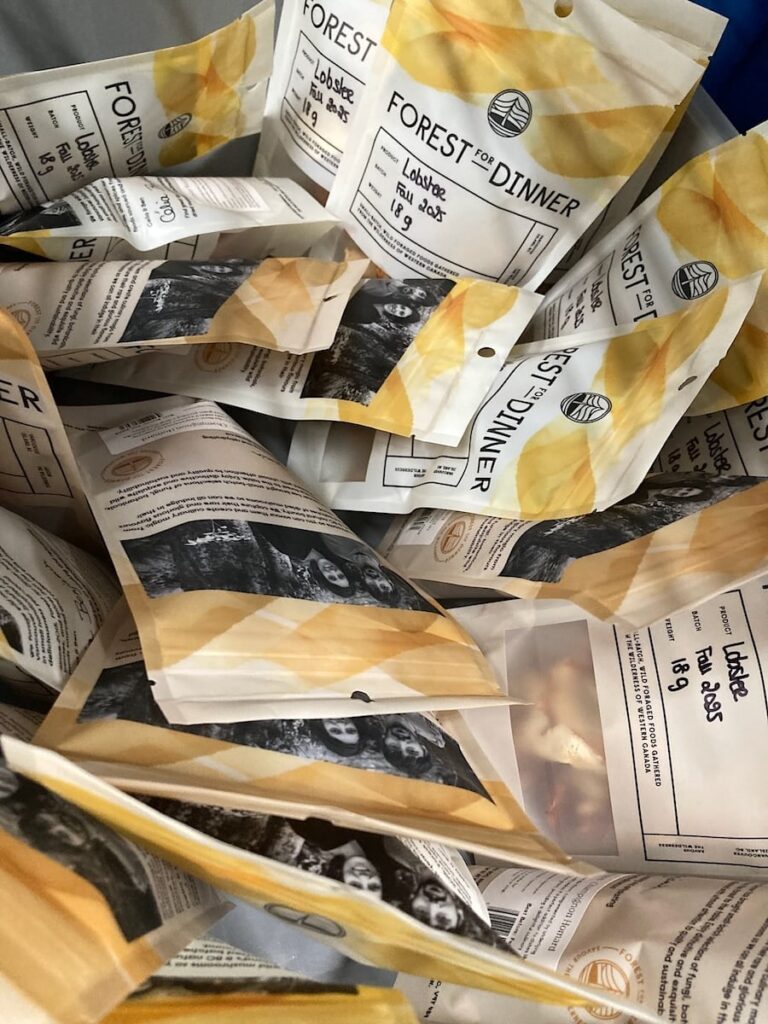
Patarin knows shifting government practice will take time. Meanwhile, he’s working to educate the public beyond seeing wild edibles on menus, in ingredient lists and on store shelves.
Picking wild plants feels dangerous to many people, which means they miss out on many delicious and nutritious ingredients just off the trail. To bridge that gap, Patarin has partnered with an RV park near Horne Lake to offer foraging tours on their 70-acre property. They host the educational walks three times per year to focus on the different opportunities in spring, summer, and fall. They’re always super popular.
“People are fascinated to learn there are so many things they can eat in the forest,” he says.
Including spruce tips. Forest for Dinner picks the young shoots of Sitka spruce in the spring and then jams, dries, and pickles them. The jelly is citrusy and refreshing, perfect for pairing with cheese and meat. Dried, the tips sub in well for rosemary or as a lemon-flavoured rub on fish and chicken. And pickled spruce tips are like capers with a tangy, woodsy flavour.
The latter is one of the bestselling products at the Mustard Lady, a Courtenay store that stocks all kinds of charcuterie ingredients.
“People see it on our shelves and say, ‘Wow, what is this? What does it taste like?’” says Stephanie Abbat-Slater, the shop’s co-owner. “They’re so intrigued. It’s a really interesting way to learn about wild foods. It gets them wondering about what else is out there.”
Exactly, says Patarin. In the forest of Vancouver Island, there is no end to what you can eat.
This article runs in a section of The Tyee called ‘What Works: The Business of a Healthy Bioregion,’ where you’ll find profiles of people creating the low-carbon, regenerative economy we need from Alaska to central California. Find out more about this project and its funders, Magic Canoe and the Salmon Nation Trust. ![[Tyee]](https://thetyee.ca/design-article.thetyee.ca/ui/img/yellowblob.png)