
When the Vietnam War officially ended in 1975, with it came 60,000 U.S. casualties, a million Vietnamese dead, and 11.7 million displaced. But here’s another statistic often lost amid the human toll: As many as 12 million acres of Southeast Asian forest were decimated during the conflict—equivalent to the size of Maryland—as the U.S. military dumped 20 million gallons of herbicides on the region to snuff out enemy forces. Five decades later, such ecocide still echoes through the people, lands, and waters. War against people, war against nature, war against self.
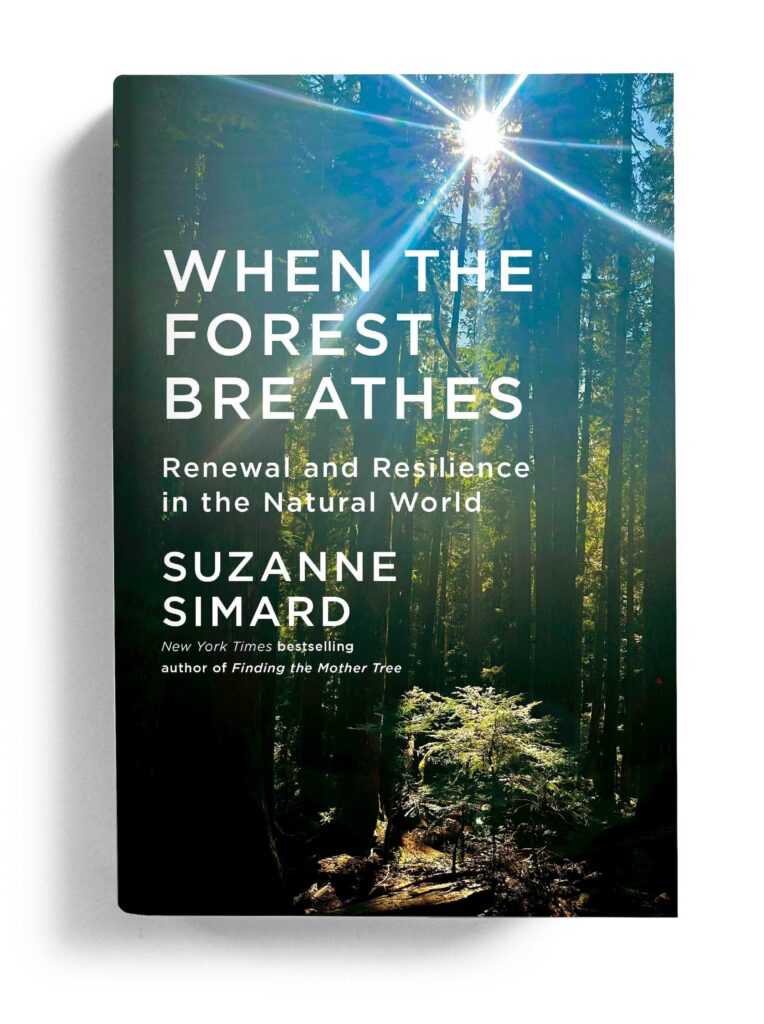
In Suzanne Simard’s newest book, When the Forest Breathes: Renewal and Resilience in the Natural World, the Canadian forest ecologist and bestselling author references a 1972 novella written by Ursula K. Le Guin, The Word for World Is Forest, a polemic in response to the violence of the Vietnam War. Le Guin’s story is set on a forested planet where a local nonviolent people live and are governed lightly by elder women, but have become enslaved by a colonizing force. After deliberations fail, one of the Indigenous leaders, Selver, uses his power to conduct a violent uprising and scare off the colonizers intent on taking their living forests. In doing so, he inoculates bloodlust in his own people.
Simard references Le Guin’s early masterwork near the end of When the Forest Breathes, where she’s joining Makwala, or Rande Cook, hereditary chief of the Ma’amtagila Nation (Kwakwaka’wakw), on a trip from Alert Bay to Haida Gwaii. Simard had been asked to help document industrial clear-cutting in the territory and to cocreate a plan to protect what old-growth remains there.
“Knife-edge aretes spawned mist that flowed steeply down basaltic faces,” Simard writes. “Waterfalls flowed and water dripped steadily from rock ledges. Ancient Sitka spruces swung from crevices in rock cliffs. On the knolls and ridges, candelabras of ancient cedars spiked to forty meters. On south faces, Douglas fir roots dug deeply into rock crevices. Where the earth was too steep, the soil had let go, leaving clean stone glistening on recent rockfalls and young hemlocks dangling in midair.”
As the two move through this living forest, Makwala looks to the trees and says to Simard, “When they breathe out, we breathe in.” In other parts of these ancestral lands, industrial clear-cuts were encroaching and every single plant unviable for human profit was removed. “This was like a real-life version of Ursula K. Le Guin’s sci-fi classic, The Word for World Is Forest,” writes Simard, “in which men from a polluted Earth colonize another planet, clearcut its forests, and oppress its Native inhabitants.”
The connection is quiet, but it echoes with shared concerns of colonial extraction, hubris in efficiency over connection, marketplace viability over sustaining relations, mono-thought over diversity and complexity. Here, what’s undeniable is Simard’s tuned awareness to a forest’s interlinking parts, and to a whole.
To Be in a Place, and of a Place
When the Forest Breathes braids the personal with the scientific—no small task—taking readers on a journey through nine experimental forests across varied zones of elevation and precipitation in British Columbia. Simard and her colleagues have organized these plots to track various methods of stewarding harvests and responses to a rapidly changing climate.
She witnesses both industrial clear-cutting and handpicked selections of logging, with increased care for larger and older “mother trees,” which Simard centered in her 2021 book, Finding the Mother Tree. These trees, she asserts, are imbued with years of memory and distributive power shared with their belowground kin through fungal networks.
Simard focuses on protecting the natural cycles of forests and their intergenerational memory. Cyclical decay and rebirth build a kind of arboreal resilience to increasing environmental stressors. And this, she says, requires us to breathe the forests as they breathe us, by getting our hands in the soil and our boots on the ground.
“If we’re going to address the great environmental ills we’re dealing with—climate change, biodiversity loss—it really comes down to what’s happening on the ground,” she told me. “Each place matters. We’ve swept away that local knowledge, handed it over to some big corporate idea, and then we lose touch with the land.”
There’s no way to respectfully manage lands, forests, and waters if we don’t first have a relationship with them. “Knowledge of the land is ancestral. It’s in our ancestors, but it’s also in us,” said Simard. “Those who are on the land and listening to what ancestors did, and then experimenting ourselves. The past is not the same as it is now, and it’s not going to be the same in the future.”
“If we’re going to address the great environmental ills we’re dealing with—climate change, biodiversity loss—it really comes down to what’s happening on the ground.”
Ecosystems of Loss and Renewal
In this ground-truthing, Simard centers relations, both human and more than human, at every turn in the book. You meet several of her graduate students and colleagues—Jean, Eva, and Amanda, who is tragically killed in a ski accident in 2022. It’s clear what Simard’s doing here: spotlighting the primacy of tending to relationships, writ large. Most notable is the simultaneous growth of one of Simard’s daughters, Hannah, who develops her own love for forest science, parallel to the hold dementia was taking on Simard’s mother.
The connections here—between a mother’s flagging memory and the hyperefficient machinery logging old-growth forests—link memory-keeping in a human body with our tree kin being surgically uprooted from their underground mycelial intelligentsia.
This ecological lobotomy, the gutting realities of state-of-the-art industrial clear-cuts, is a clear visual of her mother’s pervasive dementia, and it works. “I was trying to entwine our lives,” she said, “to weave these things together as a reminder that we, too, germinated and grew into seedlings and saplings and will become old and, eventually, die. I wanted people to know that they’re part of this. We belong in all of this. We belong in the same cycles.”
Facing the Critics
In 2021, Finding the Mother Tree became an international bestseller and stirred nearly 9 million views with her TED Talk, but not without critical responses from the greater scientific community (for example, “Mother Trees and Socialist Forests: Is the ‘Wood-Wide Web’ a Fantasy?”). Some of Simard’s closest colleagues turned on her, arguing that her studies on how elder trees harbor maternal capacity to distribute nutrients more readily to nearby kin trees were overblown, analogized too cutely, anthropomorphized in ways that didn’t honor peer-reviewed science. Simard has since been ridiculed in journals and online forums, threatened, even stalked.
“I’ve had to learn how to deal with some vicious stuff,” said Simard.
But much like her tromping through clear-cuts and facing the heat of megafire and beetle kill, she turns directly toward it. At sixty-five, Simard has always been an avid writer and reader, always dreaming of getting forest science into the hearts of larger audiences, not just academic journals. “I wanted to bring it straight to the public . . . so that people could make better decisions rather than having it be interpreted through a politician or bureaucrat.”
“Science is a beautiful thing, but it has its limitations. When you’re steeped in it, you’re so heavily trained in it and all your self-worth gets tied up in the scientific method. Then somebody comes along and says, ‘Well there’s also spirit involved in this,’ and you’re so loyal to p-values and error bars that you go, ‘What the hell are you talking about?’ Science often removes ourselves from the world to study the world. A lot of the questions I ask are very intuitive.”
Honorable Harvest
Growing up in the inland temperate rainforest of British Columbia’s Monashee Mountains, Simard’s early family life exposed her to wild spaces where she felt the immediate effects of climate change. This proved transformational. “Where I lived, I was basically in the trees,” she said. “That’s what I was. That’s where my family came from. They are my ancestors. It’s in our blood.”
Simard first learned about climate change in her early thirties. “I thought I was fighting clear-cutting and herbicide spraying, but no, the realization was that this is global.” Starting in the mid-1990s and peaking in 2005, the mountain pine beetle had killed half of British Columbia’s commercially viable pine, 47 million acres of forest. “The grief I felt seeing my beautiful home die, I couldn’t shoulder it.” But the scientific community, according to her, couldn’t deal with the immensity of this loss. “If we had, we would change course. They had not dealt with grief; they were hiding behind data, behind their positions, behind academia.”
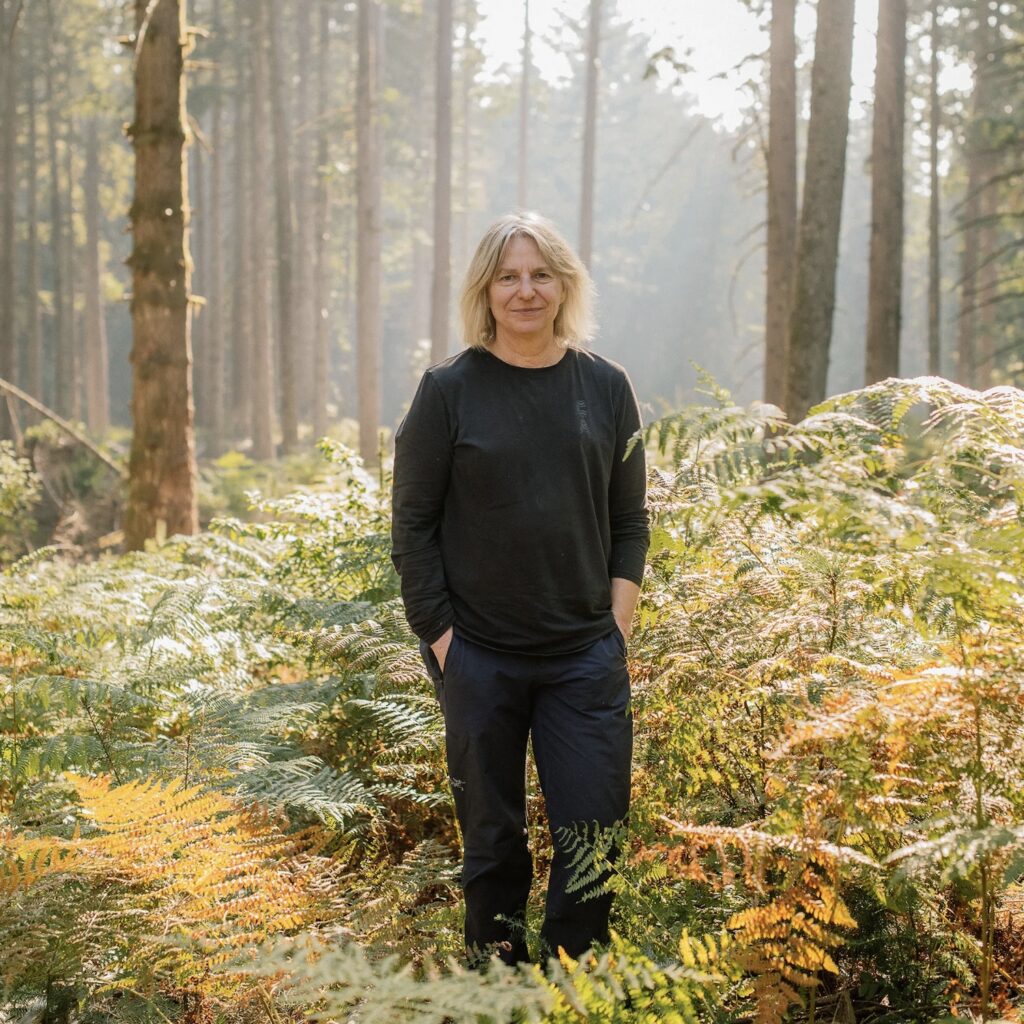
Despite the critics, Simard’s work remains guided by values. This, to her, is the crux. “We make enormous mistakes—industrial agriculture, industrial forestry, industrial fisheries—because we forgot that there’s all these other important values we have to remember: respect, giving back, being responsible, being kin and kinship.”
She turns again and again toward Indigenous leadership and traditional ways of knowing, of honorable harvest, ways of seeing forests as extensions of self. “I can see [forestry] as a cultural, social, ecological, economic force—a big complex system. Science isn’t built that way. It’s built to take things apart, to take ourselves apart and remove ourselves from the whole and just study it as a part.”
“My relationships and my community brought me through this [book]. It’s the same thing with Magic Canoe, right? We sometimes bite and claw at each other, and we’re all a bit different, but as long as our values are aligned with our moral compass, we can do it.”
Looking Ahead
Yes, the future of our planet’s forests looks stark. Worldwide, we’re losing as many as 25 million acres of forested tree cover annually. That’s forty soccer fields of trees, hacked each minute. These rates of extraction are due to several factors, but it’s largely a function of technological innovations that are becoming ever more efficient and distanced from humans, megamachines able to pull trees right out of the ground, roots and all, like a carrot.
“We’re letting the machines do this now,” said Simard. “How are they going to know about the land and the fairy slippers and the spotted toads? They’re not. It’s more than destructive, it’s inhuman.”
But Simard doesn’t want this book to be lost in doom and gloom, and the book doesn’t read that way. “I know there’s a lot of grief and loss, but I also wanted to demonstrate to people that we have it in us to solve the problem.” She references root gardens, salmon stone traps, and sister cedars. Igniting throughout the pages are stories of Indigenous knowledge and community power. These are all reminders of what we can do collectively.
“My relationships and my community brought me through this [book],” she said. “It’s the same thing with Magic Canoe, right? We sometimes bite and claw at each other, and we’re all a bit different, but as long as our values are aligned with our moral compass, we can do it.”
Here, Le Guin’s The Word for World Is Forest comes back to mind. More than fifty years later, we still hear Le Guin’s original inhabitants of the forested Athshea as they sang collectively to communicate, to defy violence, and, most important, to ensure everyone remained connected to the breathing, dreaming Earth. In fact, even the word dream for Le Guin’s forest stewards was also the word for “root.” To dream with the living world is to stay rooted in a relationship that protects each other in perpetuity.
“The forest is about who lives there, the cultures and their values and needs,” said Simard. “We’ve given that away for somebody else to look after. We’ve got to bring it back home, which means we have to transform our governance of land. For that, we have teachings out there, models in Indigenous communities who know how to do that. We need to honor and respect and learn from that.”
By the end, Simard’s fidelity to the collective power of the human capacity to transform is clear. She dreams and breathes with these forests, connecting and organizing against industrial clear-cutting and committing to a viable future, similar to the community mobilization against recent ICE raids in Minneapolis. “We have an incredible creative intelligence,” she said. “We’re built that way. It’s in our genius. We’re regenerative. We’re complex systems meant to feel. We’re meant to succeed.”
Go Deeper:
- Purchase When the Forest Breathes
- Learn more about the Mother Tree Project & Program
- Watch Simard’s Ted Talk, “How Trees Talk to Eachother“